лось
Belarusian
Alternative forms
Etymology
Inherited from Old Ruthenian лось (losʹ).
Pronunciation
- IPA(key): [ɫosʲ]
Audio (file)
Noun
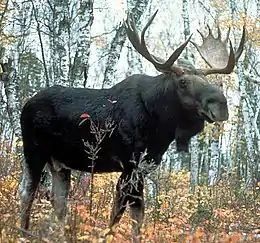
лось • (losʹ) m animal (genitive лася́, nominative plural ласі́, genitive plural ласёў)
Declension
| singular | plural | |
|---|---|---|
| nominative | лось losʹ |
ласі́ lasí |
| genitive | лася́ lasjá |
ласёў lasjóŭ |
| dative | ласю́ lasjú |
лася́м lasjám |
| accusative | лася́ lasjá |
ласёў lasjóŭ |
| instrumental | ласём lasjóm |
лася́мі lasjámi |
| locative | ласі́ lasí |
лася́х lasjáx |
| count form | — | ласі́1 lasí1 |
1Used with the numbers 2, 3, 4 and higher numbers after 20 ending in 2, 3, and 4.
References
- “лось” in Belarusian–Russian dictionaries and Belarusian dictionaries at slounik.org
- “лось”, in Skarnik's Belarusian dictionary (in Belarusian), based on Kandrat Krapiva's Explanatory Dictionary of the Belarusian Language (1977-1984)
Old Ruthenian
Alternative forms
- лѡсь (lôsʹ), лосъ (los)
Etymology
Inherited from Old East Slavic лось (losĭ), from Proto-Slavic *ȏlsь, from Proto-Balto-Slavic *alśis, from Proto-Indo-European *h₁ólḱis, from *h₁el-.[1] Cognate with Russian лось (losʹ), Old Polish łoś.
Noun
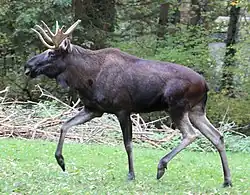
лось • (losʹ) m animal
- elk (Alces alces)
- …и ѡт тых ѕвѣрѡв єдины на по́карⸯмъ ꙗко є́ленѣ, са́ръны, лѡ́сѣ, зꙋбре́ве ― …i ot tyx zvěrôv jediny na pókarm jako jéleně, sárny, lốsě, zubréve ― (please add an English translation of this usage example)
- ричитⸯ лосъ егда иматⸯ траву ― ričit los ehda imat travu ― (please add an English translation of this usage example)
- видѣломъ мѣсцо, гдѣ лося забито ― vidělom měsco, hdě losja zabito ― (please add an English translation of this usage example)
- кгды в остꙋпахъ поⸯмают албо забют лосѧ, еленѧ, вепра, анижели ѡ сто воловъ радовали ― gdy v ostupax pojmajut albo zabjut losja, elenja, vepra, aniželi o sto volov radovali ― (please add an English translation of this usage example)
Descendants
References
- Trubachyov, O., Zhuravlyov, A. F., editors (2005), “*olsь/*olsъ”, in Этимологический словарь славянских языков [Etymological dictionary of Slavic languages] (in Russian), numbers 32 (*obžьnъ – *orzbotati), Moscow: Nauka, →ISBN, page 79
Further reading
- Chikalo, M. I., editor (2013), “лось”, in Словник української мови XVI – I пол. XVII ст. [Dictionary of the Ukrainian Language: 16ᵗʰ – 1ˢᵗ half of 17ᵗʰ c.] (in Ukrainian), numbers 16 (легкомыслность – лѧчи), Lviv: KIUS, →ISBN, page 102
- The template Template:R:zle-obe:HSBM does not use the parameter(s):
url=los-3
Please see Module:checkparams for help with this warning.Bulyka, A. M., editor (1998), “лось, лосъ II”, in Гістарычны слоўнік беларускай мовы [Historical Dictionary of the Belarusian Language] (in Belarusian), numbers 17 (лесничий – местский), Minsk: Belaruskaia navuka, →ISBN, page 120
Russian
Etymology
Inherited from Old East Slavic лось (losĭ), from Proto-Slavic *olsь, from Proto-Indo-European *h₁el- (“deer”), whence English elk.
Pronunciation
- IPA(key): [ɫosʲ]
Audio (file)
Noun
лось • (losʹ) m anim (genitive ло́ся, nominative plural ло́си, genitive plural лосе́й or ло́сей, feminine лоси́ха, relational adjective лоси́ный)
Declension
| singular | plural | |
|---|---|---|
| nominative | ло́сь lósʹ |
ло́си lósi |
| genitive | ло́ся lósja |
лосе́й, ло́сей loséj, lósej |
| dative | ло́сю lósju |
лося́м, ло́сям losjám, lósjam |
| accusative | ло́ся lósja |
лосе́й, ло́сей loséj, lósej |
| instrumental | ло́сем lósem |
лося́ми, ло́сями losjámi, lósjami |
| prepositional | ло́се lóse |
лося́х, ло́сях losjáx, lósjax |
| singular | plural | |
|---|---|---|
| nominative | ло́сь lósʹ |
ло́си lósi |
| genitive | ло́ся lósja |
лосе́й, ло́сей loséj, lósej |
| dative | ло́сю lósju |
лося́мъ, ло́сямъ losjám, lósjam |
| accusative | ло́ся lósja |
лосе́й, ло́сей loséj, lósej |
| instrumental | ло́семъ lósem |
лося́ми, ло́сями losjámi, lósjami |
| prepositional | ло́сѣ lósě |
лося́хъ, ло́сяхъ losjáx, lósjax |
Related terms
- лосёнок m (losjónok)
- лося́тина f (losjátina)
See also
- оле́нь m (olénʹ)
Ukrainian
Etymology
Inherited from Old Ruthenian лось (losʹ).
Pronunciation
- IPA(key): [ɫɔsʲ]
Audio (file)
Noun
лось • (losʹ) m animal (genitive ло́ся, nominative plural ло́сі, genitive plural ло́сів)
Declension
| singular | plural | |
|---|---|---|
| nominative | лось losʹ |
ло́сі lósi |
| genitive | ло́ся lósja |
ло́сів lósiv |
| dative | ло́севі, ло́сю lósevi, lósju |
ло́сям lósjam |
| accusative | ло́ся lósja |
ло́сі, ло́сів lósi, lósiv |
| instrumental | ло́сем lósem |
ло́сями lósjamy |
| locative | ло́севі, ло́сю, ло́сі lósevi, lósju, lósi |
ло́сях lósjax |
| vocative | ло́сю lósju |
ло́сі lósi |
References
- Bilodid, I. K., editor (1970–1980), “лось”, in Словник української мови: в 11 т. [Dictionary of the Ukrainian Language: in 11 vols] (in Ukrainian), Kyiv: Naukova Dumka