باشاق
Ottoman Turkish
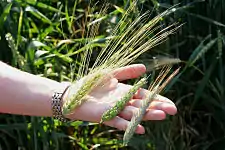
باشاقلر
Etymology
Inherited from Proto-Turkic *baĺak; equivalent to باش (baş, “head”) + ـاق (-ak, noun and adjective diminutive suffix). Cognate with Azerbaijani başaq, Bashkir башаҡ (başaq), Kazakh масақ (masaq), Southern Altai мажак (mažak) and Uzbek bоshоq.
Noun
باشاق • (başak)
Derived terms
- باشاق باغلامق (başak bağlamak, “to come into ear”)
- باشاق طوتمق (başak tutmak, “to come into ear”)
- باشاقجی (başakcı, “gleaner”)
- باشاقسز (başaksız, “earless, spikeless”)
- باشاقلانمق (başaklanmak, “to come into ear, to ear”)
- باشاقلو (başaklı, “eared; with gleanings left”)
- قره باشاق (kara başak, “rye”)
Descendants
- Turkish: başak
Further reading
- Çağbayır, Yaşar (2007) “başak1”, in Ötüken Türkçe Sözlük (in Turkish), volume 1, Istanbul: Ötüken Neşriyat, page 493
- Hindoglu, Artin (1838) “باشاق”, in Hazine-i lûgat ou dictionnaire abrégé turc-français, Vienna: F. Beck, page 102b
- Kélékian, Diran (1911) “باشاق”, in Dictionnaire turc-français, Constantinople: Mihran, page 239
- Meninski, Franciszek à Mesgnien (1687) “Spica”, in Complementum thesauri linguarum orientalium, seu onomasticum latino-turcico-arabico-persicum, simul idem index verborum lexici turcico-arabico-persici, quod latinâ, germanicâ, aliarumque linguarum adjectâ nomenclatione nuper in lucem editum, Vienna, column 1583
- Meninski, Franciszek à Mesgnien (1680) “باشاق”, in Thesaurus linguarum orientalium, Turcicae, Arabicae, Persicae, praecipuas earum opes à Turcis peculiariter usurpatas continens, nimirum Lexicon Turkico-Arabico-Persicum, Vienna, columns 663–664
- Nişanyan, Sevan (2002–) “başak”, in Nişanyan Sözlük
- Redhouse, James W. (1890) “باشاق”, in A Turkish and English Lexicon, Constantinople: A. H. Boyajian, page 325
Uyghur
Etymology
Inherited from Chagatai باشاق (bašaq), from Karakhanid بَشَقْ (bašaq), from Proto-Turkic *baĺak, derived from *baĺč (“head”).[1] Cognates with Turkish başak.
Pronunciation
- IPA(key): /bɑʃɑq/
References
- Clauson, Gerard (1972) “1 başak”, in An Etymological Dictionary of pre-thirteenth-century Turkish, Oxford: Clarendon Press, page 378
Further reading
- Schwarz, Henry G. (1992) An Uyghur-English Dictionary (East Asian Research Aids & Translations; 3), Bellingham, Washington: Center for East Asian Studies, Western Washington University, →ISBN
This article is issued from Wiktionary. The text is licensed under Creative Commons - Attribution - Sharealike. Additional terms may apply for the media files.