سرنا
Arabic
Persian
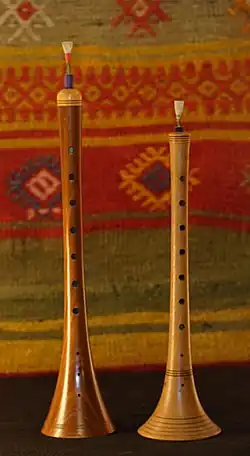
Etymology
Borrowed from an unknown Indo-European cognate of Luwian 𒍪𒌨𒉌 (zurni, “horn”), Sanskrit शृङ्ग (ṡṛṅga, “horn”), Latin cornū, English horn, probably ultimately from Proto-Indo-European *ḱerh₂- (though Kloekhorst disagrees). Folk etymology explains the word as سور (sur, “banquet, feast”) + نای (nây, “pipe, flute, nay”).
Pronunciation
- (Classical Persian) IPA(key): [suɾ.ˈnɑː]
- (Dari, formal) IPA(key): [sʊɾ.nɑ́ː]
- (Kabuli) IPA(key): [sʊɾ.nɑ́ː]
- (Hazaragi) IPA(key): [suɾ.nɔ́ː]
- (Iran, formal) IPA(key): [soɹ.nɒ́ː]
- (Tajik, formal) IPA(key): [suɾ.nɔ́]
| Readings | |
|---|---|
| Classical reading? | surnā |
| Dari reading? | surnā |
| Iranian reading? | sornâ |
| Tajik reading? | surno |
Descendants
- → Ottoman Turkish: زورنا (zurnâ), زرنا (zurna)
- Turkish: zurna
- → Bulgarian: зурна́ (zurná)
- → Classical Syriac: ܙܘܪܢܐ (zurnā)
- → English: zurna
- → Georgian: ზურნა (zurna)
- → Bats: ზურნ (zurn)
- → Greek: ζουρνάς (zournás)
- → Macedonian: зурла (zurla)
- → Middle Armenian: զուռնայ (zuṙnay), զոռնա (zoṙna)
- Armenian: զուռնա (zuṙna)
- → Russian: зурна́ (zurná)
- → Serbo-Croatian:
- → Kazakh: сырнай (syrnai)
- → Chinese:
References
- Greppin, John A. C. (1991) “The Survival of Ancient Anatolian and Mesopotamian Vocabulary Until the Present”, in Journal of Near Eastern Studies, volume 50, number 3, pages 203–207
This article is issued from Wiktionary. The text is licensed under Creative Commons - Attribution - Sharealike. Additional terms may apply for the media files.