صومون
Ottoman Turkish
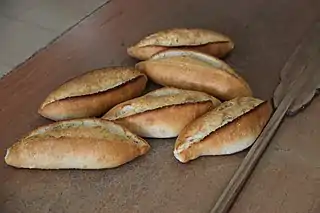
صومونلر

صومون
Alternative forms
- صمون (somun)
Etymology
From Byzantine Greek ψωμίν (psōmín) whence Greek ψωμί (psomí, “bread”), from Ancient Greek ψωμός (psōmós, “morsel”).
Pronunciation
- IPA(key): /soˈmun/
Noun
صومون • (somun)
Derived terms
- صومونجی (somuncu, occupational noun)
Descendants
References
- Meninski, Franciszek à Mesgnien (1680) “صومون”, in Thesaurus linguarum orientalium, Turcicae, Arabicae, Persicae, praecipuas earum opes à Turcis peculiariter usurpatas continens, nimirum Lexicon Turkico-Arabico-Persicum, Vienna, column 2988
- Zenker, Julius Theodor (1876) “صومون”, in Türkisch-arabisch-persisches Handwörterbuch, volume 2 (overall work in German and French), Leipzig: Wilhelm Engelmann, page 574a
This article is issued from Wiktionary. The text is licensed under Creative Commons - Attribution - Sharealike. Additional terms may apply for the media files.