پرگار
See also: پرکار
Ottoman Turkish
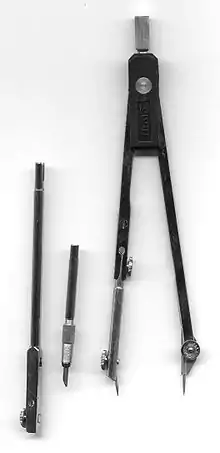
پرگار
Alternative forms
- پرگال (pergel)
Derived terms
- پرگارلاتمق (pergerletmek, “to make or let be measured by compasses”)
- پرگارلامق (pergerlemek, “to measure with a pair of compasses”)
- پرگارلانمق (pergerlenmek, “to be measured with a pair of compasses”)
- پرگاروار (pergervar, “like a pair of compasses”)
- پرگاری (pergeri, “drawn with compasses”)
Descendants
Further reading
- Çağbayır, Yaşar (2007) “pergel1”, in Ötüken Türkçe Sözlük (in Turkish), volume 1, Istanbul: Ötüken Neşriyat, page 3827
- Hindoglu, Artin (1838) “پرگار”, in Hazine-i lûgat ou dictionnaire abrégé turc-français, Vienna: F. Beck, page 114b
- Kélékian, Diran (1911) “پرگار”, in Dictionnaire turc-français, Constantinople: Mihran, page 319
- Meninski, Franciszek à Mesgnien (1687) “Circinus”, in Complementum thesauri linguarum orientalium, seu onomasticum latino-turcico-arabico-persicum, simul idem index verborum lexici turcico-arabico-persici, quod latinâ, germanicâ, aliarumque linguarum adjectâ nomenclatione nuper in lucem editum, Vienna, column 181
- Meninski, Franciszek à Mesgnien (1680) “پرگار”, in Thesaurus linguarum orientalium, Turcicae, Arabicae, Persicae, praecipuas earum opes à Turcis peculiariter usurpatas continens, nimirum Lexicon Turkico-Arabico-Persicum, Vienna, column 780
- Nişanyan, Sevan (2002–) “pergel”, in Nişanyan Sözlük
- Redhouse, James W. (1890) “پرگار”, in A Turkish and English Lexicon, Constantinople: A. H. Boyajian, page 443
Persian
Alternative forms
- پرگال (pargâl)
Etymology
From Proto-Iranian, from Proto-Indo-Iranian. Cognate with Sogdian [script needed] (prγrs’y /parγarsē/, “round, oval”), Sanskrit प्रकार (prakāra, “sort, kind, form, nature, way, mode, manner”). The first element is from Proto-Iranian *pari- (“around”), ultimately from Proto-Indo-European *per- (“before, front”).
Pronunciation
- (Classical Persian) IPA(key): [paɾ.ɡɑːɾ]
- (Dari, formal) IPA(key): [pʰäɾ.ɡɑːɾ]
- (Kabuli) IPA(key): [pʰäɾ.ɡɑːɾ]
- (Hazaragi) IPA(key): [pʰäɾ.ɡɔːɾ]
- (Iran, formal) IPA(key): [pʰæɹ.ɡɒːɹ]
- (Tajik, formal) IPA(key): [pʰäɾ.ɡɔɾ]
| Readings | |
|---|---|
| Classical reading? | pargār |
| Dari reading? | pargār |
| Iranian reading? | pargâr |
| Tajik reading? | pargor |
Derived terms
- هفتپرگار (haft-pargâr)
Descendants
References
- Dehkhoda, Ali-Akbar (1931–) “پرگار”, in Dehkhoda Dictionary Institute, editors, Dehkhoda Dictionary (in Persian), Tehran: University of Tehran Press
This article is issued from Wiktionary. The text is licensed under Creative Commons - Attribution - Sharealike. Additional terms may apply for the media files.