یمش
Ottoman Turkish
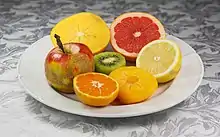
یمشلر
Alternative forms
- یمیش (yemiş)
Etymology
Inherited from Proto-Turkic *yẹ̄miĺč (“fruit, vegetable”); cognate with Azerbaijani yemiş, Bashkir емеш (yemeş), Chuvash ҫимӗҫ (śimĕś), Kazakh жеміс (jemıs), Kyrgyz жемиш (jemiş), Southern Altai јемиш (ǰemiš), Tatar җимеш (cimeş) and Turkmen iýmiş.
Noun
یمش • (yemiş) (definite accusative یمشی (yemişi), plural یمشلر (yemişler))
Derived terms
- تازه یمش (taze yemiş, “fresh-gathered fruit”)
- قوجه یمشی (koca yemişi, “arbutus berry”)
- قورو یمش (kuru yemiş, “dry fruit”)
- یمش آغاجی (yemiş ağacı, “fruit tree”)
- یمش ویرمك (yemiş virmek, “to bring fruit”)
- یمشجی (yemişci, “fruiterer, fruitmonger”)
- یمشلك (yemişlik, “the quality of fruit”)
- یمشلنمك (yemişlenmek, “to become furnished with fruits”)
- یمشلو (yemişli, “fruited; fruit-bearing”)
Descendants
Further reading
- Çağbayır, Yaşar (2007) “yemiş2”, in Ötüken Türkçe Sözlük (in Turkish), volume 1, Istanbul: Ötüken Neşriyat, page 5287
- Hindoglu, Artin (1838) “یمش”, in Hazine-i lûgat ou dictionnaire abrégé turc-français, Vienna: F. Beck, page 510b
- Kélékian, Diran (1911) “یمش”, in Dictionnaire turc-français, Constantinople: Mihran, page 1359
- Meninski, Franciszek à Mesgnien (1687) “Fructus”, in Complementum thesauri linguarum orientalium, seu onomasticum latino-turcico-arabico-persicum, simul idem index verborum lexici turcico-arabico-persici, quod latinâ, germanicâ, aliarumque linguarum adjectâ nomenclatione nuper in lucem editum, Vienna, column 619
- Meninski, Franciszek à Mesgnien (1680) “یمش”, in Thesaurus linguarum orientalium, Turcicae, Arabicae, Persicae, praecipuas earum opes à Turcis peculiariter usurpatas continens, nimirum Lexicon Turkico-Arabico-Persicum, Vienna, column 5607
- Nişanyan, Sevan (2002–) “yemiş”, in Nişanyan Sözlük
- Redhouse, James W. (1890) “یمش”, in A Turkish and English Lexicon, Constantinople: A. H. Boyajian, page 2209
This article is issued from Wiktionary. The text is licensed under Creative Commons - Attribution - Sharealike. Additional terms may apply for the media files.