ἀψίνθιον
See also: αψίνθιον
Ancient Greek
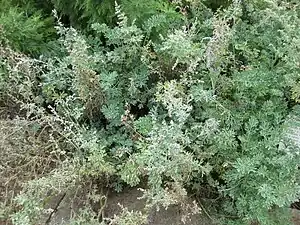
ἀψίνθιον
Alternative forms
- ἄψινθος (ápsinthos), ἀψινθία (apsinthía), ἀψινθή (apsinthḗ), ἀψίνθιν (apsínthin), ἀσπίνθιον (aspínthion)
Etymology
The cluster -ινθ- (-inth-) suggests a Pre-Greek source, as in τέρμινθος (términthos, “terebinth”), ἐρέβινθος (erébinthos, “chickpea”), μίνθη (mínthē, “mint”), ὑάκινθος (huákinthos, “hyacinth”), πλίνθος (plínthos, “brick”), μήρινθος (mḗrinthos, “cord, line”), κήρινθος (kḗrinthos, “bee bread”), λαβύρινθος (labúrinthos, “labyrinth”).[1][2] Also, the variant ἀσπίνθιον (aspínthion) with /sp/ instead of /ps/ may point to borrowing from Pre-Greek.[3][4]
Related to the source of Old Armenian աւշինդր (awšindr, “wormwood”).
Pronunciation
- (5th BCE Attic) IPA(key): /ap.sín.tʰi.on/
- (1st CE Egyptian) IPA(key): /apˈsin.tʰi.on/
- (4th CE Koine) IPA(key): /apˈsin.θi.on/
- (10th CE Byzantine) IPA(key): /apˈsin.θi.on/
- (15th CE Constantinopolitan) IPA(key): /apˈsin.θi.on/
Noun
ἀψίνθιον • (apsínthion) n (genitive ἀψινθίου); second declension
- wormwood (Artemisia absinthium)
- 430 BCE – 354 BCE, Xenophon, Anabasis 1.5.1:
- Ἐν τούτῳ δὲ τῷ τόπῳ ἦν μὲν ἡ γῆ πεδίον ἅπαν ὁμαλὲς ὥσπερ θάλαττα, ἀψινθίου δὲ πλῆρες·
- En toútōi dè tôi tópōi ên mèn hē gê pedíon hápan homalès hṓsper thálatta, apsinthíou dè plêres;
- In this region the ground was all a plain, flat like the sea, and full of wormwood.
- Ἐν τούτῳ δὲ τῷ τόπῳ ἦν μὲν ἡ γῆ πεδίον ἅπαν ὁμαλὲς ὥσπερ θάλαττα, ἀψινθίου δὲ πλῆρες·
- vermouth, wine spiced by wormwood
Inflection
| Case / # | Singular | Dual | Plural | ||||||||||
|---|---|---|---|---|---|---|---|---|---|---|---|---|---|
| Nominative | τὸ ἀψίνθιον tò apsínthion |
τὼ ἀψινθίω tṑ apsinthíō |
τᾰ̀ ἀψίνθιᾰ tà apsínthia | ||||||||||
| Genitive | τοῦ ἀψινθίου toû apsinthíou |
τοῖν ἀψινθίοιν toîn apsinthíoin |
τῶν ἀψινθίων tôn apsinthíōn | ||||||||||
| Dative | τῷ ἀψινθίῳ tôi apsinthíōi |
τοῖν ἀψινθίοιν toîn apsinthíoin |
τοῖς ἀψινθίοις toîs apsinthíois | ||||||||||
| Accusative | τὸ ἀψίνθιον tò apsínthion |
τὼ ἀψινθίω tṑ apsinthíō |
τᾰ̀ ἀψίνθιᾰ tà apsínthia | ||||||||||
| Vocative | ἀψίνθιον apsínthion |
ἀψινθίω apsinthíō |
ἀψίνθιᾰ apsínthia | ||||||||||
| Notes: |
| ||||||||||||
Descendants
- Greek: αψίνθιον (apsínthion) (Katharevousa), αψινθιά (apsinthiá), αψιθιά (apsithiá)
- → Arabic: أَفْسِنْتِين (ʔafsintīn), إِفْسَنْتِين (ʔifsantīn)
- → Persian: افسنتین
- → Gujarati: અફસંતીન (aphasantīn)
- → Hindi: अफ़संतीन (afsantīn)
- → Punjabi: ਅਫਸੰਤੀਨ (aphasantīn)
- → Persian: افسنتین
- → Aramaic:
- Galilean: אפסינתינון (ap̄sinṭīnōn)
- Babylonian: אפסנתין (ap̄sinṭīn)
- Syriac: ܐܦܣܢܬܝܢ (ap̄sinṭīn), ܐܦܣܢܬܝܘܢ (ap̄sinṭiōn)
- → Latin: absinthium (see there for further descendants)
- → Old Georgian: აფსინდი (apsindi), აფსინთი (apsinti)
References
- Beekes, Robert S. P. (2010) Etymological Dictionary of Greek (Leiden Indo-European Etymological Dictionary Series; 10), with the assistance of Lucien van Beek, Leiden, Boston: Brill, →ISBN, page xxxviii: “72. -ινθ-(ο-)”
- Beekes, Robert S. P. (2014) Stefan Norbruis, editor, Pre-Greek: Phonology, Morphology, Lexicon, Leiden: Brill, →ISBN, page 37: “81 -ινθ-(ο-)”
- Beekes, Robert S. P. (2010) Etymological Dictionary of Greek (Leiden Indo-European Etymological Dictionary Series; 10), with the assistance of Lucien van Beek, Leiden, Boston: Brill, →ISBN, page xxvi: “6a. ψ / σπ, b. ξ / σκ.”
- Beekes, Robert S. P. (2014) Stefan Norbruis, editor, Pre-Greek: Phonology, Morphology, Lexicon, Leiden: Brill, →ISBN, page 18: “6. a. ψ / σπ, b. ξ / σκ.”
Further reading
- “ἀψίνθιον”, in Liddell & Scott (1940) A Greek–English Lexicon, Oxford: Clarendon Press
- “ἀψίνθιον”, in Liddell & Scott (1889) An Intermediate Greek–English Lexicon, New York: Harper & Brothers
- ἀψίνθιον in Bailly, Anatole (1935) Le Grand Bailly: Dictionnaire grec-français, Paris: Hachette
- Bauer, Walter et al. (2001) A Greek–English Lexicon of the New Testament and Other Early Christian Literature, Third edition, Chicago: University of Chicago Press
- ἀψίνθιον in the Diccionario Griego–Español en línea (2006–2024)
- Woodhouse, S. C. (1910) English–Greek Dictionary: A Vocabulary of the Attic Language, London: Routledge & Kegan Paul Limited.
- wormwood idem, page 990.
This article is issued from Wiktionary. The text is licensed under Creative Commons - Attribution - Sharealike. Additional terms may apply for the media files.