モズ
Japanese
| Alternative spellings |
|---|
| 百舌 百舌鳥 鴃 鵙 鶪 |
Etymology
*⟨mo1mo1 su⟩ → */monsu/ → ⟨mo1zu⟩ → */mʷozu/ → /mozu/
From Old Japanese, first attested in the Kojiki (712 CE).
Likely originally a compound of 百 (momo, “hundreds; lots and lots”, in reference to the bird's practice of mimicking other bird calls) + す (su, “bird”, ancient term only found in old compounds).[1]
Noun
モズ or もず • (mozu)
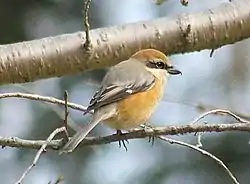
- Lanius bucephalus, the bull-headed shrike
- general name for birds in family Laniidae: the shrikes
- Hypernym: 雀 (suzume)
- , text here
- 春之在者伯勞鳥之草具吉雖不所見吾者見将遣君之當乎婆 [Man'yōgana]
- 春さればもずの草潜見えずとも我れは見やらむ君があたりをば [Modern spelling]
- haru sareba mozu no kusaguki miezu to mo ware wa miyaran kimi ga atari o ba
- After spring has come the shrike goes plunging in the reeds and cannot be seen―but I will spy it out, my love, the place where you have your home.[5]
Derived terms
Derived terms
- 百舌勘定 (mozu kanjō)
- 百舌鳥古墳群 (Mozu Kofungun)
- 百舌の草潜 (mozu no kusaguki)
- 百舌の速贄 (mozu no hayanie)
- 百舌鶲 (mozuhitaki)
- 赤百舌, 赤鵙 (akamozu)
- 大唐鵙 (ōkara-mozu)
- 大百舌 (ōmozu)
- 高砂百舌 (Takasago mozu)
- 稚児百舌 (chigomozu)
- 羽黒尾長百舌, 羽黒尾長鵙 (haguro-onaga mozu)
- 藪百舌 (yabumozu)
References
- Naoki Abe, 2008, 野鳥の名前 (Yadori no Namae, “Wild Birds' Names”, in Japanese), Tōkyō: Yama-kei Publishers, →ISBN
- Matsumura, Akira, editor (2006), 大辞林 [Daijirin] (in Japanese), Third edition, Tōkyō: Sanseidō, →ISBN
- NHK Broadcasting Culture Research Institute, editor (1998), NHK日本語発音アクセント辞典 [NHK Japanese Pronunciation Accent Dictionary] (in Japanese), Tōkyō: NHK Publishing, →ISBN
- Kindaichi, Kyōsuke et al., editors (1997), 新明解国語辞典 [Shin Meikai Kokugo Jiten] (in Japanese), Fifth edition, Tōkyō: Sanseidō, →ISBN
- Edwin A. Cranston (1998) The Gem-Glistening Cup, illustrated edition, Stanford University Press, →ISBN, page 669
This article is issued from Wiktionary. The text is licensed under Creative Commons - Attribution - Sharealike. Additional terms may apply for the media files.