径
| ||||||||
Translingual
| Traditional | 徑 |
|---|---|
| Shinjitai | 径 |
| Simplified | 径 |
Alternative forms
- In mainland China, the right component of this character is 𢀖 (⿱ス工) which is the simplified component of 巠.
- In Taiwan (based on its encoding standard), Japanese shinjitai and Korean hanja, the right component of this character is 圣 instead.
- Due to Han unification, both forms are encoded under the same code point. This character may appear to be 径 (mainland China) or 径 (Taiwan/Japan/Korea) depending on the font used.
Han character
径 (Kangxi radical 60, 彳+5, 8 strokes, cangjie input 竹人弓人一 (HONOM) or 竹人水土 (HOEG), four-corner 27212, composition ⿰彳𢀖(G) or ⿰彳圣(TJK))
Related characters
- 徑 (Traditional form of 径, kyūjitai form of 径)
- 逕 (Variant traditional form of 徑 in mainland China)
References
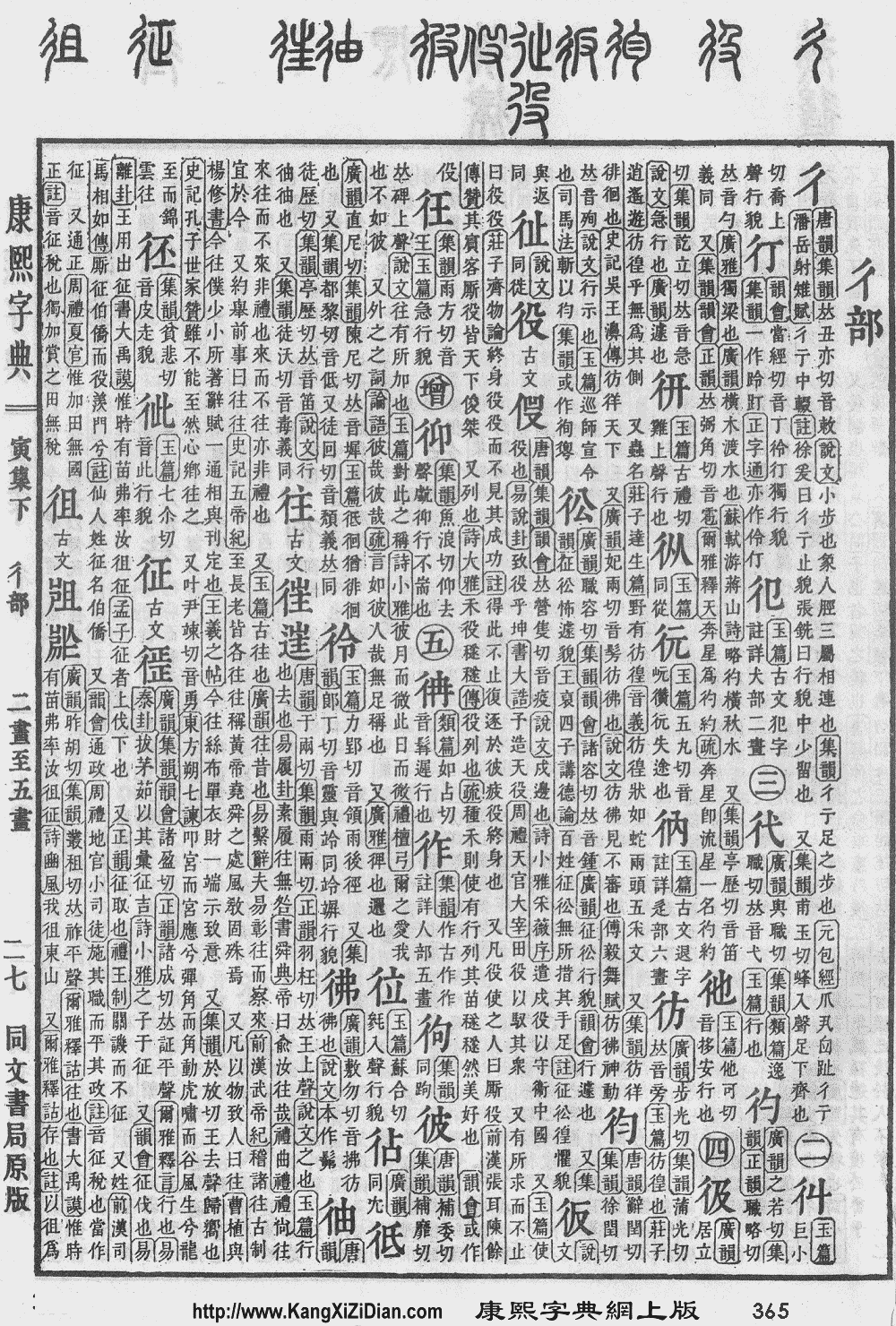
- Kangxi Dictionary: not present, would follow page 365, character 41
- Dai Kanwa Jiten: character 10080
- Dae Jaweon: page 686, character 6
- Hanyu Da Zidian (first edition): volume 2, page 818, character 1
- Unihan data for U+5F84
Chinese
Glyph 1
- This section refers to ⿰彳𢀖 glyph. (径)
Glyph origin
Simplified from 徑 (巠 → 𢀖) based on the table of 54 simplified radical components listed in the 1956 Chinese Character Simplification Scheme by the People's Republic of China.
Definitions
| For pronunciation and definitions of 径 – see 徑 (“path; road; way; etc.”). (This character is the simplified form of 徑). |
Notes:
|
Glyph origin
Simplified from 逕 which is listed as a variant traditional form of 徑/径 (jìng) in the 1956 first round revision table of variant Chinese characters (第一批异体字整理表) by the People's Republic of China.
As a variant form, 逕/迳 (jìng) is to be replaced by 徑/径 (jìng) as its orthodox form, which is succeeded by 径 as the simplified form of 徑/径 (jìng).
Definitions
| For pronunciation and definitions of 径 – see 逕 (“small path; to go to; to reach; etc.”). (This character is the simplified form of 逕). |
Notes:
|
Usage notes
Note that in modern Taiwan, 徑/径 (jìng) and 逕/迳 (jìng) are considered as two different characters while in mainland China, 逕/迳 (jìng) is considered a variant traditional form of 徑/径 (jìng).
Glyph 2
- This section refers to ⿰彳圣 glyph. (径)
Glyph origin
Unorthodox variant simplified from 徑 (巠 → 圣) found in a moveable type copy of the classical Chinese novel Jin Ping Mei 《金瓶梅 (Jīnpíngméi)》.
First attested in 《宋元以來俗字譜》, a variant forms dictionary compiled in 1930 that records unorthodox forms (俗字 (súzì)) that have existed since the Song dynasty.
Another similar character, which has (⿱ス土) as its right component can also be found in 《太平樂府》.
Korean
Hanja
径 • (gyeong) (hangeul 경, revised gyeong, McCune–Reischauer kyŏng, Yale kyeng)
- This term needs a translation to English. Please help out and add a translation, then remove the text
{{rfdef}}.
Vietnamese
Han character
- This term needs a translation to English. Please help out and add a translation, then remove the text
{{rfdef}}.