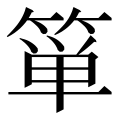
箪
See also: 簞
 | ||||||||
Translingual
| Traditional | 簞 |
|---|---|
| Shinjitai (extended) |
箪 |
| Simplified | 箪 |
Han character
箪 (Kangxi radical 118, 竹+8 in Chinese, 竹+9 in Japanese, 14 strokes in Chinese, 15 strokes in Japanese, cangjie input 竹金田十 (HCWJ), composition ⿱𥫗单 (G) or ⿱𥫗単 (J))
References
- Kangxi Dictionary: not present, would follow page 889, character 32
- Hanyu Da Zidian (first edition): volume 5, page 2985, character 13
- Unihan data for U+7BAA

Chinese
Definitions
| For pronunciation and definitions of 箪 – see 簞 (“a bamboo utensil for holding cooked rice; a basket”). (This character is the simplified form of 簞). |
Notes:
|
Korean
Hanja
箪 • (dan) (hangeul 단)
- This term needs a translation to English. Please help out and add a translation, then remove the text
{{rfdef}}.
This article is issued from Wiktionary. The text is licensed under Creative Commons - Attribution - Sharealike. Additional terms may apply for the media files.