膝
| ||||||||
Translingual
Han character
膝 (Kangxi radical 130, 肉+11, 15 strokes, cangjie input 月木人水 (BDOE), four-corner 74232, composition ⿰⺼桼)
Coordinate terms
Derived characters
- 𧀬
References
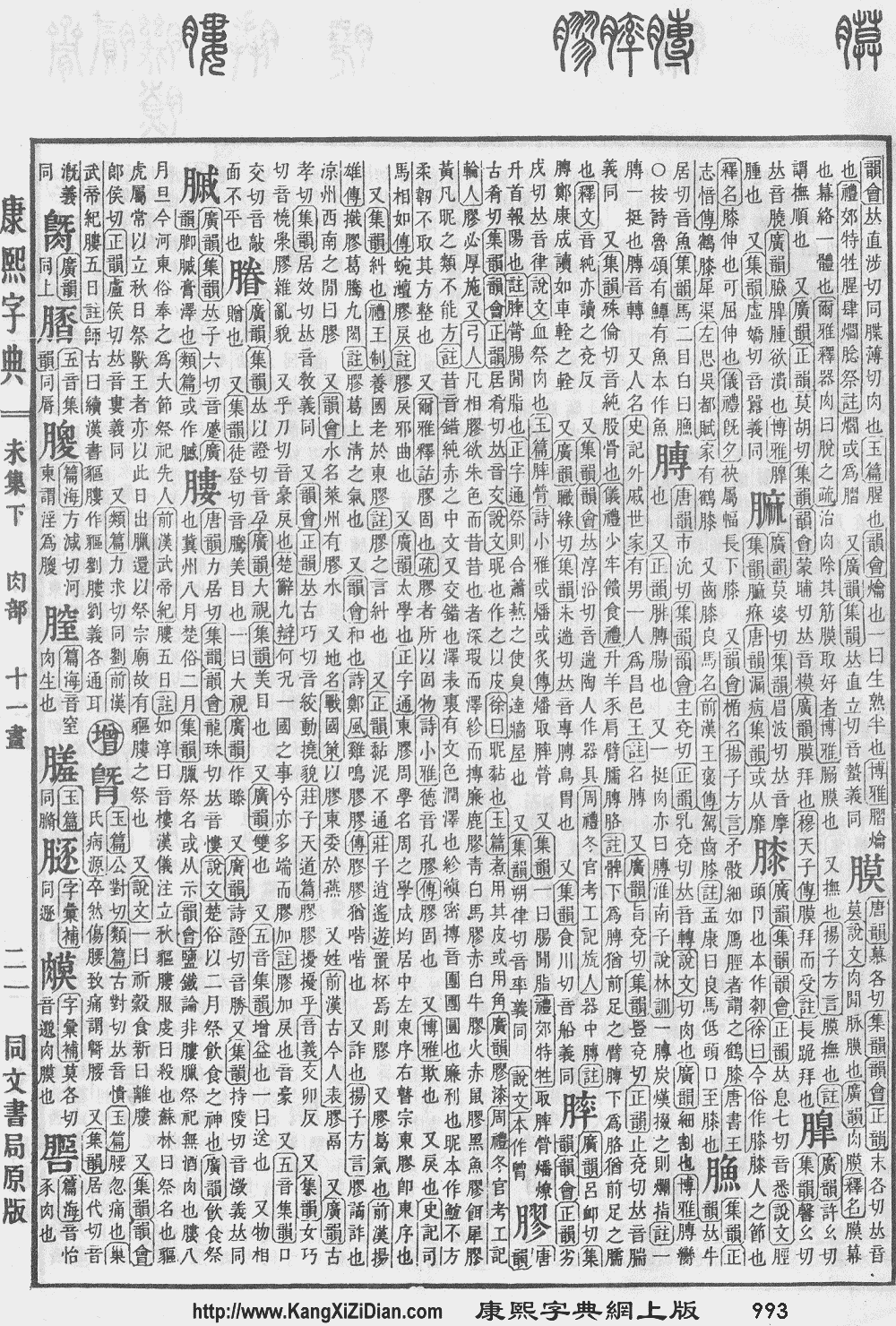
- Kangxi Dictionary: page 993, character 4
- Dai Kanwa Jiten: character 29837
- Dae Jaweon: page 1445, character 2
- Hanyu Da Zidian (first edition): volume 3, page 2106, character 11
- Unihan data for U+819D
Chinese
| trad. | 膝 | |
|---|---|---|
| simp. # | 膝 | |
| 2nd round simp. | ⿰月夕 | |
| alternative forms | 厀 䣛 𦡩 𦜔 | |
Glyph origin
Characters in the same phonetic series (桼) (Zhengzhang, 2003)
Phono-semantic compound (形聲/形声, OC *siɡ) : semantic ⺼ (“meat, body”) + phonetic 桼 (OC *sʰiɡ) – the knee.
Originally 厀, a phono-semantic compound (形聲/形声, OC *siɡ) : phonetic 桼 (OC *sʰiɡ) + semantic 卩 (“kneeling person”).
Pronunciation
Compounds
- 交臂屈膝
- 低頭屈膝/低头屈膝
- 低顏下膝/低颜下膝
- 促膝
- 促膝談心/促膝谈心
- 促膝長談/促膝长谈
- 兜膝
- 兩手過膝/两手过膝
- 加膝墜淵/加膝坠渊
- 卑躬屈膝 (bēigōng-qūxī)
- 垂手過膝/垂手过膝
- 奴顏婢膝/奴颜婢膝 (núyánbìxī)
- 婢膝奴顏/婢膝奴颜
- 容膝
- 對膝/对膝
- 屈膝 (qūxī)
- 承歡膝下/承欢膝下 (chénghuān xīxià)
- 拊膝
- 拍膝嗟歎/拍膝嗟叹
- 接膝
- 敝膝
- 盤膝/盘膝
- 盤膝而坐/盘膝而坐
- 磕膝蓋/磕膝盖
- 竹夾膝/竹夹膝
- 胳膝
- 膝下 (xīxià)
- 膝下猶虛/膝下犹虚
- 膝反射
- 膝席
- 膝癢搔背/膝痒搔背
- 膝蓋/膝盖 (xīgài)
- 膝蓋骨/膝盖骨 (xīgàigǔ)
- 膝行 (xīxíng)
- 膝行肘步
- 膝袒
- 膝褲/膝裤
- 膝頭/膝头 (xītóu)
- 蔽膝 (bìxī)
- 裂裳裹膝
- 護膝/护膝 (hùxī)
- 鶴膝/鹤膝
- 鶴膝風/鹤膝风
Synonyms
Dialectal synonyms of 膝蓋 (“knee”) [map]
Japanese
References
- Matsumura, Akira, editor (2006), 大辞林 [Daijirin] (in Japanese), Third edition, Tōkyō: Sanseidō, →ISBN
Korean
Etymology
From Middle Chinese 膝 (MC sit).
| Historical Readings | ||
|---|---|---|
| Dongguk Jeongun Reading | ||
| Dongguk Jeongun, 1448 | 시ᇙ〮 (Yale: sílq) | |
| Middle Korean | ||
| Text | Eumhun | |
| Gloss (hun) | Reading | |
| Hunmong Jahoe, 1527 | 무룹 (Yale: mwùlwùp) | 슬〮 (Yale: súl) |
Pronunciation
- (SK Standard/Seoul) IPA(key): [sʰɯɭ]
- Phonetic hangul: [슬]
Vietnamese
This article is issued from Wiktionary. The text is licensed under Creative Commons - Attribution - Sharealike. Additional terms may apply for the media files.