麦
See also: 麥
| ||||||||
| ||||||||
Translingual
| Stroke order (Chinese) | |||
|---|---|---|---|
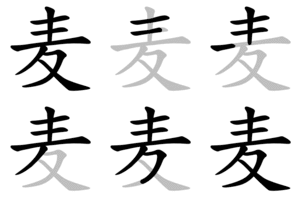 | |||
| Stroke order (Japan) | |||
|---|---|---|---|
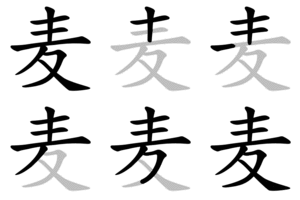 | |||
Han character
麦 (Kangxi radical 199, 麦+0, 7 strokes, cangjie input 手一水 (QME), composition ⿱龶夂(GJ) or ⿱龶夊(T))
Derived characters
References
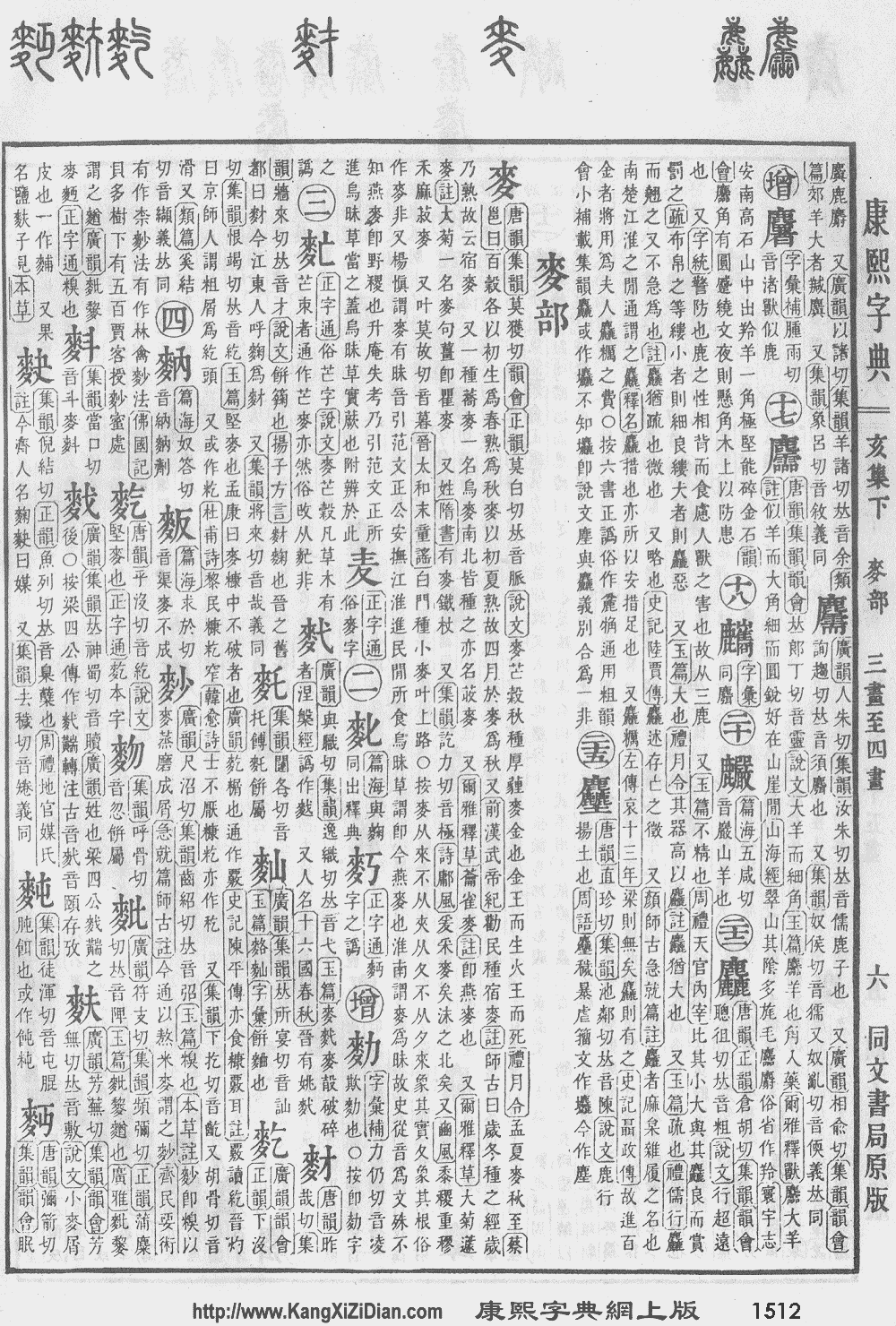
- Kangxi Dictionary: page 1512, character 9
- Dai Kanwa Jiten: character 47718
- Dae Jaweon: page 2041, character 2
- Hanyu Da Zidian (first edition): volume 7, page 4600, character 2
- Unihan data for U+9EA6
Chinese
Definitions
| For pronunciation and definitions of 麦 – see 麥 (“wheat; etc.”). (This character is the simplified and variant form of 麥). |
Notes:
|
Glyph origin
Corruption of 八 into a horizontal stroke.
Japanese
| 麦 | |
| 麥 |
Compounds
Etymology 1
| Kanji in this term |
|---|
| 麦 |
| むぎ Grade: 2 |
| kun’yomi |
| Alternative spelling |
|---|
| 麥 (kyūjitai) |
From Old Japanese.[1] In turn, theorized to be from Proto-Japonic *monki.
Noun
麦 • (mugi)
Etymology 2
| Kanji in this term |
|---|
| 麦 |
| もぎ Grade: 2 |
| irregular |
| Alternative spelling |
|---|
| 麥 (kyūjitai) |
| For pronunciation and definitions of 麦 – see the following entry. | ||
| ||
| (This term, 麦, is an alternative spelling of the above term.) |
References
- Shōgaku Tosho (1988) 国語大辞典(新装版) [Unabridged Dictionary of Japanese (Revised Edition)] (in Japanese), Tōkyō: Shogakukan, →ISBN
- Matsumura, Akira, editor (2006), 大辞林 [Daijirin] (in Japanese), Third edition, Tōkyō: Sanseidō, →ISBN
- NHK Broadcasting Culture Research Institute, editor (1998), NHK日本語発音アクセント辞典 [NHK Japanese Pronunciation Accent Dictionary] (in Japanese), Tōkyō: NHK Publishing, →ISBN
This article is issued from Wiktionary. The text is licensed under Creative Commons - Attribution - Sharealike. Additional terms may apply for the media files.