줄
| ||||||||||
| 주죽죾죿준줁줂 줃줄줅줆줇줈줉 줊줋줌줍줎줏줐 중줒줓줔줕줖줗 | |
| 죠 ← | → 줘 |
|---|---|
Korean
Etymology 1
First attested in the Seokbo sangjeol (釋譜詳節 / 석보상절), 1447, as Middle Korean 줄〮 (Yale: cwúl), with semantic narrowing; the Middle Korean word meant "situation" more generally. Perhaps ultimately related to the "string" meaning below, but this is highly speculative.
Pronunciation
- (SK Standard/Seoul) IPA(key): [t͡ɕuɭ]
(file)
- Phonetic hangul: [줄]
| Romanizations | |
|---|---|
| Revised Romanization? | jul |
| Revised Romanization (translit.)? | jul |
| McCune–Reischauer? | chul |
| Yale Romanization? | cwul |
Dependent noun
줄 • (jul) (obligatorily follows an adnominalized verb)
Usage notes
When used with the particle 을 (-eul, accusative marker), it means that the speaker is personally considering the situation as factual. When used with the particle 로 (-ro, “by, with”, instrumental marker), it means that the original perceiver considered the situation as factual, and that the speaker may or may not agree with them. Compare:
When the particle is omitted (as is very common), the meaning can be ambiguous.
Etymology 2
First attested in the Seokbo sangjeol (釋譜詳節 / 석보상절), 1447, as Middle Korean 줄〮 (Yale: cwúl).
Pronunciation
- (SK Standard/Seoul) IPA(key): [t͡ɕuɭ]
(file)
- Phonetic hangul: [줄]
| Romanizations | |
|---|---|
| Revised Romanization? | jul |
| Revised Romanization (translit.)? | jul |
| McCune–Reischauer? | chul |
| Yale Romanization? | cwul |
- South Gyeongsang (Busan) pitch accent: 줄의 / 줄에 / 줄까지
Syllables in red take high pitch. This word always takes high pitch and also heightens the next suffixed syllable, unless it is 에.
Noun
줄 • (jul) (usually no hanja; sometimes 乼, 注乙)
- string, rope
- line, row, column, queue
- line, crack (on a surface)
- line on a written page
- string of a musical instrument
- Synonym: 현(絃) (hyeon)
- (figurative) personal connections
- (North Korea, mathematics) Synonym of 현(絃) (hyeon, “chord of a circle”)
Derived terms
Verbs and idioms:
- 줄로 친 듯 (jullo chin deut, “clearly, manifestly”)
- 줄을 놓다 (jureul nota, “to approach someone to learn something”)
- 줄을 대다 (jureul daeda, “to approach with an ulterior selfish purpose”)
- 줄을 서다 (jureul seoda, “to stand in line”)
- 줄을 타다 (jureul tada, “to take the side of a stronger power”)
Nouns:
- 거미줄 (geomijul, “spiderweb”)
- 날줄 (naljul, “warp”)
- 닻줄 (datjul, “anchor hawser”)
- 목줄 (mokjul, “leash”)
- 밧줄 (batjul, “rope”)
- 씨줄 (ssijul, “woof”)
- 줄가리 (julgari, “triangular arrangement for paddy drying”)
- 줄곧 (julgot, “constantly”)
- 줄넘기 (julleomgi, “rope jumping”)
- 줄다리기 (juldarigi, “tug-of-war”)
- 줄달음질 (juldareumjil, “chain smoking”)
- 줄모 (julmo, “rice paddies in rows”)
- 줄무늬 (julmunui, “stripe of color (e.g. of zebras)”)
- 줄사다리 (julsadari, “rope ladder”)
- 줄씹 (julssip, “sexual intercourses with a sequence of partners”)
- 줄자 (julja, “tape measure”)
- 줄타기 (jultagi, “tightrope walking; pragmatism”)
- 줄팔매 (julpalmae, “sling”)
- 핏줄 (pitjul)
- 힘줄 (himjul, “sinew”)
Etymology 3
First attested in the Hunmong jahoe (訓蒙字會 / 훈몽자회), 1527, as Middle Korean 줄〯 (Yale: cwǔl).
Pronunciation
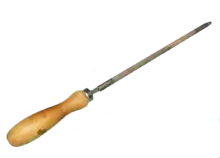
- (SK Standard/Seoul) IPA(key): [t͡ɕu(ː)ɭ]
- Phonetic hangul: [줄(ː)]
- Though still prescribed in Standard Korean, most speakers in both Koreas no longer distinguish vowel length.
| Romanizations | |
|---|---|
| Revised Romanization? | jul |
| Revised Romanization (translit.)? | jul |
| McCune–Reischauer? | chul |
| Yale Romanization? | cwūl |
- South Gyeongsang (Busan) pitch accent: 줄의 / 줄에 / 줄까지
Syllables in red take high pitch. This word always takes low pitch, and heightens the pitch of two subsequent suffixed syllables.
Etymology 4
First attested in the Yeogeo yuhae (譯語類解 / 역어유해), 1690, as Early Modern Korean 줄 (Yale: cwul).
Pronunciation
- (SK Standard/Seoul) IPA(key): [t͡ɕu(ː)ɭ]
- Phonetic hangul: [줄(ː)]
- Though still prescribed in Standard Korean, most speakers in both Koreas no longer distinguish vowel length.
| Romanizations | |
|---|---|
| Revised Romanization? | jul |
| Revised Romanization (translit.)? | jul |
| McCune–Reischauer? | chul |
| Yale Romanization? | cwūl |
Pronunciation
- (SK Standard/Seoul) IPA(key): [t͡ɕuɭ]
- Phonetic hangul: [줄]
| Romanizations | |
|---|---|
| Revised Romanization? | jul |
| Revised Romanization (translit.)? | jul |
| McCune–Reischauer? | chul |
| Yale Romanization? | cwul |
Etymology 6
Sino-Korean word from 橘.
Pronunciation
- (SK Standard/Seoul) IPA(key): [t͡ɕuɭ]
- Phonetic hangul: [줄]
| Romanizations | |
|---|---|
| Revised Romanization? | jul |
| Revised Romanization (translit.)? | jul |
| McCune–Reischauer? | chul |
| Yale Romanization? | cwul |
- South Gyeongsang (Busan) pitch accent: 줄의 / 줄에 / 줄까지
Syllables in red take high pitch. This word always takes low pitch, and heightens the pitch of two subsequent suffixed syllables.
Noun
줄 • (jul) (hanja 橘)
- (Gyeongsang, Chungcheong, Jeolla dialect) Dialectal form of 귤(橘) (gyul, “orange, clementine”)
Etymology 7
Various verbal inflections grouped under one etymology for convenience. See the main entries for more.
Verb
줄 • (jul)
Etymology 8
Modern Korean reading of various Chinese characters.