𓄿
 | ||||||||||
Egyptian
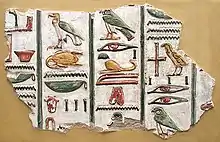
Colorful hieroglyphs from the tomb of Seti I, showing 𓄿.
Glyph origin
Representing the Egyptian vulture (Neophron percnopterus). The sharp “corner” at the back of the head represents a tuft of feathers sticking out; other details sometimes shown include a featherless area at the base of the beak and a lean, thinly feathered neck. This glyph was conventionally polychrome. The oldest depictions color the wings blue or grey, but later they become green; the glyph as a whole is polychrome, with a largely yellow head, and yellow or red feet. (Less careful representations are sometimes all yellow, all blue, or nearly all white.) The phonetic value of ꜣ is derived by the rebus principle from its use as a logogram for ꜣ (“Egyptian vulture, bird”). Compare the Chinese character 鳥.

Usage notes
This glyph should not be confused with the extremely similar
(𓅂, a buzzard), which serves as a phonogram for tjw and has a more rounded back of the head. In some inscriptions the two could also be distinguished by their colors, the buzzard being largely yellow with red details.
|

References
- Gardiner, Alan (1957) Egyptian Grammar: Being an Introduction to the Study of Hieroglyphs, third edition, Oxford: Griffith Institute, →ISBN, page 467
- Henry George Fischer (1988) Ancient Egyptian Calligraphy: A Beginner’s Guide to Writing Hieroglyphs, New York: Metropolitan Museum of Art, →ISBN
- Betrò, Maria Carmela (1995) Geroglifici: 580 Segni per Capire l'Antico Egitto, Milan: Arnoldo Mondadori Editore S.p.A., →ISBN
- Peust, Carsten (1999) Egyptian Phonology: An Introduction to the Phonology of a Dead Language, Göttingen: Peust und Gutschmidt Verlag GbR, page 48
- Nina Davies, Picture Writing in Ancient Egypt (1958): "Pl. IV, 1. Egyptian Vulture. Phonetic ꜣ 'vulture' (G1). From the tomb of Rekhmire (no. 100). White ground. Although the bird in outline differs little from the long-legged buzzard (G4, our Pl. IV, 3) with which the Egyptians sometimes confused it, there is no resemblance in the painted examples and these do not vary." [Plate depicts the vulture wih blue-green wings and mostly yellow head and feet, the buzzard entirely yellow with red feather-details on the wings and tail.]
- David Nunn, A Palaeography of Polychrome Hieroglyphs (Université Libre de Bruxelles - Faculté de Philosophie et Sciences sociales, 2020)
This article is issued from Wiktionary. The text is licensed under Creative Commons - Attribution - Sharealike. Additional terms may apply for the media files.