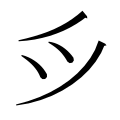
𫜵
 | ||||||||
Vietnamese
Alternative forms
Glyph origin
Debated. Probably, top part of the character 爲 (“to do”). In this case, cognate with Korean 丷 and Japanese 𬼀. Alternatively, a purely phonetic simplification of the character 濫 (“to overflow”) (Sino-Vietnamese reading lạm).[1]
Was unified in Unicode with 爫 (“top form of Kangxi radical #87”) up until the version 14.0 (2021).
This article is issued from Wiktionary. The text is licensed under Creative Commons - Attribution - Sharealike. Additional terms may apply for the media files.