Hallstatt
English
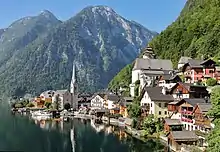
A view of the town of Hallstatt.

Some pottery from the Hallstatt Culture.
Proper noun
Hallstatt
- A village in Salzkammergut, Austria, known historically for the production of salt.
- The Hallstatt culture of the Late Bronze Age/Early Iron Age.
Derived terms
German
Etymology
The second element is Statt (“place, stead”).
Traditionally the first element is taken to be a borrowing from Celtic for ‘salt’, such as Welsh halen or Breton holen; see Proto-Celtic *salanos.[1]
David Stifter rejects the traditional etymology because of several problems, among them:
- the element hall- exists only in names of places settled by Germanic speakers (and nowhere else in the Celtic-speaking areas),
- the *s > *h sound change is not attested in Continental Celtic,
- derivation from the ‘salt’ word would have given a non-geminated final l.
He instead derives it from Proto-Germanic *hallą, from Proto-Indo-European *kHlnom (“hardened skin, encrustation”), referring to encrusted salt forming during the simmering of brine.[2]
Pronunciation
- IPA(key): /ˈhalˌʃtat/
Audio (file) - Hyphenation: Hall‧statt
Proper noun
Hallstatt n (proper noun, genitive Hallstatts or (optionally with an article) Hallstatt)
- A municipality of Upper Austria, Austria
This article is issued from Wiktionary. The text is licensed under Creative Commons - Attribution - Sharealike. Additional terms may apply for the media files.