< Reconstruction:Proto-Sino-Tibetan

Reconstruction:Proto-Sino-Tibetan/mej

This Proto-Sino-Tibetan entry contains reconstructed terms and roots. As such, the term(s) in this entry are not directly attested, but are hypothesized to have existed based on comparative evidence.

Proto-Sino-Tibetan

Etymology

  • Proto-Sino-Tibetan: *myəy ~ sməy/smyəy (Coblin, 1986)
    • Proto-Tibeto-Burman: *mey (Matisoff, STEDT; Weidert, 1987; LaPolla, 1987; Benedict, 1972)

Comparing Chinese 火 (huǒ) with Proto-Tibeto-Burman *mey is problematic. Sagart (1999) reconstructed the Chinese word as /*m̥ˤɨjʔ/, citing its variant 𤈦 (huǐ) (an ancient Wu dialect word) as the basis for reconstructing a voiceless bilabial initial. This was however revised to a uvular initial in the Baxter-Sagart (2011) system, perhaps in accordance with Zhengzhang (2003). Li (1980) reconstructed it as *hwərX, and commented that it likely came from an earlier *hmərX. The word "fire" is classified by some to belong to the same family as some words meaning "to destroy", represented by 毁 (huǐ). Compare Written Tibetan སྨྱེ་བ (smye ba, “(archaic) damaged, impaired, poor quality”).

Compare Proto-Tai *ʰmajᶜ (“to burn (intr.)”) (Thai ไหม้ (mâi), Lao ໄໝ້ (mai)).
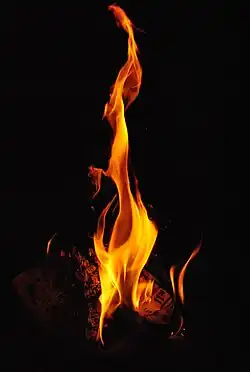
Fire.

Noun

*mej

  1. fire

Descendants

  • Old Chinese:
    火 (huǒ) /*qʷʰˤəjʔ/ (B-S); /*qʰʷaːlʔ/ (ZS) ("fire") (see note)
    and perhaps dialectally
    𤈦 (huǐ) /*m̥əjʔ/ (B-S); /*m̥ɯlʔ/ (ZS) ("(ancient Wu dialect) fire")
    燬/毁 (huǐ) /*m̥ajʔ/ (B-S); /*m̥ralʔ/ (ZS) ("(ancient Qi dialect) fire")
    (火 in the oracle bone script)
    • Middle Chinese: 火 (huɑX)
The template Template:Sinoxenic does not use the parameter(s):
5=hwa
Please see Module:checkparams for help with this warning.

**:

→ Japanese: 火 (か, ​ka)
Korean: 화 (火, hwa)
Vietnamese: hoả (火)

      • Mandarin
        • Beijing: 火 (huǒ) (huǒ, /xu̯ɔ²¹⁴/)
        • Chengdu: 火 (huǒ) /xo⁵³/
      • Cantonese
        • Guangzhou: 火 (huǒ) /fɔː³⁵/
        • Taishan: 火 (huǒ) /fu̯ɔ⁵⁵/
      • Hakka
        • Meixian: 火 (huǒ) /fo³¹/
        • Sixian: 火 (huǒ) /fo³¹/
      • Wu
        • Shanghai: 火 (huǒ) /hɯ³⁴/
    • Min
      • Eastern Min
        Fuzhou: 火 (huǒ) /huoi³³/ (colloquial), /huo³³/ (literary)
      • Northern Min
        Jian'ou: 火 (huǒ) /xo²¹/
      • Southern Min
        Hokkien:
        Xiamen, Taipei: 火 (huǒ) /he⁵³/ (colloquial), /hɔ̃⁵³/ (literary)
        Zhangzhou: 火 (huǒ) /hue⁵³/ (colloquial), /hɔ̃⁵³/ (literary)
        Quanzhou: 火 (huǒ) /hə⁵⁵⁴/ (colloquial), /hɔ̃⁵⁵⁴/ (literary)
        Teochew: 火 /hue⁵²/
  • Himalayish
    • Tibeto-Kanauri
      • Bodic
        • Tibetan
          • Written Tibetan: མེ (me, “fire, flame”)
      • Lepcha: ᰕᰧ (mi, “fire”)
    • Mahakiranti
      • Kiranti
        • Eastern Kiranti = Rai
          • Athpare: मि (mi, “fire”)
          • Yamphu: मि (mi, “fire”)
        • Western Kiranti
          • Khaling: मि (mi, “fire”)
          • Dumi: मी (mi, “fire”)
  • Tangut-Qiang
    • Tangut
      • Tangut: 𗜐 (*mə̱¹, “fire”), 𘖐 (*mjɨ², “fire”)
    • rGyalrongic
  • Lolo-Burmese-Naxi
    • Proto-Lolo-Burmese: *s/ʔ-mej²
      • Burmish
      • Loloish
        • Northern Loloish
          • Yi (Liangshan): ꃆꄔ (mup dut, “fire”)
  • Proto-Karen: *hmeᴮ (Luangthongkum, 2013)
  • Proto-Tani: *a-mə
  • Proto-Kuki-Chin: *maj
    • Khomic
      • Khumi Chin: mai
    • Northern
    • Central
  • Manipuri: ꯃꯩ (mei)

See also

  • *bʷar ~ pʷar (“to burn, to ignite; fire”)
  • *hwa-t (“to shine; light”)
  • *m-t(w)əj-n ~ m-ti-s (“water, liquid, fluid”)
This article is issued from Wiktionary. The text is licensed under Creative Commons - Attribution - Sharealike. Additional terms may apply for the media files.