bērns
Latvian
Etymology
From an earlier *berns, with lengthening ([èɾ] > [æ̀ːɾ]), from Proto-Baltic *bernas, from Proto-Indo-European *bʰer- with an extra -no-s. The meaning evolved from “carry, bear” > “carried thing, burden” > “baby (being carried by pregnant woman)” > “child.” Cognates include Lithuanian bérnas (“young, unmarried man; child; boy; servant”), Sudovian barnaj (“children”) (< *bernai), Proto-Germanic *barną (“child”) (Gothic 𐌱𐌰𐍂𐌽 (barn), Swedish barn, English bairn (“child”)). In the sense of “burden,” also Proto-Slavic *bermę < *bermen- (dialectal Russian бере́мя (berémja, “burden; lap”)), Old Armenian բեռն (beṙn), Ancient Greek φέρνη (phérnē, “dowry”); in the sense of “pregnant,” Russian бере́менная (berémennaja), Polish brzemienna, from brzemienny (“full of cargo”); and in the sense of “to be born, birth,” Ancient Greek φέρμα (phérma, “fruit of the earth”), Old English ġeberan (“to bring forth, to give birth”), German gebären, English bear, be born.[1]
Pronunciation
- IPA(key): [bæ̀ːɾns]
Noun
bērns m (1st declension)
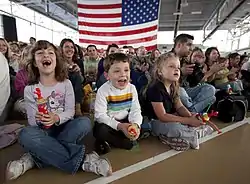
- child (boy or girl up to approximately 14 or 13 years of age)
- mazs bērns ― small child
- raudošs bērns ― crying, weeping child
- nerātns bērns ― naughty child
- neiznests bērns ― premature (lit. not-fully-carried) child
- ārlaulības, nelikumīgs bērns ― out-of-wedlock, illegitimate child
- bērna audzināšana ― a child's education
- auklēt bērnu ― to baby-sit a child
- kopt bērnu ― to care for a child
- mācīt bērnu ― to teach a child
- adoptēt bērnu ― to adopt a child
- bērnu ratiņi ― strollers (literally, “little children's carts”)
- bērnu autiņi ― diapers (literally, “children's little cloths”)
- bērnu nams, bērnunams ― orphanage (literally, “children's house”)
- bērnu dārzs, bērnudārzs ― kindergarten (literally, “children's garden”)
- bērnu laukums ― (children's) playground
- bērnu literatūra ― children's literature, books
- bērnu ārsts ― pediatrician (lit. children's doctor)
- bērnu spēle ― children's play (= something very simple and easy)
- tu runā kā bērns ― you talk like a child (= too naively, childishly)
- child (son or daughter, regardless of age, in relation to their parents; descendants)
- vienu vecāku bērni ― children of the same parents, siblings
- pieauguši bērni ― grownup children
- viņai ir vienpadsmit bērnu: septiņas meitas un četri dēli ― she has eleven children: seven daughters and four sons
- kad bērni lieli, iet tie paši ar savu galvu un vecāku prātu ― (please add an English translation of this usage example)
- (colloquial) animal offspring
- “vai, māt, Brūnaļai teļinš!” meitene priecīgi sasit rokas... “Brūnaļa mani vairs nepazīst...” “viņai bail, ka tu nedari pāri viņas bērnam” ― “oh, Mum, Brūnaļa (the cow) has a little calf!” the girl happily clapped her hands... “Brūnaļa doesn't know me anymore...” “she is afraid of what you might do to her child”
- (poetic) person, with respect to land, people, nation, political movement, etc. to which he or she belongs
- tu biji krietnais tautas bērns ― you were an honest, decent child of the people
- dziesma, ai dziesmiņa, skani skaļi / visur, kur Latvijas bērniem mājas! ― song, oh little song, do sound loud / everywhere where Latvia's children have homes!
Declension
Derived terms
- bāra bērns, bārabērns
- bērnība
- bērnišķs, bērnišķīgs, bērnišķīgums
- bērnišķība
- bērnudārzs, bērnu dārzs
- bērnu nams, bērnunams
References
- Karulis, Konstantīns (1992) “bērns”, in Latviešu Etimoloģijas Vārdnīca (in Latvian), Rīga: AVOTS, →ISBN