capall
Irish
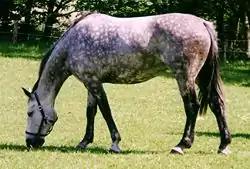
Capall
Pronunciation
- IPA(key): /ˈkapˠəl̪ˠ/
Declension
Declension of capall
First declension
|
Bare forms:
|
Forms with the definite article:
|
- Alternative plural: caiple (Cois Fharraige)
Hyponyms
Derived terms
- ar chapall, ar dhroim capaill, ar muin capaill (“on horseback”, adverb)
- athchapall m (“reserve horse; remount”)
- beach chapaill f (“wasp”)
- beithíoch capaill (“horse”)
- buaic capaill (“crest of horse”)
- capaill bhána m pl (“white horses, crested waves”)
- capaillín m, gearrchapall m (“pony”)
- capall ardfhola m (“thorough-bred horse”)
- capall ardualaigh m (“pack-horse”)
- capall ballach m (“piebald horse”)
- capall breac m (“dapple-grey horse”)
- capall buírua m (“light bay (horse)”)
- capall céachta m (“plough-horse”)
- capall ceannann m (“white-faced horse”)
- capall cogaidh m (“charger”)
- capall coille m (“capercaillie”)
- capall cóiste m (“coach-horse”)
- capall dealraitheach m (“a likely-looking horse”)
- capall deargrua m (“sorrel”)
- capall diallaite m (“saddle-horse”)
- capall docheansaithe m (“untameable horse”)
- capall faiteach m (“skittish horse”)
- capall fiaigh m, capall seilge m (“hunter (horse)”)
- capall folaíochta m (“thoroughbred horse”)
- capall gleannach m (“hollow-backed horse”)
- capall luascáin m (“rocking-horse”)
- capall macánta m (“docile horse”)
- capall maide m (“wooden, vaulting, horse; hobby-horse”)
- capall mairceach m, capall na mairce m (“galled horse”)
- capall marcaíochta m (“hackney”)
- capall marclaigh m (“pack-horse”)
- capall mear m (“fast, spirited, horse”)
- capall neamhéasca m (“slow-moving horse”)
- capall rása m (“racehorse”)
- capall rua m (“chestnut horse”)
- capall sáiteach m (“borer”)
- capall sásta m (“manageable horse”)
- capall scáfar m, sceiteog de chapall f (“shy horse”)
- capall sceadach m (“horse with blaze”)
- capall scóipiúil m (“free-striding horse”)
- capall sealaíochta m (“relay horse”)
- capall sliogánach m (“dapple-grey horse”)
- capall stailce m (“stubborn, sulky, horse”)
- capall stalcaireachta m (“stalking-horse”)
- capall taghdach m (“temperamental horse”)
- capall tarlaithe m (“draught-horse”)
- capall tarraingthe m (“draught-horse”)
- capall uaibhreach m (“spirited horse”)
- capall ualaigh m (“pack-horse”)
- capallach (“equine”, adjective)
- ceannaí capall m (“horse-dealer”)
- cinnire capaill m (“one leading a horse”)
- cíor chapaill f (“curry-comb”)
- cnó capaill m (“horse-chestnut”)
- coiléar capaill m (“horse-collar”)
- coirb capaill (“withers of horse”)
- cóiste capaill (“horse-drawn coach”)
- conablach capaill (“carcass of horse”)
- croibhín capaill m, crúb capaill (“horse's hoof”)
- crú capaill m (“horseshoe”)
- cruimh chapaill f (“grub of tiger moth”)
- cuingir chapall f (“yoke of horses”)
- culaith capaill (“horse trappings, harness”)
- cúlú capaill (“backing of horse”)
- dailc de chapall (“squat horse”)
- eireaball capaill (“horsetail”)
- faocha chapaill f (“whelk”)
- féar capaill m (“cat’s-tail grass”)
- feoil chapaill f (“horsemeat”)
- fia-chapall m (“wild horse”)
- gabháil capaill (“the harnessing of a horse”)
- gillín capaill m (“fine big horse”)
- giolla capaill m (“horse-boy”)
- láimhdeachas capaill (“handling of horse”)
- leathchapall m (“medium-sized horse, cob”)
- moing capaill (“horse’s mane”)
- pana capaill (“horse-cloth, housing”)
- péist chapaill f (“large caterpillar”)
- rás capall (“horse race”)
- rásaíocht chapall f (“horse-racing”)
- scor capaill (“unyoking of horse”)
- scothchapall m (“medium-sized horse”)
- seamair chapaill f (“red clover”)
- seangán capaill m (“black ant”)
- seisreach chapall (“team of horses”)
- seithe chapaill (“horsehide”)
- seó capall (“horse show”)
- sos capall (“relay of horses”)
- speach chapaill (“horse's kick”)
- sraoillín capall m (“string of horses”)
- taispeántas capall (“horse-show”)
- ualach capaill (“horse-load”)
- umar capall (“horse-trough”)
Mutation
| Irish mutation | ||
|---|---|---|
| Radical | Lenition | Eclipsis |
| capall | chapall | gcapall |
| Note: Some of these forms may be hypothetical. Not every possible mutated form of every word actually occurs. | ||
References
- Ó Dónaill, Niall (1977) “capall”, in Foclóir Gaeilge–Béarla, Dublin: An Gúm, →ISBN
- G. Toner, M. Ní Mhaonaigh, S. Arbuthnot, D. Wodtko, M.-L. Theuerkauf, editors (2019), “capall”, in eDIL: Electronic Dictionary of the Irish Language
Further reading
- Entries containing “capall” in English-Irish Dictionary, An Gúm, 1959, by Tomás de Bhaldraithe.
- Entries containing “capall” in New English-Irish Dictionary by Foras na Gaeilge.
Old Irish
Etymology
Uncertain. The Old Irish /p/ and the /f/ in Welsh ceffyl suggest an earlier *pp, making it impossible to be directly related to Gaulish Caballo-, which occurs in proper nouns. A common source of the Irish and Welsh words could be a hypothetical Vulgar Latin *cappillus, some kind of contamination of caballus (“horse”) and capellus (“small goat”). Latin caballus is assumed to be a borrowing from Gaulish. This might in turn be a Wanderwort originating in Asia, compare Ancient Greek καβάλλης (kabállēs, “a nag”).[1][2]
Pronunciation
- IPA(key): [ˈkapal͈]
Inflection
| Masculine o-stem | |||
|---|---|---|---|
| Singular | Dual | Plural | |
| Nominative | capall | capallL | capaillL |
| Vocative | capaill | capallL | caipliuH |
| Accusative | capallN | capallL | caipliuH |
| Genitive | capaillL | capall | capallN |
| Dative | capullL | caiplib | caiplib |
Initial mutations of a following adjective:
| |||
Descendants
Mutation
| Old Irish mutation | ||
|---|---|---|
| Radical | Lenition | Nasalization |
| capall | chapall | capall pronounced with /ɡ(ʲ)-/ |
| Note: Some of these forms may be hypothetical. Not every possible mutated form of every word actually occurs. | ||
References
- Vendryes, Joseph (1987) Lexique Étymologique de l'Irlandais Ancien [Etymological lexicon of Old Irish] (in French), volume C, Dublin, Paris: Dublin Institute for Advanced Studies, Centre national de la recherche scientifique, pages C-33-34
- Thurneysen, Rudolf (1940, reprinted 2017) D. A. Binchy and Osborn Bergin, transl., A Grammar of Old Irish, Dublin Institute for Advanced Studies, →ISBN, page 567
Further reading
- G. Toner, M. Ní Mhaonaigh, S. Arbuthnot, D. Wodtko, M.-L. Theuerkauf, editors (2019), “capall”, in eDIL: Electronic Dictionary of the Irish Language
Scottish Gaelic
Pronunciation
- IPA(key): /ˈkʰahpəl̪ˠ/
Usage notes
- Even when meaning "mare", retains masculine gender.
Derived terms
- capall-aibhne (“hippopotamus”)
- capall-coille (“capercaillie”)
- capall-lìn (“flax beater”)
- capall-mara (“seahorse”)
- capall-uallaich (“packhorse”)
Mutation
| Scottish Gaelic mutation | |
|---|---|
| Radical | Lenition |
| capall | chapall |
| Note: Some of these forms may be hypothetical. Not every possible mutated form of every word actually occurs. | |
Further reading
- Edward Dwelly (1911) “capall”, in Faclair Gàidhlig gu Beurla le Dealbhan [The Illustrated Gaelic–English Dictionary], 10th edition, Edinburgh: Birlinn Limited, →ISBN
- G. Toner, M. Ní Mhaonaigh, S. Arbuthnot, D. Wodtko, M.-L. Theuerkauf, editors (2019), “capall”, in eDIL: Electronic Dictionary of the Irish Language
This article is issued from Wiktionary. The text is licensed under Creative Commons - Attribution - Sharealike. Additional terms may apply for the media files.