charlotte
See also: Charlotte
English
Etymology
Borrowed from French charlotte,[1] or possibly from Middle English charlet, charlette (“dish made from eggs, meat, milk, etc.”), probably from Old French char laitée (“meat with milk”).[2][3]
Pronunciation
- (Received Pronunciation) IPA(key): /ˈʃɑːlət/
- (General American) IPA(key): /ˈʃɑɹlət/
Audio (GA) (file) - Rhymes: -ɑː(ɹ)lət
- Hyphenation: char‧lotte
Noun
charlotte (plural charlottes)
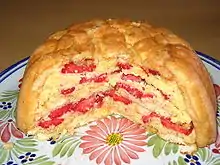
- A dessert consisting of sponge cake filled with fruit, and cream or custard.
- 1995 November 26, Florence Fabricant, “Sweet Charlottes for Dessert”, in The New York Times, →ISSN:
- A charlotte consists of a mold lined with buttered bread, filled with a fruit mixture and baked. […] A savory charlotte, also made with a bread lining, is an excellent way to dress up ratatouille, especially if picked up from a catering shop.
Derived terms
- apple charlotte
- charlotte russe
Translations
References
- “charlotte”, in Lexico, Dictionary.com; Oxford University Press, 2019–2022.
- “charlet(te, n.”, in MED Online, Ann Arbor, Mich.: University of Michigan, 2007, retrieved 19 June 2018; see A[bram] Smythe Palmer (1882) “Charlotte”, in Folk-etymology: A Dictionary of Verbal Corruptions or Words Perverted in Form or Meaning, by False Derivation or Mistaken Analogy, London: George Bell and Sons, […], →OCLC, page 59, column 2.
- Douglas Harper (2001–2024) “charlotte”, in Online Etymology Dictionary.
French
Etymology
From the female forename Charlotte,[1] or from Old French char laitée (“meat with milk”):[2] char (“meat”) + laitée (“milk”).
Pronunciation
- IPA(key): /ʃaʁ.lɔt/
Audio (file)
Descendants
References
- Etymology and history of “charlotte”, in Trésor de la langue française informatisé [Digitized Treasury of the French Language], 2012.
- “charlet(te, n.”, in MED Online, Ann Arbor, Mich.: University of Michigan, 2007, retrieved 19 June 2018; see A[bram] Smythe Palmer (1882) “Charlotte”, in Folk-etymology: A Dictionary of Verbal Corruptions or Words Perverted in Form or Meaning, by False Derivation or Mistaken Analogy, London: George Bell and Sons, […], →OCLC, page 59, column 2.
Further reading
- “charlotte”, in Trésor de la langue française informatisé [Digitized Treasury of the French Language], 2012.
This article is issued from Wiktionary. The text is licensed under Creative Commons - Attribution - Sharealike. Additional terms may apply for the media files.