elkonis
Latvian
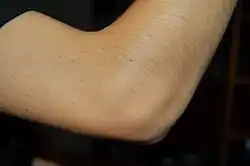
Elkonis
Alternative forms
- (dialectal forms) elkons, elkone, elkūne
Etymology
From Latvian dialectal elks (“bend, angle”) + -onis, from Proto-Baltic *elk-, from Proto-Indo-European *Heh₃l- (“to bend”), with an extra k. Cognates include Lithuanian alkū́nė (“elbow; bend”), dialectal elkū́nė, Old Prussian alkunis ([alkūnis]), Proto-Slavic *olkъtь (Old Church Slavonic лакъть (lakŭtĭ), Russian ло́коть (lókotʹ), Czech loket, Polish lokieć), Old Irish aleina, Old High German elina, German Ellenbogen, Dutch elleboog, English elbow, Ancient Greek ὠλένη (ōlénē), Latin ulna (“elbow, arm”) (< *olinā-), Old Armenian ողն (ołn, “back, spine”), ուլն (uln, “neck”), Hittite alkištan-.[1]
Pronunciation
- IPA(key): [æ̀lkùonis]
| (file) |
Noun
elkonis m (2nd declension)
- (anatomy) elbow (joint connecting the upper and lower arm and the adjacent region)
- atspiesties uz elkoņiem ― to lean on the elbows
- paņemt pie elkoņa ― to take (someone) by the elbow
- piegrūst ar elkoni ― to nudge (someone) with the elbow
- elbow (part of a sleeve located near the arm joint)
- vecs, rūtains krekls trīskārt lāpītiem elkoņiem ― an old, checkered shirt with thrice-patched elbows
Declension
Declension of elkonis (2nd declension)
| singular (vienskaitlis) | plural (daudzskaitlis) | |
|---|---|---|
| nominative (nominatīvs) | elkonis | elkoņi |
| accusative (akuzatīvs) | elkoni | elkoņus |
| genitive (ģenitīvs) | elkoņa | elkoņu |
| dative (datīvs) | elkonim | elkoņiem |
| instrumental (instrumentālis) | elkoni | elkoņiem |
| locative (lokatīvs) | elkonī | elkoņos |
| vocative (vokatīvs) | elkoni | elkoņi |
References
- Karulis, Konstantīns (1992) “elkonis”, in Latviešu Etimoloģijas Vārdnīca (in Latvian), Rīga: AVOTS, →ISBN
This article is issued from Wiktionary. The text is licensed under Creative Commons - Attribution - Sharealike. Additional terms may apply for the media files.