furufnatt
Swedish
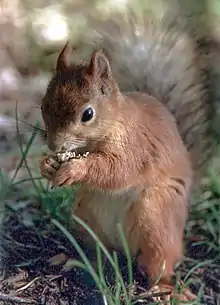
en furufnatt
Etymology
Compound of fura (“pine”) + fnatt (“conniption”). First attested in 1917[1] according to SAOB, but earlier examples are available under quotations.
Noun
furufnatt c
- (dialect) Synonym of ekorre (“squirrel”).
- 1903, August Strindberg, “Gullhjälmarne i Ålleberg”, in Sagor, page 174:
- Då kom en furufnatt och satte svansen i vädret :
— Låt bli mina nötter ! sa ’ ekorrn .- Then came a scug and raised its tail:
— Leave my nuts alone! said the squirrel.
- Then came a scug and raised its tail:
- 1970, anonymous author, “Ilmarinens mandomsrön”, in Björn Collinder, transl., Kalevala, page 143:
- […] skedens tänder knäppte kraftigt som en hackspett i en trädstam, bommen vände sig och vred sig som en furufnatt i skogen.
- […] the reed's teeth snapped strongly like a woodpecker in a tree trunk, the beater turned and twisted like a squirrel in the forest.
- 1975, Margit Friberg, Skog har öron mark har ögon, page 9:
- En liten kvick furufnatt, som samlade och drog till huset, det liknade Mattis mest.
- A small, nimble squirrel, gathering and heading to the house, that resembled Mattis the most.
- 2022 November 5, Mitt i Södermalm, via Svenska Dagstidningsarkivet, page 2:
- […] besök av ett litet furufnatt på sin balkong på sjätte våningen.
- […] visit from a small squirrel on their balcony on the sixth floor.
Declension
| Declension of furufnatt | ||||
|---|---|---|---|---|
| Uncountable | ||||
| Indefinite | Definite | |||
| Nominative | furufnatt | furufnatten | — | — |
| Genitive | furufnatts | furufnattens | — | — |
See also
- (faux Norwegian) tallefjant (“squirrel”)
References
This article is issued from Wiktionary. The text is licensed under Creative Commons - Attribution - Sharealike. Additional terms may apply for the media files.