istaba
See also: istabā
Latvian
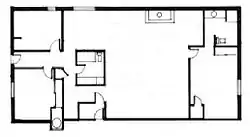
Istabas
Etymology
Borrowed from Old East Slavic истьба (istĭba, “house, bathhouse”) (cf. Proto-Slavic *jьstъba, Old Church Slavonic истьба (istĭba), Russian изба (izba, “peasant house”)), itself a borrowing from either Latin stuba (“room”) (Spanish estufa (“heating stove”), Portuguese estufa (“greenhouse”), French étuve (“drying oven”)) or its borrowed counterpart in Proto-Germanic, *stuba “(heated) room” (compare German Stube (“room”), English stove). The word was borrowed into Latvian before the 13th century, but its first mention is in 17th-century dictionaries (together with parallel forms ustuba, ustaba, apparently formed by assimilation).[1]
Noun
istaba f (4th declension)
- room (separate, enclosed living space in a house, apartment, building, etc.)
- liela, gaiša istaba ― big, bright room
- istabas logi, durvis ― room windows, door
- istabas iekārta ― room furniture
- mēbelēta istaba ― furnished room
- ieiet istabā ― to enter the room
- room (enclosed space in a building for a specific purpose)
- uzgaidāmā istaba ― waiting room
- skolotāju istaba ― teachers' room
- (usually genitive) room; house (said of something meant to be, or be used, indoors)
- istabas puķes ― room flowers
- istabas lampa ― room, indoor lamp
- (archaic) peasant house, hut
- istaba stāvēja uz kalnā starp vecu ozolu un egli ― the peasant house stood on the hill between an old oak and a spruce
Declension
Declension of istaba (4th declension)
| singular (vienskaitlis) | plural (daudzskaitlis) | |
|---|---|---|
| nominative (nominatīvs) | istaba | istabas |
| accusative (akuzatīvs) | istabu | istabas |
| genitive (ģenitīvs) | istabas | istabu |
| dative (datīvs) | istabai | istabām |
| instrumental (instrumentālis) | istabu | istabām |
| locative (lokatīvs) | istabā | istabās |
| vocative (vokatīvs) | istaba | istabas |
Derived terms
References
- Karulis, Konstantīns (1992) “istaba”, in Latviešu Etimoloģijas Vārdnīca (in Latvian), Rīga: AVOTS, →ISBN
This article is issued from Wiktionary. The text is licensed under Creative Commons - Attribution - Sharealike. Additional terms may apply for the media files.