kelet
Hungarian
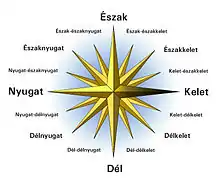
Compass rose
Pronunciation
- IPA(key): [ˈkɛlɛt]
- Hyphenation: ke‧let
- Rhymes: -ɛt
Noun
kelet (usually uncountable, plural keletek)
Usage notes
Names of compass points are not capitalized in Hungarian unless they refer to a given bloc of countries or states[2] or when they are part of a proper name (e.g. Nyugat-Szahara). However, their abbreviations are capitalized and have no dot at the end. (The dotted forms are the abbreviations of the related adjectives suffixed with ‑i.)
Declension
| Inflection (stem in -e-, front unrounded harmony) | ||
|---|---|---|
| singular | plural | |
| nominative | kelet | keletek |
| accusative | keletet | keleteket |
| dative | keletnek | keleteknek |
| instrumental | kelettel | keletekkel |
| causal-final | keletért | keletekért |
| translative | keletté | keletekké |
| terminative | keletig | keletekig |
| essive-formal | keletként | keletekként |
| essive-modal | — | — |
| inessive | keletben | keletekben |
| superessive | keleten | keleteken |
| adessive | keletnél | keleteknél |
| illative | keletbe | keletekbe |
| sublative | keletre | keletekre |
| allative | kelethez | keletekhez |
| elative | keletből | keletekből |
| delative | keletről | keletekről |
| ablative | kelettől | keletektől |
| non-attributive possessive - singular |
keleté | keleteké |
| non-attributive possessive - plural |
keletéi | keletekéi |
| Possessive forms of kelet | ||
|---|---|---|
| possessor | single possession | multiple possessions |
| 1st person sing. | keletem | keleteim, keletjeim |
| 2nd person sing. | keleted | keleteid, keletjeid |
| 3rd person sing. | kelete, keletje | keletei, keletjei |
| 1st person plural | keletünk | keleteink, keletjeink |
| 2nd person plural | keletetek | keleteitek, keletjeitek |
| 3rd person plural | keletük, keletjük | keleteik, keletjeik |
Coordinate terms
(compass points) égtájak;
| északnyugat (ÉNy) | észak (É) | északkelet (ÉK) |
| nyugat (Ny) |  |
kelet (K) |
| délnyugat (DNy) | dél (D) | délkelet (DK) |
Derived terms
Compound words
Proper nouns
Noun
kelet
- (with a possessive suffix) marketability, demand (chiefly with the verbs van and nincs)
- Synonyms: kelendőség, kereslet
- nagy keletje van ― popular, in demand
- nincs keletje ― not popular, not in demand
Declension
| Inflection (stem in -e-, front unrounded harmony) | ||
|---|---|---|
| singular | plural | |
| nominative | kelet | — |
| accusative | keletet | — |
| dative | keletnek | — |
| instrumental | kelettel | — |
| causal-final | keletért | — |
| translative | keletté | — |
| terminative | keletig | — |
| essive-formal | keletként | — |
| essive-modal | — | — |
| inessive | keletben | — |
| superessive | keleten | — |
| adessive | keletnél | — |
| illative | keletbe | — |
| sublative | keletre | — |
| allative | kelethez | — |
| elative | keletből | — |
| delative | keletről | — |
| ablative | kelettől | — |
| non-attributive possessive - singular |
keleté | — |
| non-attributive possessive - plural |
keletéi | — |
| Possessive forms of kelet | ||
|---|---|---|
| possessor | single possession | multiple possessions |
| 1st person sing. | keletem | — |
| 2nd person sing. | keleted | — |
| 3rd person sing. | kelete, keletje | — |
| 1st person plural | keletünk | — |
| 2nd person plural | keletetek | — |
| 3rd person plural | keletük, keletjük | — |
Noun
kelet
- (rare, singular only) date of dispatch (the date indicated in written documents: whether the date of writing, or that of mailing; possibly including the place of dispatch as well)
- Synonyms: keltezés, (both: date) dátum
- A levélen nem volt sem kelet, sem aláírás. ― There was neither date, nor signature on the letter.
Declension
| Inflection (stem in -e-, front unrounded harmony) | ||
|---|---|---|
| singular | plural | |
| nominative | kelet | — |
| accusative | keletet | — |
| dative | keletnek | — |
| instrumental | kelettel | — |
| causal-final | keletért | — |
| translative | keletté | — |
| terminative | keletig | — |
| essive-formal | keletként | — |
| essive-modal | — | — |
| inessive | keletben | — |
| superessive | keleten | — |
| adessive | keletnél | — |
| illative | keletbe | — |
| sublative | keletre | — |
| allative | kelethez | — |
| elative | keletből | — |
| delative | keletről | — |
| ablative | kelettől | — |
| non-attributive possessive - singular |
keleté | — |
| non-attributive possessive - plural |
keletéi | — |
| Possessive forms of kelet | ||
|---|---|---|
| possessor | single possession | multiple possessions |
| 1st person sing. | keltem | — |
| 2nd person sing. | kelted | — |
| 3rd person sing. | kelte, kelete | — |
| 1st person plural | keltünk | — |
| 2nd person plural | keltetek | — |
| 3rd person plural | keltük, keletük | — |
References
- kelet in Zaicz, Gábor (ed.). Etimológiai szótár: Magyar szavak és toldalékok eredete (‘Dictionary of Etymology: The origin of Hungarian words and affixes’). Budapest: Tinta Könyvkiadó, 2006, →ISBN. (See also its 2nd edition.)
- Tóth, Etelka, editor (2017), Magyar helyesírási szótár: A magyar helyesírás szabályai tizenkettedik kiadása szerint [Dictionary of Hungarian orthography: according to the 12th edition of the Rules of Hungarian orthography], Budapest: Akadémiai Kiadó, →ISBN. Online version
Further reading
- (east): kelet in Bárczi, Géza and László Országh. A magyar nyelv értelmező szótára (‘The Explanatory Dictionary of the Hungarian Language’, abbr.: ÉrtSz.). Budapest: Akadémiai Kiadó, 1959–1962. Fifth ed., 1992: →ISBN
- (marketability): kelet in Bárczi, Géza and László Országh. A magyar nyelv értelmező szótára (‘The Explanatory Dictionary of the Hungarian Language’, abbr.: ÉrtSz.). Budapest: Akadémiai Kiadó, 1959–1962. Fifth ed., 1992: →ISBN
- (date): kelet in Bárczi, Géza and László Országh. A magyar nyelv értelmező szótára (‘The Explanatory Dictionary of the Hungarian Language’, abbr.: ÉrtSz.). Budapest: Akadémiai Kiadó, 1959–1962. Fifth ed., 1992: →ISBN
This article is issued from Wiktionary. The text is licensed under Creative Commons - Attribution - Sharealike. Additional terms may apply for the media files.