lauva
Latvian
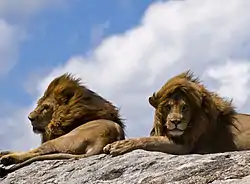
Etymology
Borrowed from Middle High German louwe (cf. German Löwe), from Proto-Germanic *laujan, a borrowing from Latin leō. It has been suggested, on the basis of Lithuanian liū̃tas (“lion”), Russian лю́тый зверь (ljútyj zverʹ, “beast, lion”), that there was an earlier Slavo-Balto-Germanic term with the root *liu-; if so, this term was lost very early on in Latvian, replaced by the Middle High German borrowing. First mentioned (as lavis, lauve) in 17th-century Bible translations. A family name Louvis is attested from the 16th century.[1]
Pronunciation
- IPA(key): [lāwva]
Audio (file)
Noun
lauva m or f (4th declension, irregular gender, dative singular)
- lion in general (Panthera leo)
- lauvu mātīte, lauvene ― female lion, lioness
- dresēt lauvas ― to tame, train lions
- lauvas tiesa ― the lion's share, the biggest part
- specifically, a male lion
Usage notes
The term lauva is ambigenous. It is masculine when it refers to males and feminine when it refers to females. It is, however, always declined as a feminine noun, with the exception of its dative singular form, which is lauvam when it refers to a male and lauvai when it refers to a female.
Declension
Synonyms
- (idiom) zvēru ķēniņš
Derived terms
- Lauva (Zodiac symbol)
- lauvene
- lauvēns
- jūras lauva
- skudrlauva
Descendants
- → Livonian: louv
References
- Karulis, Konstantīns (1992) “lauva”, in Latviešu Etimoloģijas Vārdnīca (in Latvian), Rīga: AVOTS, →ISBN