slāvs
Latvian
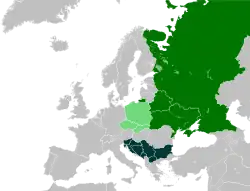
Slāvu valstis
Etymology
A 19th-century borrowing from German Slawen, itself a borrowing from Slavic languages, ultimately either from Old Church Slavonic слово (slovo, “word”) (cf. Russian сло́во (slóvo)), or from an unattested verb *sluti (“to speak (understandably)”) (present tense form *slovǫ; cf. Russian слыть (slytʹ, “to be well known, to be praised”)).[1]
Noun
slāvs m (1st declension, feminine form: slāviete)
- (male) Slav, a man belonging to one of the Slavic peoples
- Jans Huss, citētās frāzes autors, bija slāvs ― Jan Hus, the author of the quoted sentences, was a Slav
- slāvi ir etnolingvistika, indoeiropiešiem piederoša tautu grupa ― the Slavs are an ethnologuistic group of people belonging to the Indo-Europeans
- (genitive plural) Slavic, pertaining to Slavic languages, Slavic peoples or their lands
- slāvu valstis ― Slavic countries
- slāvu valodas ― Slavic languages
- slāvu burti ― Slavic letters, alphabet
- slāvu tautas ― Slavic peoples, nations
- slāvu mitoloģija ― Slavic mythology
Declension
Declension of slāvs (1st declension)
Derived terms
Related terms
References
- Karulis, Konstantīns (1992) “slāvi”, in Latviešu Etimoloģijas Vārdnīca (in Latvian), Rīga: AVOTS, →ISBN
This article is issued from Wiktionary. The text is licensed under Creative Commons - Attribution - Sharealike. Additional terms may apply for the media files.