tupilak
See also: Tupilak
English
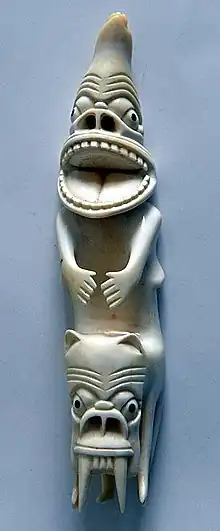
carved representation of a monster
Alternative forms
Etymology
From Greenlandic tupilak or Inuktitut ᑐᐱᓚᒃ (topilak), ᑐᐱᓚᖅ (topilaq).
Noun
tupilak (plural tupilaks or tupilat)
- (Inuit mythology) A monster (either invisible or having a physical form constructed from animal bones, sinew, etc) created in secret by a shaman and sent into the sea to seek and kill a specific enemy.
- A (small) representation of such a monster, often carved from whale bone.
Danish
Etymology
Borrowed from Greenlandic tupilak.
Pronunciation
- IPA(key): [tˢupʰiˈlɑɡ̊], [tˢub̥iˈlɑɡ̊]
Noun
tupilak
- tupilak (statuette)
- tupilak (creature)
Declension
Declension of tupilak
| common gender |
Singular | Plural | ||
|---|---|---|---|---|
| indefinite | definite | indefinite | definite | |
| nominative | tupilak | tupilakken | tupilakker | tupilakkerne |
| genitive | tupilaks | tupilakkens | tupilakkers | tupilakkernes |
Greenlandic
Etymology
From Proto-Inuit *tupǝ-ɣi- (“be surprised at, demon”), from Proto-Eskimo *tupǝ-kǝ- (“be surprised, excited”). Compare tupigaa (“is surprised by him/her or it”), and tupigusuppoq (“is surprised”).
Noun
tupilak (plural tupilaat)
- tupilak (statuette)
- tupilak (creature)
Declension
Declension of tupilak
| singular | plural | |
|---|---|---|
| absolutive | tupilak | tupilaat |
| ergative | tupilaap | tupilaat |
| allative | tupilammut | tupilannut |
| ablative | tupilammit | tupilannit |
| prosecutive | tupilakkut | tupilatsigut |
| locative | tupilammi | tupilanni |
| instrumental | tupilammik | tupilannik |
| equative | tupilattut | tupilattut |
This article is issued from Wiktionary. The text is licensed under Creative Commons - Attribution - Sharealike. Additional terms may apply for the media files.