tusk
English
Pronunciation
- IPA(key): /ˈtʌsk/
Audio (Southern England) (file) - Rhymes: -ʌsk
Etymology 1
From Middle English tusk (also tux, tusch), from Old English tūx, tūsc (“canine tooth, tusk, molar”), from Proto-West Germanic *tų̄sk, *tunsk, from Proto-Germanic *tunþskaz (“canine tooth”), extended form of *tanþs (“tooth”), from Proto-Indo-European *h₃dónts (“tooth”). Cognate with Saterland Frisian Tusk (“tooth”), West Frisian tosk (“tooth”), Icelandic toskur (“a tusk, tooth”) (whence the Old Norse and Icelandic Ratatoskr and Ratatoskur respectively), Gothic 𐍄𐌿𐌽𐌸𐌿𐍃 (tunþus, “tooth”) and *𐍄𐌿𐌽𐌳𐌹 (*tundi, “thorn, tooth”). Doublet of tush. More at tooth.
Noun
tusk (plural tusks)
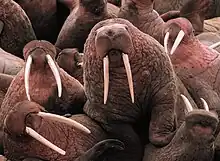
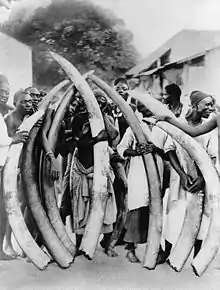
- One of a pair of elongated pointed teeth that extend outside the mouth of an animal such as walrus, elephant or wild boar, and which continue to grow throughout the animal's life.
- Until the CITES sales ban, elephant tusks were the 'backbone' of the legal ivory trade.
- A small projection on a (tusk) tenon.
- A tusk shell.
- (carpentry) A projecting member like a tenon, and serving the same or a similar purpose, but composed of several steps, or offsets, called teeth.[1]
- A sharp point.
- The share of a plough.
Translations
| ||||


|
Verb
tusk (third-person singular simple present tusks, present participle tusking, simple past and past participle tusked)
References
- “tusk”, in Webster’s Revised Unabridged Dictionary, Springfield, Mass.: G. & C. Merriam, 1913, →OCLC.
- Douglas Harper (2001–2024) “tusk”, in Online Etymology Dictionary.
- Webster's Seventh New Collegiate Dictionary, Springfield, Massachusetts, G.&C. Merriam Co., 1967
Etymology 2
(This etymology is missing or incomplete. Please add to it, or discuss it at the Etymology scriptorium.)
Kashubian
Descendants
Ludian
Middle English
Etymology
From Old English tūx, from earlier tūsc, from Proto-Germanic *tunþskaz. Compare tusshe.
Pronunciation
- IPA(key): /tusk/, /tuks/
Noun
tusk (plural tuskes)
- A tusk (protruding long tooth)
- Any long and sharp tooth.
- (rare) The end of a spear.
References
- “tusk, n.(1).”, in MED Online, Ann Arbor, Mich.: University of Michigan, 2007, retrieved 2018-07-22.
Old Frisian
Alternative forms
Etymology
Cognate with Old English tūsc.
Veps
Etymology
Borrowed from Old East Slavic тъска (tŭska) (compare Russian тоска́ (toská, “melancholy”)).
Declension
| Inflection of tusk (inflection type 6/kuva) | |||
|---|---|---|---|
| nominative sing. | tusk | ||
| genitive sing. | tuskan | ||
| partitive sing. | tuskad | ||
| partitive plur. | — | ||
| singular | plural | ||
| nominative | tusk | — | |
| accusative | tuskan | — | |
| genitive | tuskan | — | |
| partitive | tuskad | — | |
| essive-instructive | tuskan | — | |
| translative | tuskaks | — | |
| inessive | tuskas | — | |
| elative | tuskaspäi | — | |
| illative | tuskaha | — | |
| adessive | tuskal | — | |
| ablative | tuskalpäi | — | |
| allative | tuskale | — | |
| abessive | tuskata | — | |
| comitative | tuskanke | — | |
| prolative | tuskadme | — | |
| approximative I | tuskanno | — | |
| approximative II | tuskannoks | — | |
| egressive | tuskannopäi | — | |
| terminative I | tuskahasai | — | |
| terminative II | tuskalesai | — | |
| terminative III | tuskassai | — | |
| additive I | tuskahapäi | — | |
| additive II | tuskalepäi | — | |