vārna
Latvian
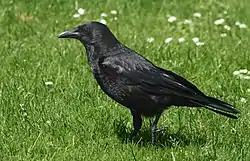
Vārna
Alternative forms
- (archaic form) vārne
Etymology
From an earlier *varna (where the intonation later caused lengthening: ar̄ > āːr), from Proto-Baltic *war- with an extra -nā, from Proto-Indo-European *war-, *wer- (“to burn; to be black”). A parallel masculine counterpart must have existed, from Proto-Baltic *war-no-, *war-nyo-; cf. Lithuanian var̃nas, Old Prussian warnis, Russian во́рон (vóron) (< Proto-Slavic *vronъ). In Latvian, a masculine form vārnis is attested only in folk tales. Cognates include Lithuanian várna, Old Prussian warne, Proto-Slavic *vorna (Old Church Slavonic врана (vrana), Russian, Ukrainian воро́на (voróna), Belarusian варо́на (varóna), Bulgarian вра́на (vrána), Czech vrána, Polish wrona), Tocharian B wrauña.[1]
Pronunciation
- IPA(key): [vāːɾna]
| (file) |
Noun
vārna f (4th declension)
- crow (several species of passerine birds of genus Corvus, esp. Corvus corone and Corvus cornix, with black or grayish black feathers)
- pelēkā, melnā vārna ― gray, black crow
- vārnu ligzda ― crow's nest
- vārnu olas ― crow's eggs
- kailajos zaros sakliegdamies nometās uz naktsguļu vārnu bariņš ― on the naked branches, a small group of cawing crows came down to sleep
Declension
Declension of vārna (4th declension)
References
- Karulis, Konstantīns (1992) “vārna”, in Latviešu Etimoloģijas Vārdnīca (in Latvian), Rīga: AVOTS, →ISBN
This article is issued from Wiktionary. The text is licensed under Creative Commons - Attribution - Sharealike. Additional terms may apply for the media files.