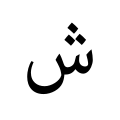
ش
 | ||||||||
| ||||||||
| ||||||||
| ||||||||
| ||||||||
Arabic
Etymology
From Proto-Semitic *šinn- (“tooth”), the source of سن (sinn). The association of "tooth" with this letter was the result of folk etymology and based on the corresponding Phoenician letter, 𐤔 (š), having a shape resembling a tooth. The letter originally depicted a composite bow, which usually has the tips curving away from the archer when unstrung.[1][2]
Related to Classical Syriac ܫ, Hebrew ש, Phoenician 𐤔 (š), Aramaic ܫ. More at Shin.
Letter
ش / ش / ش / ش • (šīn)
Symbol
ش / ش / ش / ش • (šīn)
See also
- (Arabic script letters) ا (ʔalif), ب (bāʔ), ت (tāʔ), ث (ṯāʔ), ج (jīm), ح (ḥāʔ), خ (ḵāʔ), د (dāl), ذ (ḏāl), ر (rāʔ), ز (zāy), س (sīn), ش (šīn), ص (ṣād), ض (ḍād), ط (ṭāʔ), ظ (ẓāʔ), ع (ʕayn), غ (ḡayn), ف (fāʔ), ق (qāf), ك (kāf), ل (lām), م (mīm), ن (nūn), ه (hāʔ), و (wāw), ي (yāʔ)
- Wikipedia article on the Arabic alphabet
- Search for entries beginning with ش
References
- “shin”, in The American Heritage Dictionary of the English Language, 5th edition, Boston, Mass.: Houghton Mifflin Harcourt, 2016, →ISBN.
- Albright, W. F. (1948). "The Early Alphabetic Inscriptions from Sinai and their Decipherment". Bulletin of the American Schools of Oriental Research. 110 (110): 6–22 [p. 15].
Balti
Pronunciation
- IPA(key): /ʃ/, [ʃ]
Letter
ش (transliteration needed)
- The twenty-fifth letter of the Balti alphabet, written in the Perso-Arabic script
Burushaski
Pronunciation
- IPA(key): /ɕ/, [ɕ]
Letter
ش (ś)
- The twenty-fourth letter of the Burushaski alphabet, written in the Perso-Arabic script
Chinese
Pronunciation
- IPA(key): /ʂ/, [ʂ], [ɕ]
Usage notes
- This letter is also used to represent Pinyin initial x-.
Iraqi Arabic
Etymology
Clipping of شنو (šinu). Compare Moroccan Arabic ش (š, “what”), Maltese x’ (“what”)
Pronunciation
- IPA(key): /ʃ/
Kashmiri
Forms
| Isolated form | Final form | Medial form | Initial form |
|---|---|---|---|
| ش | ـش | ـشـ | شـ |
Kazakh
| Alternative scripts | |
|---|---|
| Arabic | ش |
| Cyrillic | Ш, ш |
| Latin | Ş, ş |
| Yañalif | C, c |
Letter
ش • (ş)
Forms
| Isolated form | Final form | Medial form | Initial form |
|---|---|---|---|
| ش | ـش | ـشـ | شـ |
Khowar
Forms
| Isolated form | Final form | Medial form | Initial form |
|---|---|---|---|
| ش | ـش | ـشـ | شـ |
Malay
Pronunciation
- (Name of letter) IPA(key): [ʃin]
- (Phoneme) IPA(key): [ʃ]
Pashto
Pronunciation
- (letter name): IPA(key): /ʃin/
- (phoneme): IPA(key): /ʃ/
Letter
ش • (šin)
- The twenty-second letter of the Pashto alphabet.
Forms
| Isolated form | Final form | Medial form | Initial form |
|---|---|---|---|
| ش | ـش | ـشـ | شـ |
Persian
Etymology
From Middle Persian 𐭱𐭭 (-išn).
Suffix
ـش • (-eš)
Usage notes
Present stems ending in a long vowel add ـیـ (-y-) before this suffix, for example the present stem of the verb پالودن (pâludan) being پالا (pâlâ), the resulting noun is پالایش (pâlâyeš, “refinement”).
See also
Letter
شٍ • (šin)
- The sixteenth letter of the Perso-Arabic alphabet. It is preceded by س and followed by ص. Its name is شین.
Punjabi
Forms
| Isolated form | Final form | Medial form | Initial form |
|---|---|---|---|
| ش | ـش | ـشـ | شـ |
Sindhi
Forms
| Isolated form | Final form | Medial form | Initial form |
|---|---|---|---|
| ش | ـش | ـشـ | شـ |
South Levantine Arabic
Etymology
(This etymology is missing or incomplete. Please add to it, or discuss it at the Etymology scriptorium.)
Pronunciation
- IPA(key): /ʃ/, [ʃ]
Suffix
ـش • (-š)
- don't, didn't (negation of verbs)
- Synonyms: ما (mā), (imperative) لا (la)
- بحكيش إنكليزي ― biḥkīš ʔinglīzi ― he doesn't speak English
Audio (Ramallah) (file) - ما بحكيش إنكليزي ― ma biḥkīš ʔinglīzi ― he doesn't speak English
Audio (Ramallah) (file) - تنساش ― tinsāš ― don't forget
Audio (Ramallah) (file) - ما تنساش ― ma tinsāš ― don't forget
Audio (Ramallah) (file) - ما كتبش ― ma katabš ― he didn't write
Audio (Ramallah) (file)
Usage notes
See also
- مش (miš)
Urdu
Pronunciation
- (letter name): (Standard Urdu) IPA(key): /ʃiːn/
- (phoneme): (Standard Urdu) IPA(key): /ʃ/
Forms
| Isolated form | Final form | Medial form | Initial form |
|---|---|---|---|
| ش | ـش | ـشـ | شـ |
Etymology 2
From Classical Persian ـش (-iš).
Suffix
ـش • (-iś)
Usage notes
Persian nouns ending in a long vowel that add ـیـ (-y-) in Persian before this suffix, usually become ـئـ (-i-) due to modified pronunciation. In certain instances, ـیـ (-i-) remains or is one of the acceptable spellings. For example, Persian آزمایش (âzmâyeš) is normally spelled as Urdu آزمائش (āzmāiś).
Uyghur
Pronunciation
- (letter name): IPA(key): /ʃe/
- (phoneme): IPA(key): /ʃ/
Letter
ش • (she)
- The fourteenth letter of the Uyghur alphabet.
Forms
| Isolated form | Final form | Medial form | Initial form |
|---|---|---|---|
| ش | ـش | ـشـ | شـ |
Yoruba
Letter
ش (ṣ)
Forms
| Isolated form | Final form | Medial form | Initial form |
|---|---|---|---|
| ش | ـش | ـشـ | شـ |