㫃
| ||||||||
Translingual
Alternative forms
- 𭤨 (when used as a component)
Han character
㫃 (Kangxi radical 70, 方+2, 6 strokes, cangjie input 卜尸人 (YSO), composition ⿰方人)
Derived characters
- 𪥏, 𬀁, 𣃘
Related characters
References
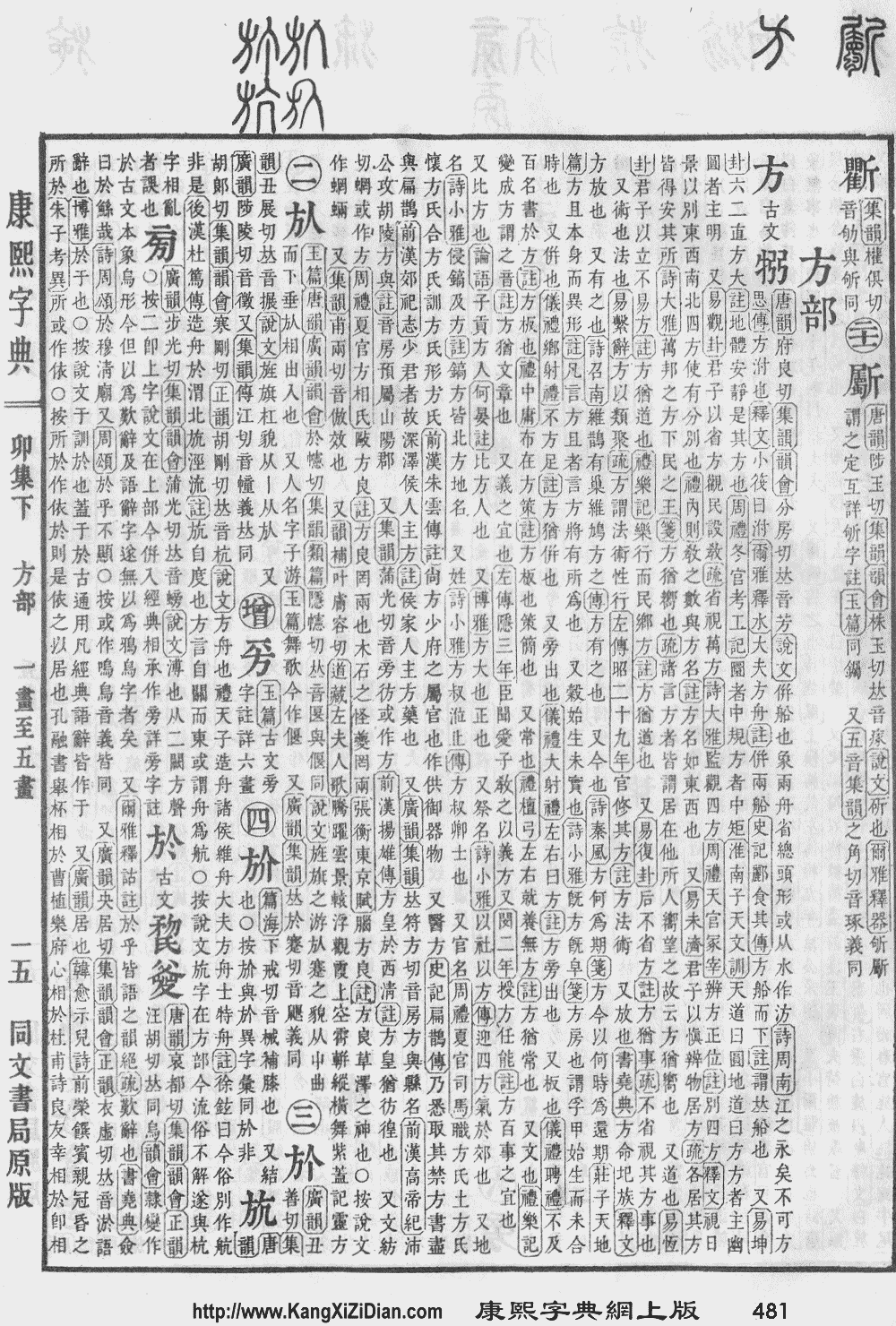
- Kangxi Dictionary: page 481, character 5
- Hanyu Da Zidian (first edition): volume 3, page 2174, character 1
- Unihan data for U+3AC3
Chinese
| simp. and trad. |
㫃 | |
|---|---|---|
Glyph origin
| Historical forms of the character 㫃 | ||||
|---|---|---|---|---|
| Shang | Western Zhou | Shuowen Jiezi (compiled in Han) | ||
| Bronze inscriptions | Oracle bone script | Bronze inscriptions | Ancient script | Small seal script |
 |
 |
 |
 |
 |
Pronunciation
Etymology 2
| For pronunciation and definitions of 㫃 – see 偃 (“used in personal names”). (This character is an ancient form of 偃). |
References
- Dictionary of Chinese Character Variants (教育部異體字字典), C04746
- “㫃”, in 漢語多功能字庫 (Multi-function Chinese Character Database), 香港中文大學 (the Chinese University of Hong Kong), 2014–
This article is issued from Wiktionary. The text is licensed under Creative Commons - Attribution - Sharealike. Additional terms may apply for the media files.