二十日大根
Japanese
| Kanji in this term | ||||
|---|---|---|---|---|
| 二 | 十 | 日 | 大 | 根 |
| はた > はつ | か Grade: 1 |
だい Grade: 1 |
こん Grade: 3 | |
| Grade: 1 | Grade: 1 | |||
| jukujikun | kun’yomi | on’yomi | ||
| Alternative spelling |
|---|
| 廿日大根 |
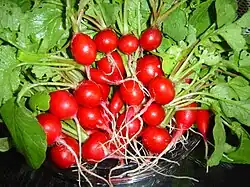
二十日大根: red radishes
Etymology
Cultivars were introduced to Japan during the Meiji period (1868-1912),[1] and the word appears in print by the early 20th century (see quotations below). Superficially of 二十日 (hatsuka, “20 days, 20th day”) + 大根 (daikon, “daikon”), possibly from the fact that the vegetable may be harvested as early as 20 days after planting.
Pronunciation
- IPA(key): [ha̠t͡sɨᵝka̠da̠ikõ̞ɴ]
Noun
二十日大根 or 二十日大根 • (hatsuka daikon or hatsukadaikon)
- radish, Raphanus sativus, (specifically) small red radishes
- 1908, Fukuba Hayato, Kaju sosai kōtō saibai ron [On cultivation of high-quality fruits and vegetables], page 271:
- 二十日大根ハ邦式調理ニテハサマデ需要 […]
- Hatsuka daikon wa kuni-shiki chōri nite wa sama de juyō […]
- Regarding hatsuka daikon, there is great demand for various Japanese-style dishes
- 二十日大根ハ邦式調理ニテハサマデ需要 […]
- 1911, Nōson jichi no kenkyū [Report on an autonomous agricultural village], Yokohama: Yūrindō, page 251:
- 二期生馬鈴薯、晚大根、時無大根、二十日大根(四月ヨリ八月ニ至る)
- niki sei bareisho, ban daikon, tokinashi daikon, hatsuka daikon (shigatsu yori hachigatsu ni itaru)
- second-season potatoes, ban daikon, all-season daikon, and hatsuka daikon (harvested April through August)
- 二期生馬鈴薯、晚大根、時無大根、二十日大根(四月ヨリ八月ニ至る)
See also
- 大根 (daikon, “daikon, mooli”)
 ハツカダイコン on the Japanese Wikipedia.Wikipedia ja
References
- Shōgaku Tosho (1988) 国語大辞典(新装版) [Unabridged Dictionary of Japanese (Revised Edition)] (in Japanese), Tōkyō: Shogakukan, →ISBN
This article is issued from Wiktionary. The text is licensed under Creative Commons - Attribution - Sharealike. Additional terms may apply for the media files.