佃
| ||||||||
Translingual
| Stroke order | |||
Japanese For Chinese: swap strokes 5 and 6. | |||
Han character
佃 (Kangxi radical 9, 人+5, 7 strokes, cangjie input 人田 (OW), four-corner 26200, composition ⿰亻田)
- tenant farmer
- be a tenant farmer
References
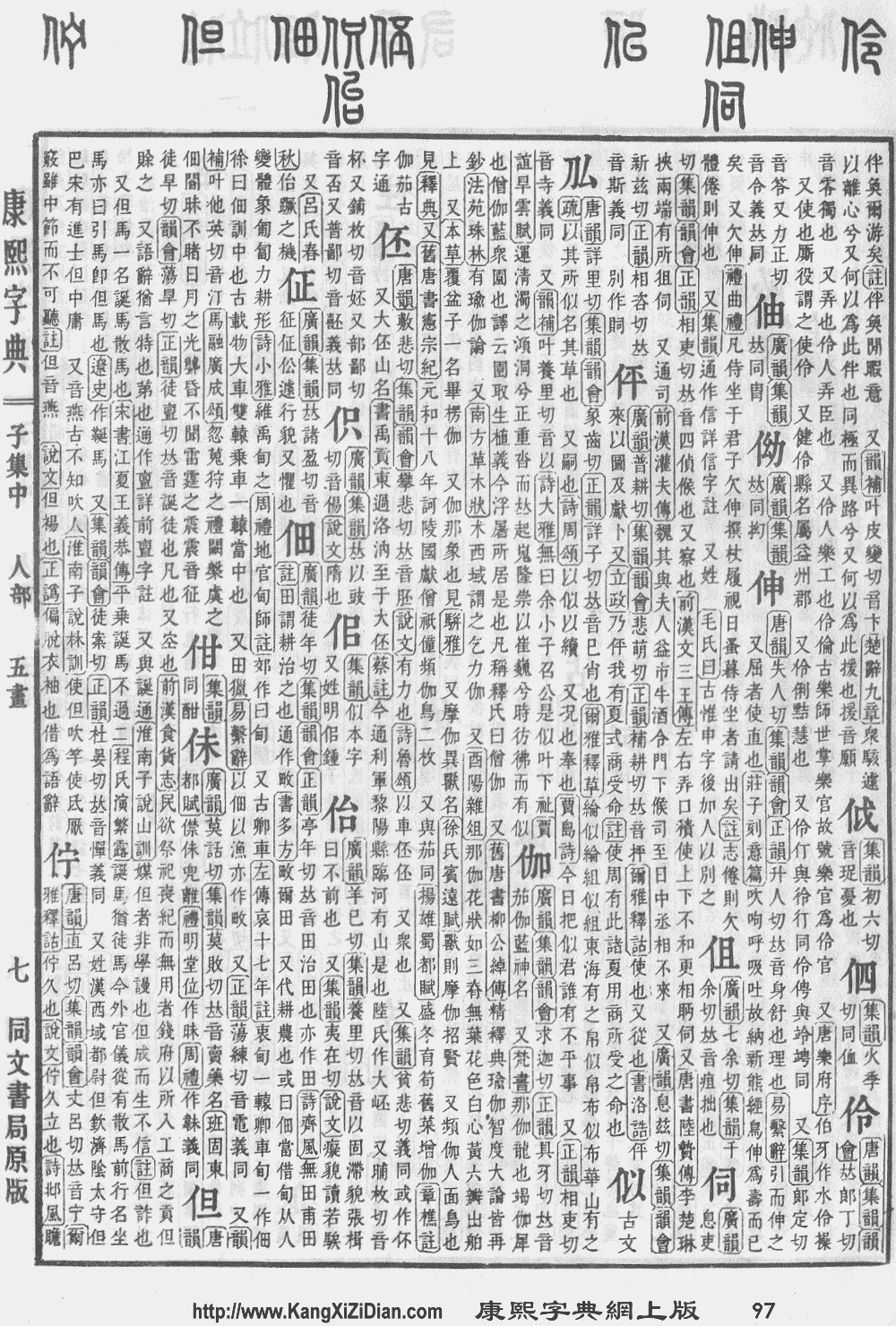
- Kangxi Dictionary: page 97, character 18
- Dai Kanwa Jiten: character 492
- Dae Jaweon: page 206, character 6
- Hanyu Da Zidian (first edition): volume 1, page 133, character 3
- Unihan data for U+4F43
Chinese
| simp. and trad. |
佃 | |
|---|---|---|
Glyph origin
| Historical forms of the character 佃 | ||||||||
|---|---|---|---|---|---|---|---|---|
| ||||||||
|
References: Mostly from Richard Sears' Chinese Etymology site (authorisation),
|


Pronunciation 1
Pronunciation 2
Definitions
佃
Synonyms
- (to rent):
Dialectal synonyms of 租 (“to rent”) [map]
| Variety | Location | Words |
|---|---|---|
| Classical Chinese | 賃 | |
| Formal (Written Standard Chinese) | 租, 租賃 | |
| Mandarin | Taiwan | 租 |
| Harbin | 租 | |
| Yantai (Muping) | 租 | |
| Jinan | 租, 賃 | |
| Luoyang | 租, 賃 | |
| Wanrong | 租 more literary, 賃 | |
| Xi'an | 租, 賃 | |
| Yinchuan | 租, 賃 | |
| Xining | 租 | |
| Ürümqi | 租, 賃 | |
| Wuhan | 租 | |
| Chengdu | 租 | |
| Guiyang | 租, 佃 | |
| Liuzhou | 租 | |
| Xuzhou | 租, 賃 | |
| Yangzhou | 租 | |
| Nanjing | 租 | |
| Singapore | 租 | |
| Cantonese | Guangzhou | 租 |
| Hong Kong | 租 | |
| Gan | Nanchang | 租 |
| Lichuan | 賃 | |
| Hakka | Meixian | 租 |
| Miaoli (N. Sixian) | 稅, 租 | |
| Pingtung (Neipu; S. Sixian) | 稅, 租 | |
| Hsinchu County (Zhudong; Hailu) | 稅, 租 | |
| Taichung (Dongshi; Dabu) | 稅, 租 | |
| Hsinchu County (Qionglin; Raoping) | 稅, 租 | |
| Yunlin (Lunbei; Zhao'an) | 稅 | |
| Huizhou | Jixi | 租 |
| Jin | Taiyuan | 租, 賃 |
| Xinzhou | 租, 賃 | |
| Northern Min | Jian'ou | 租 |
| Eastern Min | Fuzhou | 租 |
| Southern Min | Xiamen | 稅 |
| Zhangzhou | 稅 | |
| Tainan | 稅 | |
| Penang (Hokkien) | 稅 | |
| Singapore (Hokkien) | 稅 | |
| Shantou | 稅 | |
| Shantou (Chenghai) | 稅 | |
| Jieyang | 稅 | |
| Singapore (Teochew) | 稅 | |
| Leizhou | 租 | |
| Haikou | 租 | |
| Southern Pinghua | Nanning (Tingzi) | 租 |
| Wu | Shanghai | 租 |
| Shanghai (Chongming) | 租 | |
| Suzhou | 租 | |
| Danyang | 租 | |
| Hangzhou | 租 | |
| Wenzhou | 稅 | |
| Jinhua | 賃 | |
| Xiang | Changsha | 佃 |
Korean
Hanja
佃 (eum 전 (jeon))
- This term needs a translation to English. Please help out and add a translation, then remove the text
{{rfdef}}.
Vietnamese
This article is issued from Wiktionary. The text is licensed under Creative Commons - Attribution - Sharealike. Additional terms may apply for the media files.