佩

See also: 珮 and 姵
佩 U+4F69, 佩
CJK UNIFIED IDEOGRAPH-4F69
← 佨
[U+4F68]
CJK Unified Ideographs 佪 →
[U+4F6A]

Translingual

Han character

佩 (Kangxi radical 9, 人+6, 8 strokes, cangjie input 人竹弓月 (OHNB), four-corner 27210, composition ⿰亻𫥞)

Derived characters

  • 𤦍, 𩃥

References

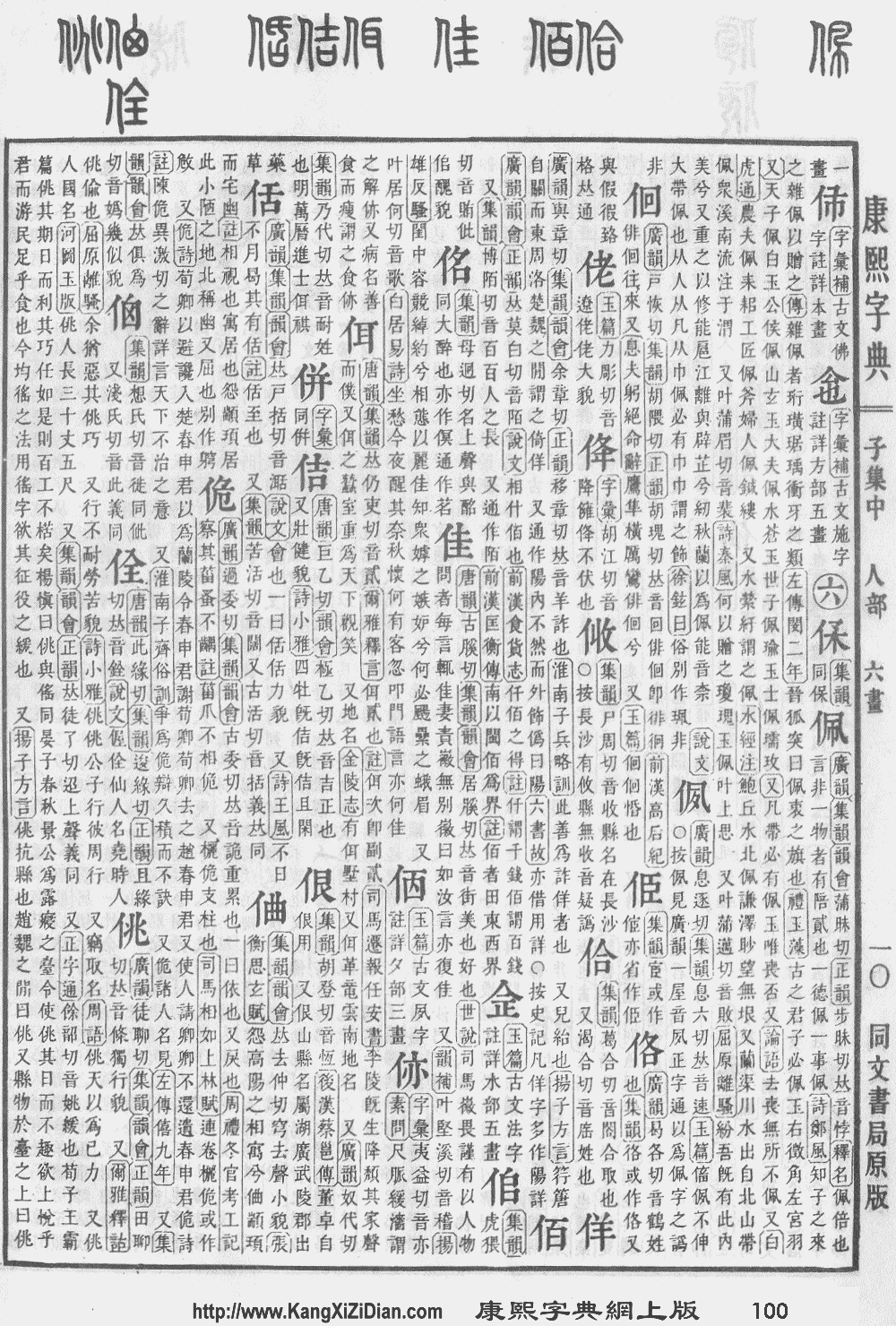
  • Kangxi Dictionary: page 100, character 4
  • Dai Kanwa Jiten: character 543
  • Dae Jaweon: page 211, character 17
  • Hanyu Da Zidian (first edition): volume 1, page 150, character 7
  • Unihan data for U+4F69

Chinese

simp. and trad.
佩
alternative forms 珮

Glyph origin

Historical forms of the character 佩
Western Zhou Shuowen Jiezi (compiled in Han) Liushutong (compiled in Ming)
Bronze inscriptions Small seal script Transcribed ancient scripts


References:

Mostly from Richard Sears' Chinese Etymology site (authorisation),
which in turn draws data from various collections of ancient forms of Chinese characters, including:

  • Shuowen Jiezi (small seal),
  • Jinwen Bian (bronze inscriptions),
  • Liushutong (Liushutong characters) and
  • Yinxu Jiaguwen Bian (oracle bone script).

人 (“person”) + 凡 + 巾 (“piece of cloth”).

Pronunciation


Note: phoa̍h - 披 is used in the Mainland.
  • Wu
    • (Shanghai):
      • Wugniu: 6be
      • MiniDict: be去
      • Wiktionary Romanisation (Shanghai): 3be
      • Sinological IPA (Shanghai): /be²³/

  • Dialectal data
Variety Location 佩
Mandarin Beijing /pʰei⁵¹/
Harbin /pʰei⁵³/
Tianjin /pʰei⁵³/
Jinan /pʰei²¹/
Qingdao /pʰe⁴²/
Zhengzhou /pʰei³¹²/
Xi'an /pʰei⁵³/
Xining /pʰɨ²¹³/
Yinchuan /pʰei¹³/
Lanzhou /pʰei¹³/
Ürümqi /pʰei²¹³/
Wuhan /pʰei³⁵/
Chengdu /pʰei¹³/
Guiyang /pʰei²¹³/
Kunming /pʰei²¹²/
Nanjing /pʰəi⁴⁴/
Hefei /pʰe⁵³/
Jin Taiyuan /pʰei⁴⁵/
Pingyao /pʰæ³⁵/
Hohhot /pʰei⁵⁵/
Wu Shanghai /be²³/
Suzhou /be̞³¹/
Hangzhou /bei¹³/
Wenzhou /bai²²/
Hui Shexian /pʰɛ³²⁴/
Tunxi /pʰə⁴²/
Xiang Changsha /pʰei⁵⁵/
Xiangtan /pʰəi⁵⁵/
Gan Nanchang /pʰi²¹³/
Hakka Meixian /pʰi⁵³/
Taoyuan /pʰɑi¹¹/
Cantonese Guangzhou /pʰui³³/
Nanning /pʰui³³/
Hong Kong /pʰui³³/
Min Xiamen (Hokkien) /pue²²/
/pʰue²²/
Fuzhou (Eastern Min) /puɔi²⁴²/
Jian'ou (Northern Min) /pʰo³³/
Shantou (Teochew) /pue³⁵/
Haikou (Hainanese) /ʔbɔi³⁵/

Rime
Character 佩
Reading # 1/1
Initial (聲) 並 (3)
Final (韻) 灰 (42)
Tone (調) Departing (H)
Openness (開合) Closed
Division (等) I
Fanqie 蒲昧切
Baxter bwojH
Reconstructions
Zhengzhang
Shangfang
/buʌiH/
Pan
Wuyun
/buoiH/
Shao
Rongfen
/buɒiH/
Edwin
Pulleyblank
/bwəjH/
Li
Rong
/buᴀiH/
Wang
Li
/buɒiH/
Bernard
Karlgren
/bʱuɑ̆iH/
Expected
Mandarin
Reflex
bèi
Expected
Cantonese
Reflex
bui6
Baxter–Sagart system 1.1 (2014)
Character 佩
Reading # 1/1
Modern
Beijing
(Pinyin)
pèi
Middle
Chinese
‹ bwojH ›
Old
Chinese
/*[b]ˁək-s/
English to wear at girdle, pendants

Notes for Old Chinese notations in the Baxter–Sagart system:

* Parentheses "()" indicate uncertain presence;
* Square brackets "[]" indicate uncertain identity, e.g. *[t] as coda may in fact be *-t or *-p;
* Angle brackets "<>" indicate infix;
* Hyphen "-" indicates morpheme boundary;

* Period "." indicates syllable boundary.
Zhengzhang system (2003)
Character 佩
Reading # 1/1
No. 9651
Phonetic
component
佩
Rime
group
之
Rime
subdivision
0
Corresponding
MC rime
佩
Old
Chinese
/*bɯːs/

Definitions

佩

  1. belt ornament; pendant
    玉佩  ―  yùpèi  ―  jade pendant
  2. to wear; to hang (from the waist)
    佩帶/佩带  ―  pèidài  ―  to wear or carry (gun, sword, etc. at waist)
    佩戴  ―  pèidài  ―  to wear (adornment on one's clothes)
  3. † to hold; to carry
  4. † to remember in heart
  5. to admire
    佩服  ―  pèifú  ―  to admire
    欽佩/钦佩  ―  qīnpèi  ―  to admire; to respect; to esteem
  6. † to surround; to encircle

Compounds

  • 佩件兒/佩件儿
  • 佩刀
  • 佩劍/佩剑 (pèijiàn)
  • 佩印
  • 佩帶/佩带 (pèidài)
  • 佩弦
  • 佩恩
  • 佩戴 (pèidài)
  • 佩掛/佩挂
  • 佩文詩韻/佩文诗韵
  • 佩文韻府/佩文韵府
  • 佩斯坦
  • 佩服 (pèifú)
  • 佩玉
  • 佩環/佩环
  • 佩紫懷黃/佩紫怀黄
  • 佩脫拉克/佩脱拉克
  • 佩蘭/佩兰
  • 佩蟬/佩蝉
  • 佩西芬
  • 佩觿
  • 佩韋/佩韦
  • 佩韋佩弦/佩韦佩弦
  • 倒冠落佩
  • 可佩
  • 吳佩孚/吴佩孚
  • 大佩
  • 布達佩斯/布达佩斯 (Bùdápèisī)
  • 帶牛佩犢/带牛佩犊
  • 帶金佩紫/带金佩紫
  • 感佩
  • 懷黃佩紫/怀黄佩紫
  • 我黼子佩
  • 戴雞佩豚/戴鸡佩豚
  • 敬佩 (jìngpèi)
  • 欽佩/钦佩 (qīnpèi)
  • 欽佩莫名/钦佩莫名
  • 歐佩克/欧佩克 (Ōupèikè)
  • 漢皋解佩/汉皋解佩
  • 玉佩 (yùpèi)
  • 玉佩瓊琚/玉佩琼琚
  • 環佩/环佩 (huánpèi)
  • 紉佩/纫佩 (rènpèi)
  • 解佩
  • 讚佩/赞佩
  • 銘佩/铭佩
  • 銜華佩實/衔华佩实

Japanese

Kanji

佩

(uncommon “Hyōgai” kanji)

Readings

  • On (unclassified): はい (hai)
  • Kun: おびだま (obidama, 佩); おびる (obiru, 佩びる); はく (haku, 佩く)

Counter

佩(はい) • (-hai) 

  1. swords

Noun

佩(はい) • (hai) 

  1. ancient ornamental belt

Korean

Hanja

佩 (eum 패 (pae))

  1. This term needs a translation to English. Please help out and add a translation, then remove the text {{rfdef}}.

Vietnamese

Han character

佩: Hán Nôm readings: bội

  1. This term needs a translation to English. Please help out and add a translation, then remove the text {{rfdef}}.

References

This article is issued from Wiktionary. The text is licensed under Creative Commons - Attribution - Sharealike. Additional terms may apply for the media files.