僆

僆 U+50C6, 僆
CJK UNIFIED IDEOGRAPH-50C6
← 僅
[U+50C5]
CJK Unified Ideographs 僇 →
[U+50C7]

Translingual

Han character

僆 (Kangxi radical 9, 人+11, 13 strokes, cangjie input 人卜十十 (OYJJ), four-corner 25230, composition ⿰亻連)

References

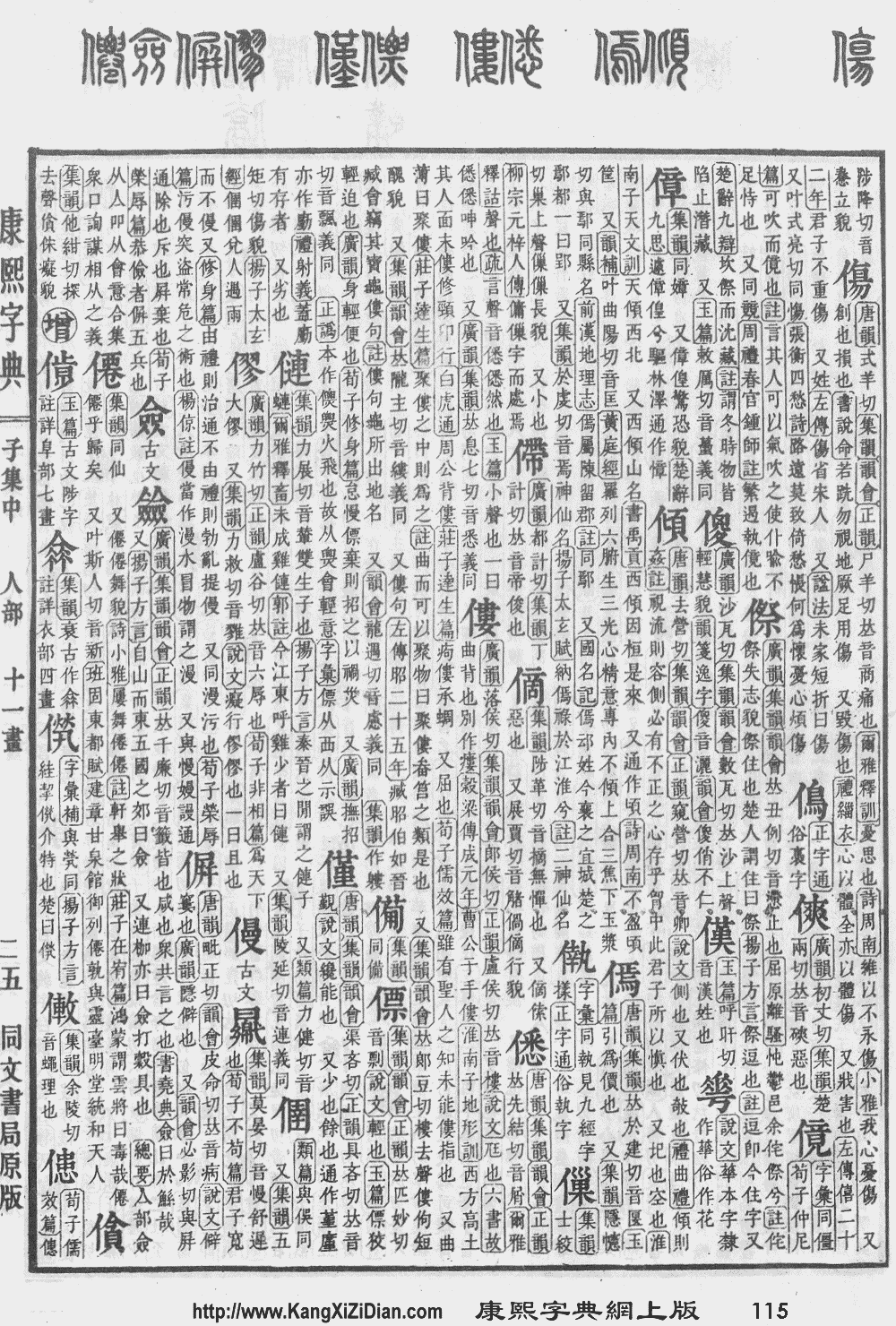
  • Kangxi Dictionary: page 115, character 21
  • Dai Kanwa Jiten: character 1049
  • Dae Jaweon: page 246, character 9
  • Hanyu Da Zidian (first edition): volume 1, page 208, character 8
  • Unihan data for U+50C6

Chinese

trad. 僆
simp. 𫢪

Etymology 1

Unclear. Compare Lepcha ᰜᰤᰬᰵ (lyeŋ, “young”), Iu Mien jaih jaanx (“a hen which has not laid eggs”), Proto-Tai *C̬.qɤːŋᴮ (“young hen”), Proto-Hlai *C-ləŋ (“chicken classifier”) (whence Hlai lang) (Schuessler, 2007).

Pronunciation 1


Rime
Character 僆
Reading # 2/2
Initial (聲) 來 (37)
Final (韻) 先 (85)
Tone (調) Departing (H)
Openness (開合) Open
Division (等) IV
Fanqie 郎甸切
Baxter lenH
Reconstructions
Zhengzhang
Shangfang
/lenH/
Pan
Wuyun
/lenH/
Shao
Rongfen
/lɛnH/
Edwin
Pulleyblank
/lɛnH/
Li
Rong
/lenH/
Wang
Li
/lienH/
Bernard
Karlgren
/lienH/
Expected
Mandarin
Reflex
liàn
Expected
Cantonese
Reflex
lin6
Baxter–Sagart system 1.1 (2014)
Character 僆
Reading # 1/1
Modern
Beijing
(Pinyin)
liàn
Middle
Chinese
‹ ljenH ›
Old
Chinese
/*k.r[a]n-s/ (no pre-Qín exx.)
English chick

Notes for Old Chinese notations in the Baxter–Sagart system:

* Parentheses "()" indicate uncertain presence;
* Square brackets "[]" indicate uncertain identity, e.g. *[t] as coda may in fact be *-t or *-p;
* Angle brackets "<>" indicate infix;
* Hyphen "-" indicates morpheme boundary;

* Period "." indicates syllable boundary.
Zhengzhang system (2003)
Character 僆
Reading # 2/2
No. 8007
Phonetic
component
連
Rime
group
元
Rime
subdivision
2
Corresponding
MC rime
練
Old
Chinese
/*reːns/
Definitions

僆

  1. † (newly hatched) chick

Compounds

Pronunciation 2


Note: leng1 - vernacular.
Definitions

僆

  1. (Cantonese) Alternative form of 𡃁

Etymology 2

(This etymology is missing or incomplete. Please add to it, or discuss it at the Etymology scriptorium. Particularly: “related to 孿?”)

Pronunciation


Rime
Character 僆
Reading # 1/2
Initial (聲) 來 (37)
Final (韻) 仙 (77)
Tone (調) Rising (X)
Openness (開合) Open
Division (等) III
Fanqie 力展切
Baxter ljenX
Reconstructions
Zhengzhang
Shangfang
/liᴇnX/
Pan
Wuyun
/liɛnX/
Shao
Rongfen
/ljænX/
Edwin
Pulleyblank
/lianX/
Li
Rong
/liɛnX/
Wang
Li
/lĭɛnX/
Bernard
Karlgren
/li̯ɛnX/
Expected
Mandarin
Reflex
liǎn
Expected
Cantonese
Reflex
lin5
Zhengzhang system (2003)
Character 僆
Reading # 1/2
No. 7998
Phonetic
component
連
Rime
group
元
Rime
subdivision
2
Corresponding
MC rime
輦
Old
Chinese
/*renʔ/

Definitions

僆

  1. † twin

Compounds

  • 僆子/𫢪子

Pronunciation


Definitions

僆

  1. Only used in 僆𠋵/𫢪𠋵.

References

Japanese

Kanji

僆

(uncommon “Hyōgai” kanji)

  1. This term needs a translation to English. Please help out and add a translation, then remove the text {{rfdef}}.

Readings

  • On (unclassified): れん (ren)
  • Kun: ふたご (futago); およぶ (oyobu); おひつく (ohitsuku)

Korean

Hanja

僆 • (ryeon) (hangeul 련, revised ryeon, McCune–Reischauer ryŏn)

  1. This term needs a translation to English. Please help out and add a translation, then remove the text {{rfdef}}.
This article is issued from Wiktionary. The text is licensed under Creative Commons - Attribution - Sharealike. Additional terms may apply for the media files.