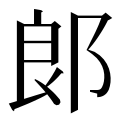
郎
| ||||||||
 | ||||||||
Translingual
Han character
郎 (Kangxi radical 163, 邑+6, 9 strokes, cangjie input 戈戈弓中 (IINL), four-corner 37727, composition ⿰良阝)
References
- Kangxi Dictionary: not present, would follow page 1271, character 12
- Dai Kanwa Jiten: character 39405
- Dae Jaweon: page 1770, character 25
- Hanyu Da Zidian (first edition): volume 6, page 3770, character 8
- Unihan data for U+90CE
- Unihan data for U+F92C

Chinese
| simp. and trad. |
郎 | |
|---|---|---|
| alternative forms | 郞 𨝥 郒 | |
Glyph origin
| Historical forms of the character 郎 | |
|---|---|
| Shuowen Jiezi (compiled in Han) | Liushutong (compiled in Ming) |
| Small seal script | Transcribed ancient scripts |
 |
 |
| Old Chinese | |
|---|---|
| 剆 | *raːl, *raːlʔ |
| 郎 | *raːŋ |
| 稂 | *raːŋ |
| 桹 | *raːŋ |
| 鋃 | *raːŋ |
| 硠 | *raːŋ |
| 浪 | *raːŋ, *raːŋs |
| 蜋 | *raːŋ, *raŋ |
| 琅 | *raːŋ |
| 狼 | *raːŋ |
| 欴 | *raːŋ |
| 踉 | *raːŋ, *raŋ, *raŋs |
| 莨 | *raːŋ, *raːŋs |
| 艆 | *raːŋ |
| 駺 | *raːŋ |
| 躴 | *raːŋ |
| 筤 | *raːŋ |
| 閬 | *raːŋ, *raːŋs |
| 哴 | *raːŋ, *raŋs |
| 蓈 | *raːŋ |
| 廊 | *raːŋ |
| 榔 | *raːŋ, *raːŋʔ |
| 螂 | *raːŋ |
| 瑯 | *raːŋ |
| 朗 | *raːŋʔ |
| 朖 | *raːŋʔ |
| 誏 | *raːŋʔ |
| 俍 | *raːŋʔ |
| 崀 | *raːŋʔ |
| 埌 | *raːŋs |
| 蒗 | *raːŋs |
| 娘 | *naŋ |
| 良 | *raŋ |
| 粮 | *raŋ |
| 悢 | *raŋs |
Phono-semantic compound (形聲/形声, OC *raːŋ) : phonetic 良 (OC *raŋ) + semantic 邑 (“county; town”).
Etymology 1
STEDT compares it to Proto-Sino-Tibetan *b/m-laŋ (“penis; male; husband”), including Burmese လင် (lang, “husband”) as a descendant.
However, Zev Handel considers comparison to this root to be improbable since the meaning of "husband; young man" is not attested in early texts. These senses seem to develop from "an official's title", which was a metonymic extension of "veranda or corridor (of a palace or mansion)" (later written as 廊) (Schuessler, 2007). Schuessler (2007) suggests that the Burmese word is a loan from Chinese.
Pronunciation
Definitions
郎
- (historical) an official's title
- (archaic, laudatory) man; male adult
- (archaic) A term of address used by women for their husband or lover: darling; love
- (archaic) A term of address used by servants for their master: sir; master
- † father [Northern Dynasties]
- young person
- someone else's son
- † soldier [Ming–Qing]
- (dated) man of a particular occupation
- † A term of address for a poor, lowly person. [Yuan–Ming]
- (literary or dialectal Cantonese, dialectal Hakka, Gan, Xiang, Northern Min) son-in-law (daughter's husband)
Synonyms
Compounds
- 一大郎當/一大郎当
- 三影郎中
- 三郎爺爺/三郎爷爷
- 不郎不秀 (bùlángbùxiù)
- 中郎 (zhōngláng)
- 中郎將/中郎将 (zhōnglángjiàng)
- 二郎 (Èrláng)
- 二郎神 (Èrlángshén)
- 二郎腿 (èrlángtuǐ)
- 仙郎
- 令郎 (lìngláng)
- 伴郎 (bànláng)
- 佛郎機/佛郎机 (fólángjī)
- 侍郎 (shìláng)
- 傅粉何郎
- 傅粉郎
- 兔女郎 (tùnǚláng)
- 兒郎/儿郎 (érláng)
- 八郎
- 公郎
- 前度劉郎/前度刘郎 (qiándùliúláng)
- 十郎八當/十郎八当
- 午夜牛郎
- 博郎鼓
- 吊兒郎當/吊儿郎当
- 吉普女郎
- 周郎
- 周郎癖
- 周郎顧曲/周郎顾曲
- 員外郎/员外郎
- 噴火女郎/喷火女郎
- 囊溫郎當/囊温郎当
- 四郎探母
- 外郎
- 夜郎 (Yèláng)
- 夜郎自大 (yèlángzìdà)
- 大郎
- 天壤王郎
- 女貌郎才
- 女郎 (nǚláng)
- 如意郎君 (rúyìlángjūn)
- 妙齡女郎/妙龄女郎
- 孫郎/孙郎 (Sūnláng)
- 宣議郎/宣议郎
- 封面女郎
- 將仕郎/将仕郎
- 小郎
- 少年郎
- 尚書郎/尚书郎 (shàngshūláng)
- 巖郎/岩郎
- 巴郎鼓
- 弟郎
- 彭郎磯/彭郎矶
- 情郎 (qíngláng)
- 慢郎中
- 應召女郎/应召女郎 (yìngzhào nǚláng)
- 打魚郎/打鱼郎
- 拼命三郎 (pīnmìng sānláng)
- 挽歌郎
- 探花郎
- 摩登女郎
- 播郎鼓
- 擲果潘郎/掷果潘郎
- 支郎
- 新郎 (xīnláng)
- 新郎君
- 新郎官 (xīnlángguān)
- 村郎
- 林郎
- 桃太郎 (Táotàiláng)
- 校書郎/校书郎
- 棹郎
- 檀郎
- 檀郎謝女/檀郎谢女
- 歌郎
- 武大郎
- 江湖郎中
- 江郎才盡/江郎才尽 (jiānglángcáijìn)
- 法郎
- 海郎
- 漁郎/渔郎
- 潔郎/洁郎
- 潘郎
- 潘郎車滿/潘郎车满
- 灌口二郎
- 烏衣郎/乌衣郎
- 牙郎 (yáláng)
- 牛郎 (niúláng)
- 牛郎織女/牛郎织女
- 玉貌潘郎
- 玉郎
- 田舍郎
- 白面書郎/白面书郎
- 白髮郎潛/白发郎潜
- 粉郎
- 老郎
- 老郎庵
- 老郎神
- 芒郎
- 花郎
- 著作郎
- 蔡中郎
- 蕭郎/萧郎 (xiāoláng)
- 薄情郎
- 行郎
- 諸葛四郎/诸葛四郎
- 議郎/议郎 (yìláng)
- 貨郎/货郎 (huòláng)
- 貨郎兒/货郎儿
- 貨郎擔兒/货郎担儿 (huòlángdànr)
- 貨郎鼓/货郎鼓
- 賓郎/宾郎 (bīnláng)
- 賢郎/贤郎
- 郎中 (lángzhōng)
- 郎主
- 郎伯
- 郎個/郎个
- 郎君 (lángjūn)
- 郎子
- 郎官
- 郎心如鐵/郎心如铁
- 郎才女姿
- 郎才女貌
- 郎潛白髮/郎潜白发
- 郎當/郎当 (lángdāng)
- 郎窯/郎窑
- 郎署
- 郎舅
- 郎貓/郎猫 (lángmāo)
- 鐵索郎當/铁索郎当
- 鐵衣郎/铁衣郎
- 阻街女郎
- 阿郎
- 阿郎雜碎/阿郎杂碎
- 阿里郎 (Ālǐláng)
- 顧曲周郎/顾曲周郎
- 風塵女郎/风尘女郎
- 馬郎/马郎 (mǎláng)
- 魯齋郎/鲁斋郎
- 黃頭郎/黄头郎
Descendants
Etymology 2
(This etymology is missing or incomplete. Please add to it, or discuss it at the Etymology scriptorium.)
Pronunciation
Definitions
郎
Pronunciation
References
- “郎”, in 漢語多功能字庫 (Multi-function Chinese Character Database), 香港中文大學 (the Chinese University of Hong Kong), 2014–
Japanese
| 郎 | |
| 郞 |
Readings
Suffix
| Kanji in this term |
|---|
| 郎 |
| ろう Grade: S |
| on’yomi |
| Alternative spelling |
|---|
| 郞 (kyūjitai) |
郎 • (-rō)
- suffixes certain male names
- 鷲郎 ― Washirō
- 太郎 ― Tarō (literally, “great (1st) son”)
- 一郎 ― Ichirō (literally, “1st son”)
- 二郎 ― Jirō (literally, “2nd son”)
- 次郎 ― Jirō (literally, “next son”)
- 三郎 ― Saburō (literally, “3rd son”)
- 桃太郎 ― Momotarō
- 小三郎 ― Kosaburō
- 源三郎 ― Genzaburō
- 四郎 ― Shirō (literally, “4th son”)
- 総一郎 ― Sōichirō
- 小四郎 ― Koshirō
- 五郎 ― Gorō (literally, “5th son”)
- 小五郎 ― Kogorō
- 六郎 ― Rokurō (literally, “6th son”)
- 七郎 ― Shichirō (literally, “7th son”)
- 八郎 ― Hachirō (literally, “8th son”)
- 九郎 ― Kurō (literally, “9th son”)
- 十郎 ― Jūrō (literally, “10th son”)