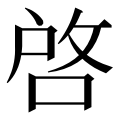
啓
| ||||||||
 | ||||||||
Translingual
| Traditional | 啟 |
|---|---|
| Simplified | 启 |
| Japanese | 啓 |
| Korean | 啓 |
Alternative forms
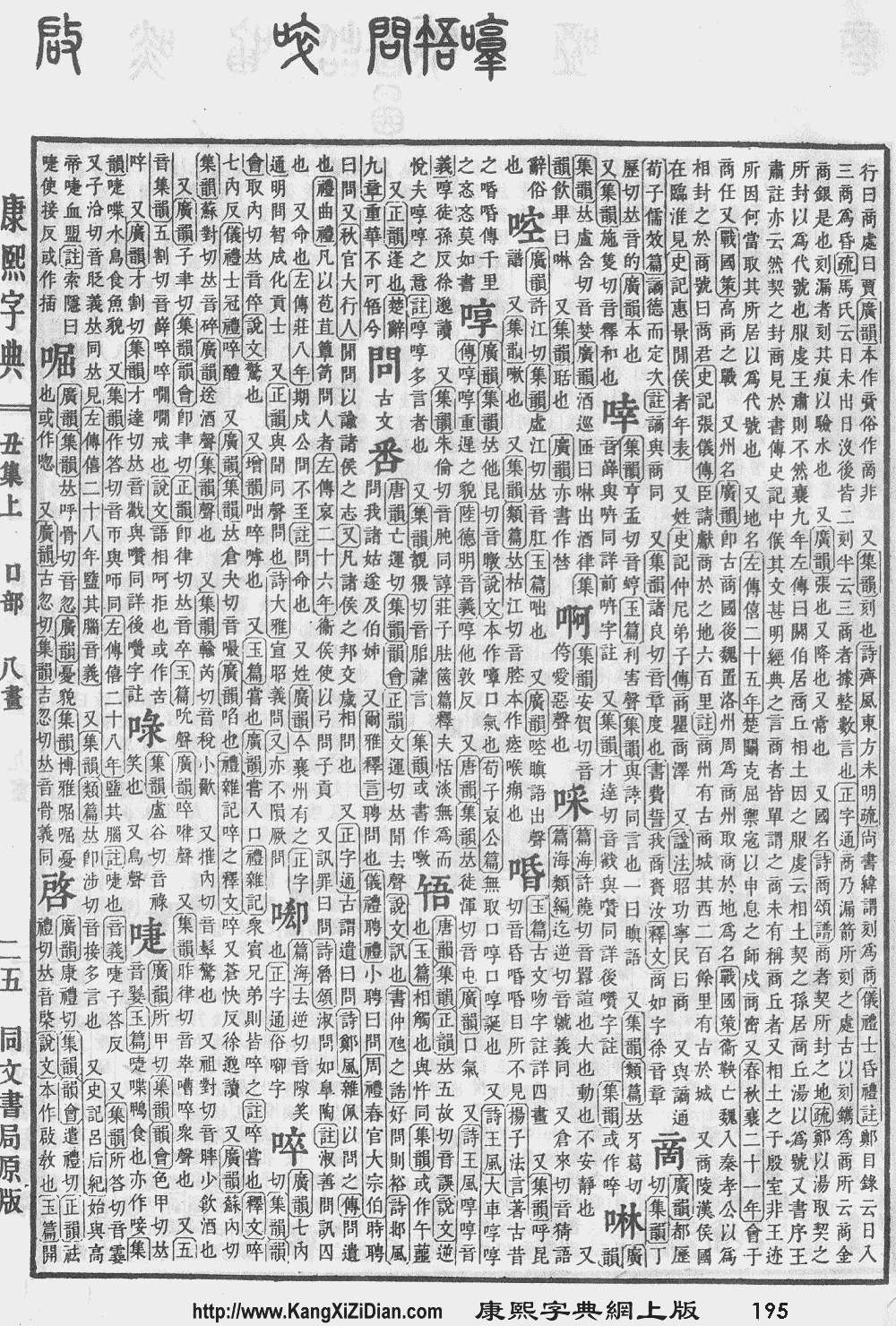
- Note that regional variations exist for the upper left component of this character (戸 in Japan, 戶 in Taiwan and Korea, 户 in China, Hong Kong and Vietnam). In the Kangxi dictionary, the component is written 戸 similar to the Japanese form.
- An alternative form 啟 (U+555F) exists which is the preferred form used in Hong Kong and Taiwan.
Han character
啓 (Kangxi radical 30, 口+8, 11 strokes, cangjie input 竹大口 (HKR) or 戈大口 (IKR) or 難竹大口 (XHKR), composition ⿱⿰戸攵口(J) or ⿱⿰戶攵口(TK) or ⿱⿰户攵口(GHV or U+2F843))
Derived characters
- 𢴖, 㬖, 𭿚, 𦄊
Related characters
- 啟 (Character used in Hong Kong and Taiwan)
- 启 (Simplified Chinese)
References
- Kangxi Dictionary: page 195, character 17
- Dai Kanwa Jiten: character 3820
- Dae Jaweon: page 416, character 16
- Hanyu Da Zidian (first edition): volume 1, page 646, character 12
- Unihan data for U+5553
- Unihan data for U+2F843
Chinese
Glyph origin
Japanese
| Shinjitai | 啓 | |
| Kyūjitai [1][2] |
啓󠄁 啓+ 󠄁?(Adobe-Japan1) |
 |
| 啓󠄃 啓+ 󠄃?(Hanyo-Denshi) (Moji_Joho) | ||
| The displayed kanji may be different from the image due to your environment. See here for details. | ||
Readings
- Go-on: け (ke)
- Kan-on: けい (kei, Jōyō)
- Kun: ひらく (hiraku, 啓く); もうす (mōsu, 啓す)←まをす (mawosu, 啓す, historical); もうす (mōsu, 啓す)←まうす (mausu, 啓す, historical)
- Nanori: あきら (akira); さとし (satoshi); たか (taka); のぶ (nobu); のり (nori); はじめ (hajime); はる (haru); ひ (hi); ひら (hira); ひらき (hiraki); ひらく (hiraku); ひろ (hiro); ひろし (hiroshi); ひろむ (hiromu); よし (yoshi)
References
- “啓”, in 漢字ぺディア (Kanjipedia) (in Japanese), 日本漢字能力検定協会, 2015–2024
- Shōundō Henshūjo, editor (1927), 新漢和辞典 [The New Kanji-Japanese Dictionary] (in Japanese), Ōsaka: Shōundō, , page 302 (paper), page 163 (digital)
Vietnamese
This article is issued from Wiktionary. The text is licensed under Creative Commons - Attribution - Sharealike. Additional terms may apply for the media files.