塡
See also: 填
| ||||||||
Translingual
Han character
塡 (Kangxi radical 32, 土+10, 13 strokes, cangjie input 土心月金 (GPBC), four-corner 42181, composition ⿰土眞)
References
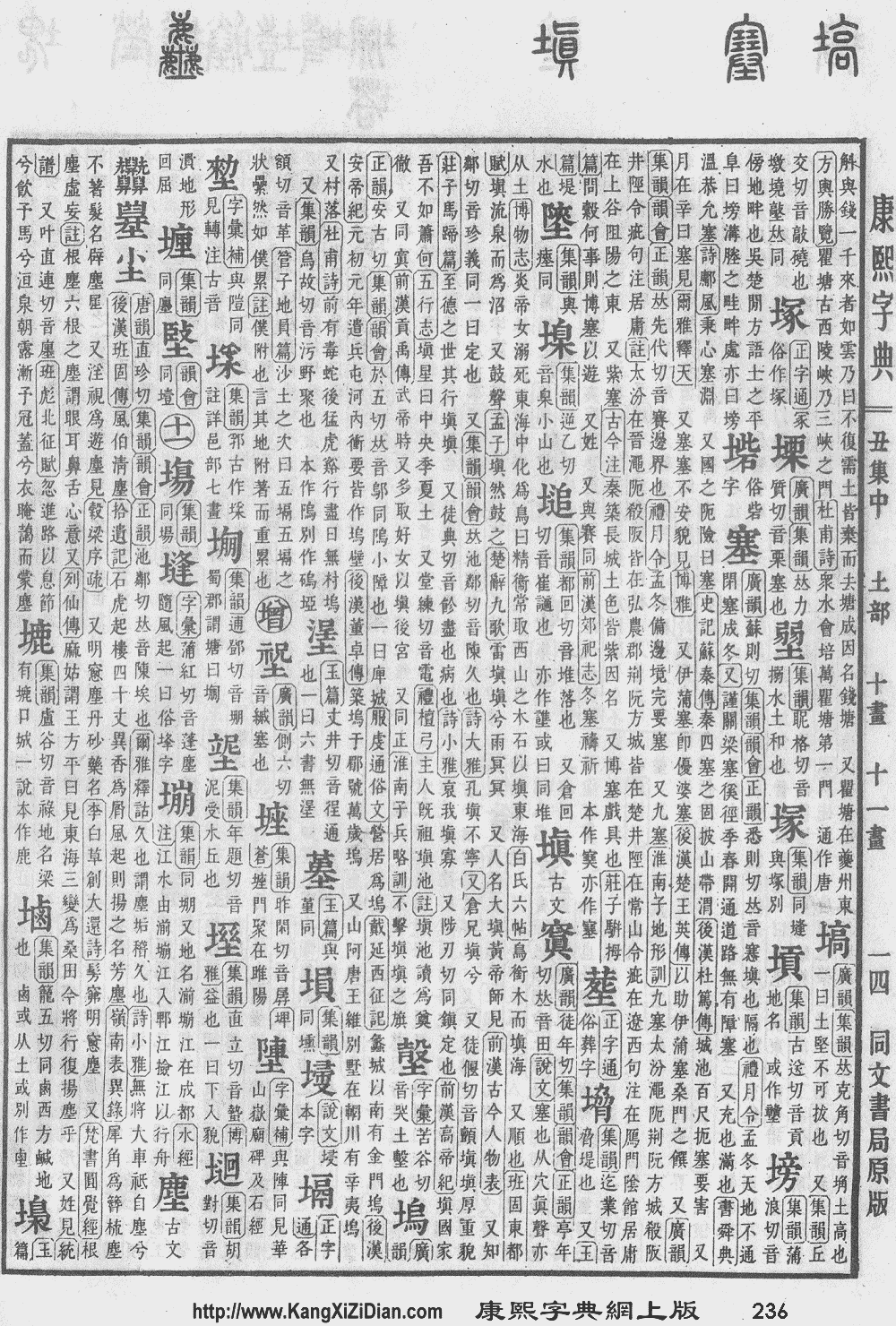
- Kangxi Dictionary: page 236, character 15
- Dai Kanwa Jiten: character 5355
- Dae Jaweon: page 474, character 7
- Hanyu Da Zidian (first edition): not present, would follow volume 1, page 473, character 11
- Unihan data for U+5861
Chinese
Definitions
| For pronunciation and definitions of 塡 – see 填 (“to fill; to fill up; to fill; to fill in; to make up; etc.”). (This character is a variant traditional form of 填). |
Usage notes
This character is the original form of 填 (tián) found in the historical Kangxi dictionary.
Japanese
Compounds
- 装塡 (sōten): to reload
Usage notes
This character was added to the 2010 Jōyō kanji reform instead of 填, despite 填 being part of the JIS X 0208 standard character set at that time.
Korean
Etymology 1
From Middle Chinese 填 (MC den|denH). Recorded as Middle Korean 뎐 (tyen)訓 (Yale: tyen) in Sinjeung Yuhap (新增類合 / 신증유합), 1576.
Pronunciation
- (SK Standard/Seoul) IPA(key): [t͡ɕʌ̹n]
- Phonetic hangul: [전]
Compounds
Etymology 2
Related to Middle Chinese 填 (MC trin|trinH).
Hanja
This article is issued from Wiktionary. The text is licensed under Creative Commons - Attribution - Sharealike. Additional terms may apply for the media files.