帰
| ||||||||
Translingual
| Stroke order (Japan) | |||
|---|---|---|---|
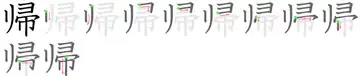 | |||
| Traditional | 歸 |
|---|---|
| Shinjitai | 帰 |
| Simplified | 归 |
Han character
帰 (Kangxi radical 50, 巾+7, 10 strokes, cangjie input 中中尸一月 (LLSMB) or 戈竹尸一月 (IHSMB), four-corner 27027, composition ⿲丿丿帚(G) or ⿲丶丿帚(T) or ⿲丨丿帚(JK))
Related characters
- 歸 (Orthodox traditional form)
References
- Kangxi Dictionary: not present, would follow page 332, character 12
- Dai Kanwa Jiten: character 8930
- Dae Jaweon: page 638, character 11
- Hanyu Da Zidian (first edition): volume 1, page 739, character 16
- Unihan data for U+5E30

Chinese
Glyph origin
Unorthodox variant simplified from 歸 (⿱𠂤止 (duī zhǐ) → ⿰丨丿) originally found in the Yuan dynasty orthographic dictionary 《字鑑》.
Japanese
| 帰 | |
| 歸 |
Readings
Compounds
- 帰京 (kikyō): to return to the capital (Tokyo)
- 帰依 (kie): (Buddhism) refuge
- 帰化 (kika): naturalization
- 帰国 (kikoku): to return to one's country
- 帰宅 (kitaku): to return home
- 帰属 (kizoku): (psychology) attribution
- 帰省 (kisei): homecoming; to return home
- 帰納 (kinō): inductive reasoning
- 帰還 (kikan): repatriation
- 帰阪 (kihan): to return to Osaka
- 帰順 (kijun): submission to a government or ruler
| Kanji in this term |
|---|
| 帰 |
| き Grade: 2 |
| on’yomi |
| Alternative spelling |
|---|
| 歸 (kyūjitai) |
Pronunciation
- IPA(key): [kʲi]
This article is issued from Wiktionary. The text is licensed under Creative Commons - Attribution - Sharealike. Additional terms may apply for the media files.