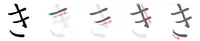
き

See also: さ, ざ, さ゚, ぎ, and き゚

き U+304D, き
HIRAGANA LETTER KI
← が
[U+304C]
Hiragana ぎ →
[U+304E]

Japanese

Stroke order
4 strokes

Pronunciation

  • IPA(key): [kʲi]

Etymology 1

Derived in the Heian period from writing the man'yōgana kanji 幾 in the cursive sōsho style.

Syllable

き • (ki) 

  1. The hiragana syllable き (ki). Its equivalent in katakana is キ (ki). It is the seventh syllable in the gojūon order; its position is か行い段 (ka-gyō i-dan, “row ka, section i”).
Derived terms
See also

Etymology 2

For pronunciation and definitions of き – see the following entry.
【木】1
[noun] a tree or shrub
[noun] wood, timber, lumber
[noun] (graph theory, computer science) a tree (data structure)
[noun] (theater, sumo, etc.) a clapper used to signal the opening or closing of a match or play
Alternative spelling
樹
(This term, き, is the hiragana spelling of the above term.)
For a list of all kanji read as き, see Category:Japanese kanji read as き.)

Etymology 3

For pronunciation and definitions of き – see the following entries.
【気】1
[noun] spirit, mood
[noun] inclination, will, mood, urge
[noun] feeling, sense
[noun] air, gas
[noun] air, nature, disposition, sense
[noun] This term needs a translation to English.
【汽】2
[affix] steam; vapor
【帰】2
[affix] to return; to come back to
[affix] to follow; to submit
【記】2
[affix] to record; to mark
[affix] to remember; to keep in mind
[noun] a chronicle
[suffix] chronicle, history, account, record
[proper noun] Short for 古事記 (Kojiki): the oldest extant record of the history of ancient Japan
[proper noun] a surname
【起】3
[affix] to rise; to get up; to stand up
[affix] to start; to begin; to cause; to bring about
[affix] origin; cause; beginning
【期】3
[affix] time; period
[affix] to expect; to look forward to
[suffix] period (of time)
[suffix] (television show) season
[suffix] geological age
【希】4
[affix] to hope
[affix] rare; scarce
[affix] sparse; dilute
Alternative spellings
稀, け
【季】4
[affix] season
[affix] end of a period
[affix] youngest
【紀】5
[affix] rule; regulation
[affix] age; era; period
[affix] to record; to write down
[proper noun] a surname
【喜】5
[affix] joy; delight; pleasure
【旗】4
[affix] flag; banner
[noun] banner (type of administrative division in Inner Mongolia, China)
【器】4
[affix] device; instrument
[affix] container; vessel
[suffix] device; instrument
【機】4
[noun] a machine, a device; a contraption
[noun] (weaving) a loom
[noun] an opportunity, a chance to do something; the right time or moment
[noun] something of great importance: the linchpin of the matter
[noun] resourcefulness
[noun] (Buddhism) the moment of being moved into action by the teachings of the Buddha: see 機根 (kikon)
[noun] by extension, the workings of the heart or mind in general
[noun] in Noh theater, the breath of the mind
[noun] short for 飛行機 (hikōki): an airplane, an aircraft
[noun] short for 機関銃 (kikanjū): a machine gun
[counter] indicates aircraft
[counter] indicates paper aeroplanes
[counter] indicates lives in video games
[suffix] indicates machines
[suffix] indicates airplanes
【基】5
[affix] foundation; base; basis
[affix] (chemistry) a group; a radical
[counter] counter for grounded things (e.g. pyramids, electric power plants, wells, toro (Japanese traditional lantern), tombs)
[counter] counter for wooden grave tablets (卒塔婆 (sotoba))
【己】6
[proper noun] the sixth of the ten heavenly stems
【貴】6
[prefix] (archaic) added to nouns related to people to indicate superiority
[prefix] (archaic) added to nouns to indicate respect and possession: your
[suffix] added after nouns related to people to express love and respect
【忌】S
[noun] mourning
[noun] anniversary of someone's death
【奇】S
[adjective] strange
[noun] strangeness
【祈】S
[affix] to pray
[affix] to wish
【姫】S
[suffix] lady
【飢】S
[affix] hungry; starve
【鬼】S
[proper noun] (astronomy) the Ghost constellation, one of the Twenty-Eight Mansions
【亀】S
[affix] tortoise, turtle
[affix] tortoise shell used in divination
【騎】S
[affix] riding on horseback
[affix] a horseperson
[counter] [early 1200s] horseperson
[noun] riding on horseback
[noun] [1877] (rare) a horseperson
【癸】H
[proper noun] the tenth of the ten heavenly stems;
[proper noun] the tenth rank; something J
【冀】H
[affix] hope for, look forward to, wish
[proper noun] (historical) Short for 冀州 (Kishū): Ji Province
[proper noun] Synonym of 河北 (Kahoku): Hebei Province
(This term, き, is the hiragana spelling of the above terms.)
For a list of all kanji read as き, see Category:Japanese kanji read as き.)

(The following entries are uncreated: 寄, 規, 危, 机, 揮, 企, 肌, 岐, 軌, 既, 幾, 棋, 棄, 毀, 畿, 輝, 稀, 綺, 嬉, 毅, 窺, 徽, 几, 悸, 愧, 詭, 跪, 麾, 騏, 饑, 羈, 驥.)

Etymology 4

Suffix

き • (-ki) 

  1. (Classical Japanese) Indicates past tense: -ed
    Used when the speaker has directly experienced the event described, as opposed to けり.
Usage notes

Follows the 連用形 (ren'yōkei, “continuative or stem form”) of inflectable words, except:

終止形 (“terminal”)連体形 (“attributive”)已然形 (“realis”)
来(く) (ku) + き (unattested)こし (koshi)こしか (koshika)
す (su) + き しき (shiki)せし (seshi)せしか (seshika)

This word is morphologically an inflectional suffix. It is classified as 助動詞 (jodōshi, “auxiliary verb”) in traditional Japanese grammar.

Conjugation
Derived terms
  • けむ (kemu) (possibly a derivative)

See also

This article is issued from Wiktionary. The text is licensed under Creative Commons - Attribution - Sharealike. Additional terms may apply for the media files.