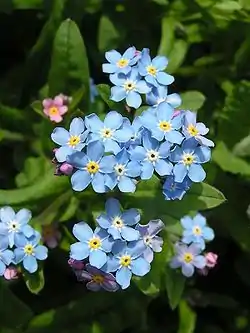
忘れな草
Japanese
| Kanji in this term | |
|---|---|
| 忘 | 草 |
| わす Grade: 6 |
くさ > ぐさ Grade: 1 |
| kun’yomi | |
| Alternative spelling |
|---|
| 勿忘草 |
Alternative forms
Etymology
Calque of English forget-me-not, from 忘れな (wasurena, archaic negative form of verb 忘れる (wasureru, “to forget”)) + 草 (kusa, “grass”).[1][2][3] The kusa changes to gusa as an instance of rendaku (連濁).
First attested in 1913.[2] The wasurunagusa form is first attested in 1961.[2]
Pronunciation
Usage notes
- As with many terms that name organisms, this term is often spelled in katakana, especially in biological contexts (where katakana is customary), as ワスレナグサ.
References
- Shinmura, Izuru, editor (1998), 広辞苑 [Kōjien] (in Japanese), Fifth edition, Tōkyō: Iwanami Shoten, →ISBN
- “勿忘草”, in 日本国語大辞典 (Nihon Kokugo Daijiten, “Nihon Kokugo Daijiten”) (in Japanese), concise edition, Tōkyō: Shogakukan, 2000
- Matsumura, Akira, editor (2006), 大辞林 [Daijirin] (in Japanese), Third edition, Tōkyō: Sanseidō, →ISBN
- NHK Broadcasting Culture Research Institute, editor (1998), NHK日本語発音アクセント辞典 [NHK Japanese Pronunciation Accent Dictionary] (in Japanese), Tōkyō: NHK Publishing, →ISBN
- Kindaichi, Kyōsuke et al., editors (1997), 新明解国語辞典 [Shin Meikai Kokugo Jiten] (in Japanese), Fifth edition, Tōkyō: Sanseidō, →ISBN
This article is issued from Wiktionary. The text is licensed under Creative Commons - Attribution - Sharealike. Additional terms may apply for the media files.