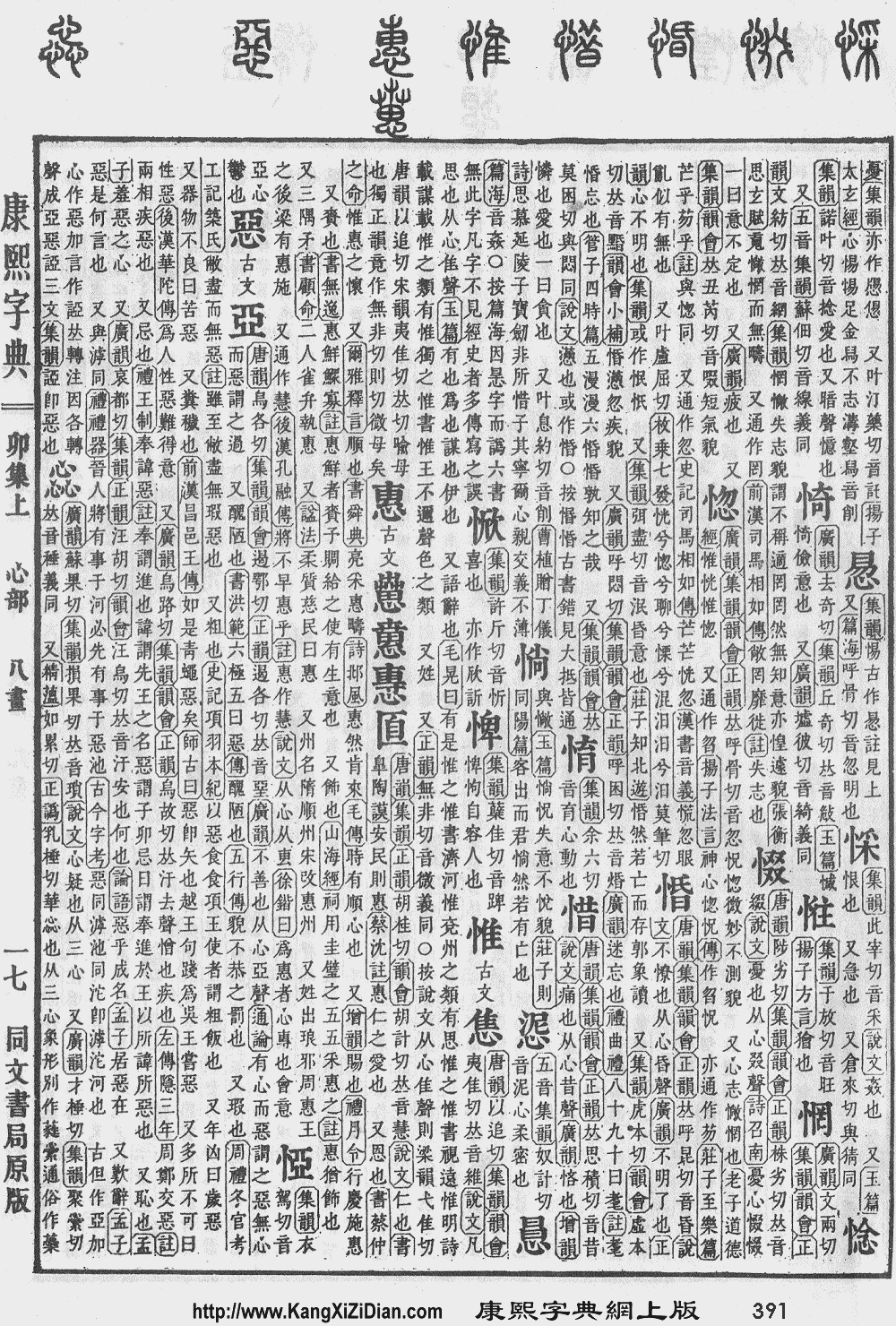
惝

惝 U+60DD, 惝
CJK UNIFIED IDEOGRAPH-60DD
← 惜
[U+60DC]
CJK Unified Ideographs 惞 →
[U+60DE]

Translingual

Han character

惝 (Kangxi radical 61, 心+8, 11 strokes, cangjie input 心火月口 (PFBR), four-corner 99027, composition ⿰忄尚)

References

  • Kangxi Dictionary: page 391, character 12
  • Dai Kanwa Jiten: character 10815
  • Dae Jaweon: page 725, character 24
  • Hanyu Da Zidian (first edition): volume 4, page 2315, character 2
  • Unihan data for U+60DD

Chinese

simp. and trad.
惝
alternative forms 㒉
戃/𰑿
𢠵

Pronunciation


Baxter–Sagart system 1.1 (2014)
Character 惝
Reading # 1/1
Modern
Beijing
(Pinyin)
chǎng
Middle
Chinese
‹ tsyhangX ›
Old
Chinese
/*tʰaŋʔ/
English despondent; scared

Notes for Old Chinese notations in the Baxter–Sagart system:

* Parentheses "()" indicate uncertain presence;
* Square brackets "[]" indicate uncertain identity, e.g. *[t] as coda may in fact be *-t or *-p;
* Angle brackets "<>" indicate infix;
* Hyphen "-" indicates morpheme boundary;

* Period "." indicates syllable boundary.

Definitions

惝

  1. disappointed; dejected
  2. fearful; terrified

Compounds

Japanese

Kanji

惝

(uncommon “Hyōgai” kanji)

  1. This term needs a translation to English. Please help out and add a translation, then remove the text {{rfdef}}.

Readings

  • On (unclassified): しょう (shō); とう (tō)
  • Kun: うつとりする (utsutorisuru)

Korean

Hanja

惝 (eum 창 (chang))

  1. This term needs a translation to English. Please help out and add a translation, then remove the text {{rfdef}}.

Vietnamese

Han character

惝: Hán Nôm readings: sượng

  1. This term needs a translation to English. Please help out and add a translation, then remove the text {{rfdef}}.
This article is issued from Wiktionary. The text is licensed under Creative Commons - Attribution - Sharealike. Additional terms may apply for the media files.