尚
| ||||||||
Translingual
| Traditional | 尚 |
|---|---|
| Simplified | 尚 |
| Japanese | 尚 |
| Korean | 尙 |
Alternative forms
- 𫩠 (when used at the top of a character)
Han character
| Stroke order | |||
|---|---|---|---|
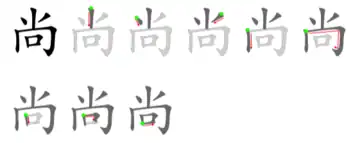 | |||
尚 (Kangxi radical 42, 小+5, 8 strokes, cangjie input 火月口 (FBR), four-corner 90227, composition ⿱⺌冋)
References
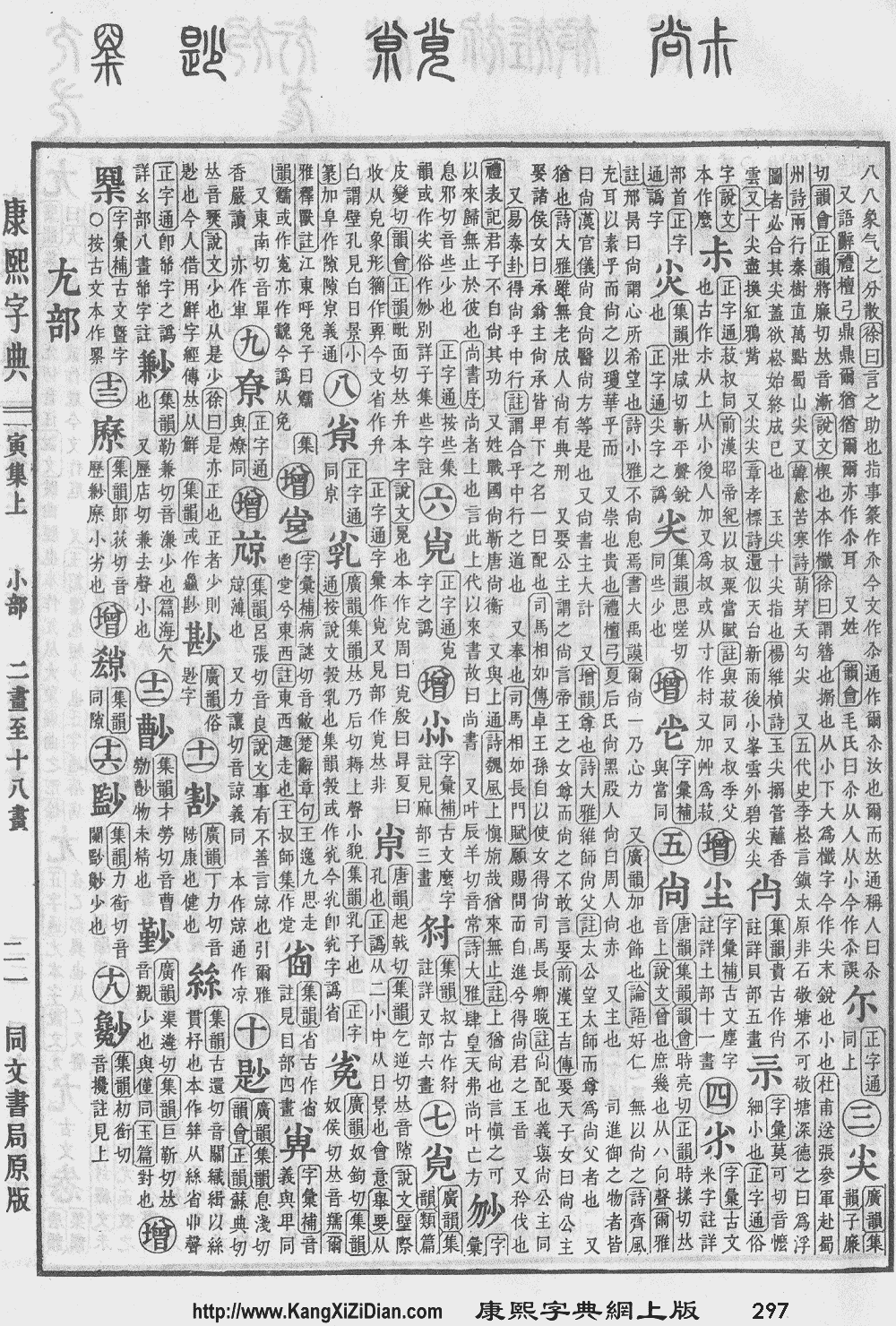
- Kangxi Dictionary: not present, would follow page 297, character 12
- Dai Kanwa Jiten: character 7493
- Hanyu Da Zidian (first edition): volume 1, page 563, character 5
- Unihan data for U+5C1A
Chinese
| trad. | 尚/尙 | |
|---|---|---|
| simp. | 尚 | |
Glyph origin
| Historical forms of the character 尚 | |||
|---|---|---|---|
| Western Zhou | Warring States | Shuowen Jiezi (compiled in Han) | Liushutong (compiled in Ming) |
| Bronze inscriptions | Chu slip and silk script | Small seal script | Transcribed ancient scripts |
 |
 |
 |
 |
Characters in the same phonetic series (尚) (Zhengzhang, 2003)
| Old Chinese | |
|---|---|
| 當 | *taːŋ, *taːŋs |
| 襠 | *taːŋ |
| 鐺 | *taːŋ, *sʰraːŋ |
| 簹 | *taːŋ |
| 璫 | *taːŋ |
| 檔 | *taːŋ, *taːŋs |
| 儅 | *taːŋ, *taːŋs |
| 蟷 | *taːŋ |
| 擋 | *taːŋʔ, *taːŋs |
| 黨 | *taːŋʔ, *tʰaːŋʔ |
| 讜 | *taːŋʔ |
| 欓 | *taːŋʔ |
| 譡 | *taːŋs |
| 闣 | *taːŋs |
| 瓽 | *taːŋs |
| 鏜 | *tʰaːŋ |
| 闛 | *tʰaːŋ, *daːŋ |
| 鼞 | *tʰaːŋ |
| 曭 | *tʰaːŋʔ |
| 儻 | *tʰaːŋʔ, *tʰaːŋs |
| 戃 | *tʰaːŋʔ |
| 矘 | *tʰaːŋʔ |
| 爣 | *tʰaːŋʔ |
| 攩 | *hl'aːŋʔ, *ɦʷlaːŋʔ, *ɦʷlaːŋs |
| 淌 | *tʰaːŋʔ |
| 倘 | *tʰaːŋʔ |
| 躺 | *tʰaːŋʔ |
| 趟 | *tʰaːŋs, *rtaːŋ, *rtaːŋs |
| 堂 | *daːŋ |
| 坣 | *daːŋ |
| 棠 | *daːŋ |
| 糛 | *daːŋ |
| 螳 | *daːŋ |
| 隚 | *daːŋ |
| 橖 | *daːŋ |
| 掌 | *tjaŋʔ |
| 廠 | *tʰjaŋʔ, *tʰjaŋs |
| 敞 | *tʰjaŋʔ |
| 僘 | *tʰjaŋʔ |
| 氅 | *tʰjaŋʔ |
| 常 | *djaŋ |
| 嘗 | *djaŋ |
| 裳 | *djaŋ |
| 徜 | *djaŋ |
| 尚 | *djaŋ, *djaŋs |
| 甞 | *djaŋ |
| 鋿 | *djaŋ |
| 嫦 | *djaŋ |
| 償 | *djaŋ, *djaŋs |
| 賞 | *hjaŋʔ |
| 瞠 | *rtʰaːŋ |
| 撐 | *rtʰaːŋ |
| 樘 | *rtʰaːŋ |
| 橕 | *rtʰaːŋ |
| 牚 | *rtʰaːŋs |
| 埫 | *tʰoŋʔ |
Phono-semantic compound (形聲/形声, OC *djaŋ, *djaŋs) : semantic 八 + phonetic 向 (OC *hljaŋs, *hlaŋs).
Etymology
From Proto-Sino-Tibetan *zrjaŋ ~ rjaŋ (“uncle, superior”) (STEDT; cf. Proto-Sino-Tibetan *s-tjaŋ (“, upper part, rise, raise, top, summit”)). Cognate with 丈 (OC *daŋʔ) "gentleman, older man, husband", Tibetan ཨ་ཞང (a zhang, “maternal uncle”), Burmese အရှင် (a.hrang, “master, lord”), etc.
Pronunciation 1
Definitions
尚
- still; yet
- (literary, or in compounds) even
- to value; to esteem; to worship
- 尚武 ― shàngwǔ ― (please add an English translation of this usage example)
- (obsolete) to assist; to administer (for the emperor)
- prevailing custom
- (literary, or in compounds) noble; virtuous
- (obsolete) Alternative form of 上 (“to exceed”)
- 今天下地醜德齊,莫能相尚。 [Classical Chinese, trad.]
- From: Mencius, c. 4th century BCE
- Jīn tiānxià dìchǒudéqí, mò néng xiàng shàng. [Pinyin]
- Now throughout the kingdom, the territories of the princes are of equal extent, and in their achievements they are on a level. Not one of them is able to exceed the others.
今天下地丑德齐,莫能相尚。 [Classical Chinese, simp.]
- a surname: Shang
- 尚可喜 ― Shàng Kěxǐ ― Shang Kexi (Chinese general of the Ming and Qing Dynasties)
Synonyms
- (still):
Dialectal synonyms of 還 (“still; yet”) [map]
- (even):
- (to value):
- (noble):
Descendants
- → Tangut: → 𗊻 (*śjo²) (transliteration)
Compounds
- 一息尚存 (yīxīshàngcún)
- 不尚
- 今文尚書/今文尚书
- 伏維尚饗/伏维尚飨
- 俗尚 (súshàng)
- 元尚篇
- 兵部尚書/兵部尚书
- 刑部尚書/刑部尚书
- 口尚乳臭
- 古文尚書/古文尚书
- 和尚 (héshàng)
- 和尚打傘/和尚打伞
- 嘉尚
- 坦尚尼亞/坦尚尼亚 (Tǎnshàngníyà)
- 堂頭和尚/堂头和尚
- 大和尚
- 好尚
- 尊年尚齒/尊年尚齿
- 尚且 (shàngqiě)
- 尚佳
- 尚友
- 尚可 (shàngkě)
- 尚古自
- 尚市 (Shàngshì)
- 尚志 (shàngzhì)
- 尚方
- 尚方寶劍/尚方宝剑 (shàngfāng bǎojiàn)
- 尚書/尚书 (shàngshū)
- 尚書令/尚书令 (shàngshūlìng)
- 尚書大傳/尚书大传
- 尚書省/尚书省
- 尚書郎/尚书郎 (shàngshūláng)
- 尚有可為/尚有可为
- 尚未 (shàngwèi)
- 尚武 (shàngwǔ)
- 尚比亞/尚比亚 (Shàngbǐyà)
- 尚然
- 尚猶/尚犹
- 尚衣
- 尚饗/尚飨 (shàngxiǎng)
- 尚齒/尚齿
- 山和尚 (shānhéshàng)
- 崇尚 (chóngshàng)
- 崇節尚儉/崇节尚俭
- 巴達赫尚/巴达赫尚 (Bādáhèshàng)
- 布袋和尚
- 弄性尚氣/弄性尚气
- 循尚
- 志尚
- 戶部尚書/户部尚书
- 時尚/时尚 (shíshàng)
- 法海和尚
- 由竇尚書/由窦尚书
- 當家和尚/当家和尚
- 疏財尚氣/疏财尚气
- 禮尚往來/礼尚往来 (lǐshàngwǎnglái)
- 禮部尚書/礼部尚书
- 節尚/节尚
- 紅杏尚書/红杏尚书
- 素尚
- 習尚/习尚 (xíshàng)
- 花和尚 (huāhéshàng)
- 衣錦尚絅/衣锦尚䌹
- 跳牆和尚/跳墙和尚
- 鄉黨尚齒/乡党尚齿
- 阿必尚
- 風尚/风尚 (fēngshàng)
- 高尚 (gāoshàng)
Pronunciation 2
Japanese
| 尚 | |
| 尙 |
Readings
- Go-on: じょう (jō)←じやう (zyau, historical)
- Kan-on: しょう (shō, Jōyō)←しやう (syau, historical)
- Kun: くわえる (kuwaeru, くわえる)←くはへる (kufaferu, 尚へる, historical); たかい (takai, 尚い); たかめる (takameru, 尚める); たっとぶ (tattobu, 尚ぶ); とうとぶ (tōtobu, 尚ぶ)←たふとぶ (tafutobu, 尚ぶ, historical); とうとい (tōtoi, 尚い)←たふとい (tafutoi, 尚い, historical); なお (nao, 尚)←なほ (nafo, なほ, historical); ねがう (negau, 尚う)←ねがふ (negafu, 尚ふ, historical)
- Nanori: さね (sane); たか (taka); たかし (takashi); なか (naka); なり (nari); ひさ (hisa); ひさし (hisashi); まさ (masa); まし (mashi); ます (masu); よし (yoshi); より (yori)
Compounds
Etymology 1
| Kanji in this term |
|---|
| 尚 |
| しょう Grade: S |
| kan’on |
| Alternative spelling |
|---|
| 尙 (kyūjitai) |
From Middle Chinese 尚 (MC dzyangH).
Proper noun
- a surname used by the Ryukyu royal family
- a male or female given name
Etymology 2
| Kanji in this term |
|---|
| 尚 |
| なお Grade: S |
| kun’yomi |
| Alternative spelling |
|---|
| 尙 (kyūjitai) |
| For pronunciation and definitions of 尚 – see the following entry. | ||
| ||
| (This term, 尚, is an alternative spelling of the above term.) |
Etymology 3
| Kanji in this term |
|---|
| 尚 |
| たかし Grade: S |
| nanori |
| Alternative spelling |
|---|
| 尙 (kyūjitai) |
Nominalization of classical adjective 高し (takashi), modern 高い (takai, “high”).
Korean
Hanja
尚 • (sang) (hangeul 상, revised sang, McCune–Reischauer sang)
- This term needs a translation to English. Please help out and add a translation, then remove the text
{{rfdef}}.
Vietnamese
This article is issued from Wiktionary. The text is licensed under Creative Commons - Attribution - Sharealike. Additional terms may apply for the media files.