根付
Japanese
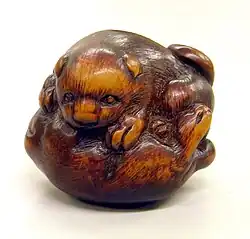
根付 (netsuke): a netsuke.
Etymology 1
| Kanji in this term | |
|---|---|
| 根 | 付 |
| ね Grade: 3 |
つ(け) Grade: 4 |
| kun’yomi | |
| Alternative spelling |
|---|
| 根付け |
Compound of 根 (ne, “root, base”) + 付け (tsuke, “attachment, attacher”), the 連用形 (ren'yōkei, “continuative or stem form”) of verb 付ける (tsukeru, “to attach”, transitive), from the way the netsuke was attached to the end of the drawstring of a coin purse or pouch to prevent the drawstring from slipping through one's 帯 (obi, “sash, belt”).[1][2]
See the 提げ物 (sagemono) entry for an illustration of how netsuke were used.
Pronunciation
Noun
根付 • (netsuke)
- a netsuke: miniature sculptures that serve as a fastener for a sagemono (a pouch, like a coin purse, tobacco pouch, or pillbox).
Etymology 2
| Kanji in this term | |
|---|---|
| 根 | 付 |
| ね Grade: 3 |
つ(き) Grade: 4 |
| kun’yomi | |
| Alternative spelling |
|---|
| 根付き |
Compound of 根 (ne, “root, base”) + 付き (tsuki, “attaching”), the 連用形 (ren'yōkei, “continuative or stem form”) of verb 付く (tsuku, “to attach”, intransitive).[1][2]
Noun
根付 • (netsuki)
References
- Shōgaku Tosho (1988) 国語大辞典(新装版) [Unabridged Dictionary of Japanese (Revised Edition)] (in Japanese), Tōkyō: Shogakukan, →ISBN
- Matsumura, Akira, editor (2006), 大辞林 [Daijirin] (in Japanese), Third edition, Tōkyō: Sanseidō, →ISBN
- NHK Broadcasting Culture Research Institute, editor (1998), NHK日本語発音アクセント辞典 [NHK Japanese Pronunciation Accent Dictionary] (in Japanese), Tōkyō: NHK Publishing, →ISBN
- Yamada, Tadao et al., editors (2011), 新明解国語辞典 [Shin Meikai Kokugo Jiten] (in Japanese), Seventh edition, Tōkyō: Sanseidō, →ISBN
This article is issued from Wiktionary. The text is licensed under Creative Commons - Attribution - Sharealike. Additional terms may apply for the media files.