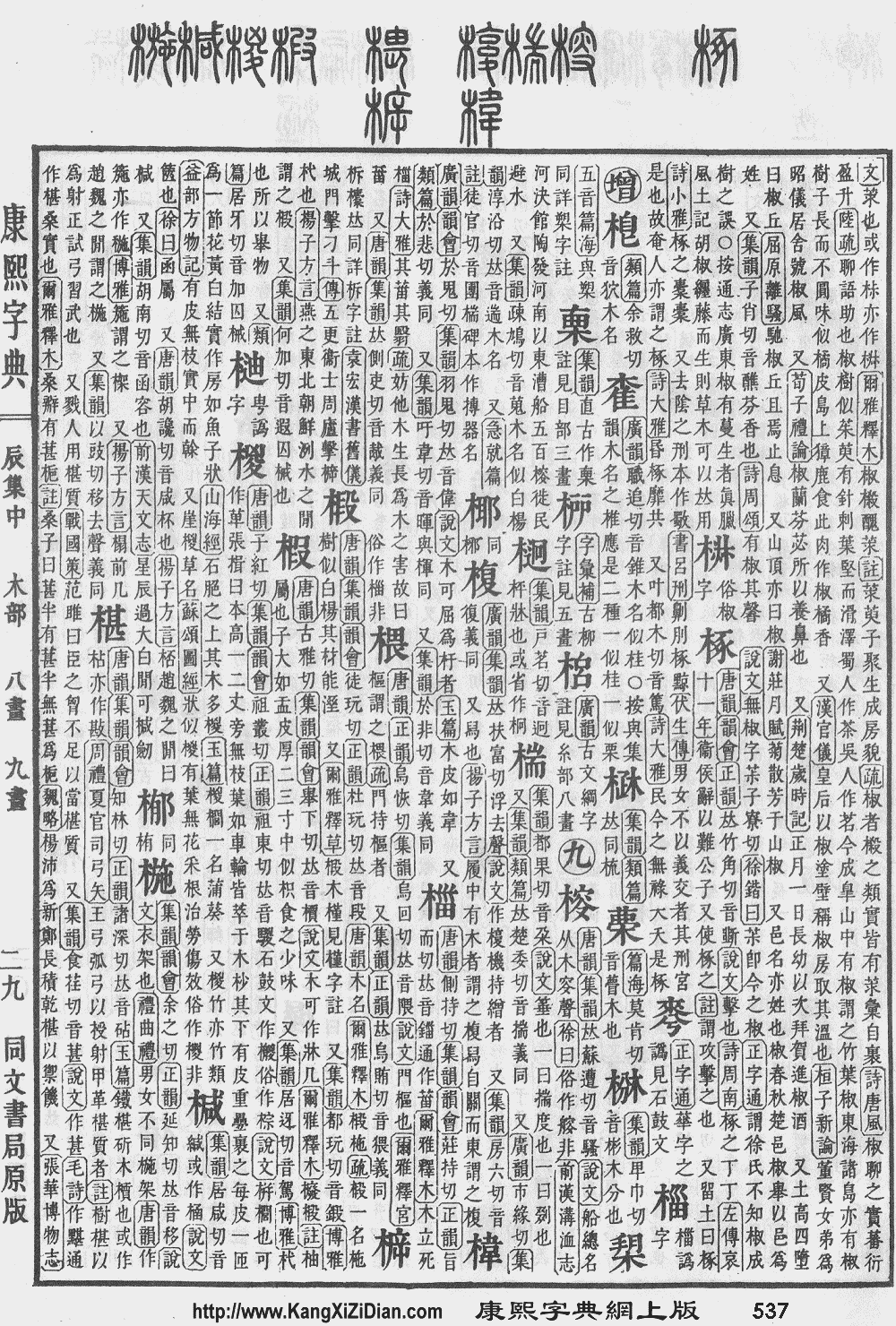
椳

椳 U+6933, 椳
CJK UNIFIED IDEOGRAPH-6933
← 椲
[U+6932]
CJK Unified Ideographs 椴 →
[U+6934]

Translingual

Han character

椳 (Kangxi radical 75, 木+9, 13 strokes, cangjie input 木田一女 (DWMV), four-corner 46932, composition ⿰木畏)

References

  • Kangxi Dictionary: page 537, character 21
  • Dai Kanwa Jiten: character 15073
  • Dae Jaweon: page 925, character 8
  • Hanyu Da Zidian (first edition): volume 2, page 1249, character 8
  • Unihan data for U+6933

Chinese

simp. and trad.
椳

Glyph origin

Pronunciation


Rime
Character 椳
Reading # 1/1
Initial (聲) 影 (34)
Final (韻) 灰 (42)
Tone (調) Level (Ø)
Openness (開合) Closed
Division (等) I
Fanqie 烏恢切
Baxter 'woj
Reconstructions
Zhengzhang
Shangfang
/ʔuʌi/
Pan
Wuyun
/ʔuoi/
Shao
Rongfen
/ʔuɒi/
Edwin
Pulleyblank
/ʔwəj/
Li
Rong
/ʔuᴀi/
Wang
Li
/uɒi/
Bernard
Karlgren
/ʔuɑ̆i/
Expected
Mandarin
Reflex
wēi
Expected
Cantonese
Reflex
wui1
Zhengzhang system (2003)
Character 椳
Reading # 1/1
No. 12925
Phonetic
component
畏
Rime
group
微
Rime
subdivision
2
Corresponding
MC rime
隈
Old
Chinese
/*quːl/

Definitions

椳

  1. the pivots, at the top and bottom of a Chinese door, on which the door turns

Japanese

Kanji

椳

(uncommon “Hyōgai” kanji)

  1. This term needs a translation to English. Please help out and add a translation, then remove the text {{rfdef}}.

Readings

  • On (unclassified): わい (wai); がい (gai)

Vietnamese

Han character

椳: Hán Nôm readings: ổi

  1. This term needs a translation to English. Please help out and add a translation, then remove the text {{rfdef}}.
This article is issued from Wiktionary. The text is licensed under Creative Commons - Attribution - Sharealike. Additional terms may apply for the media files.