微
| ||||||||
Translingual
| Japanese | 微 |
|---|---|
| Simplified | 微 |
| Traditional | 微 |
Alternative forms
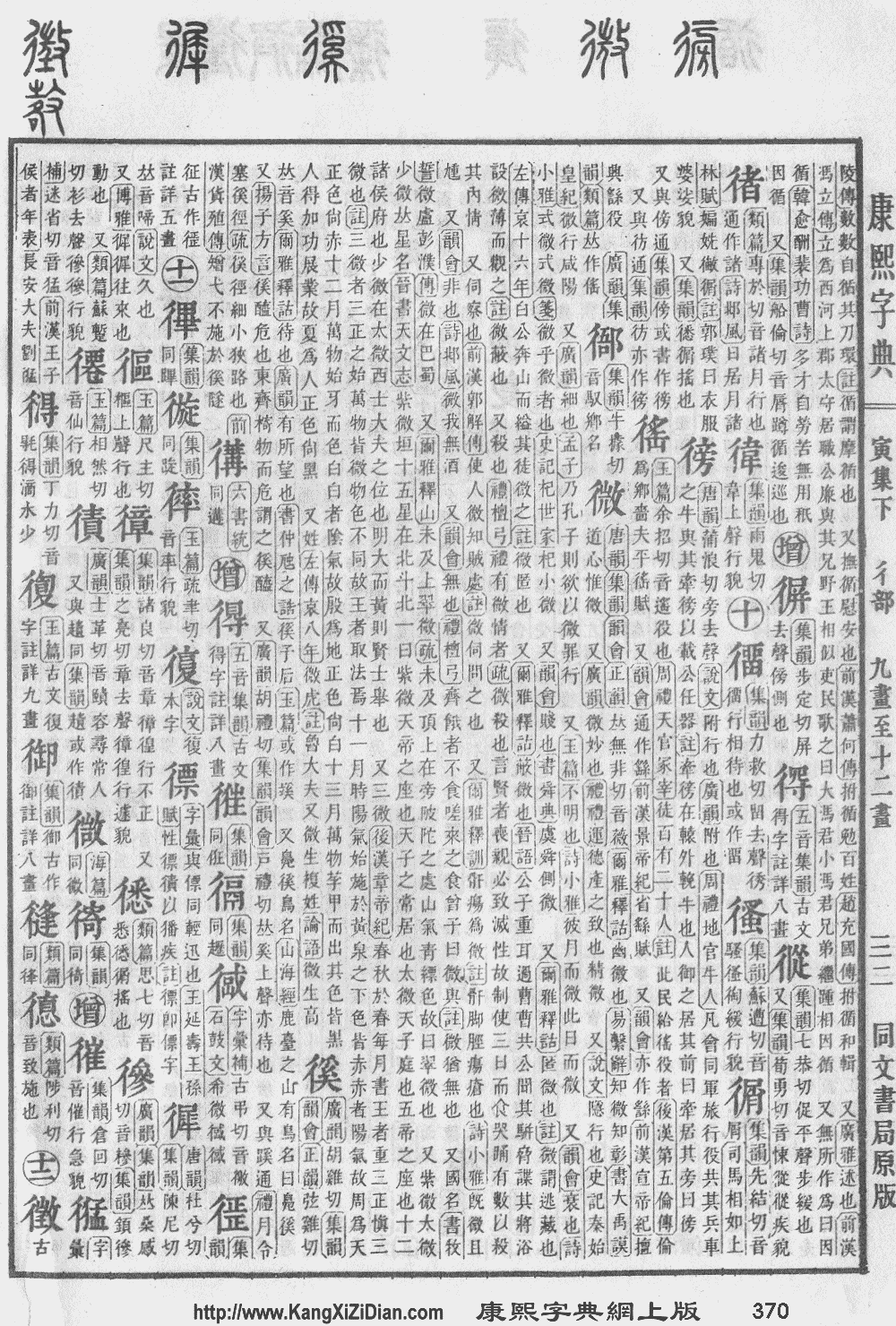
Note that the middle component is written as 𡵂 (⿳山一几) in simplified Chinese and Korean. In Japanese, the middle component is written as 𡵉 (⿱山兀). In traditional Chinese, the middle component is written (⿳山一儿), as found in the Kangxi dictionary.
Han character
微 (Kangxi radical 60, 彳+10, 13 strokes, cangjie input 竹人山弓大 (HOUNK) or 竹人山山大 (HOUUK), four-corner 28240, composition ⿰彳𢼸(GK) or ⿰彳𣁋(TJV))
References
- Kangxi Dictionary: page 370, character 12
- Dai Kanwa Jiten: character 10203
- Dae Jaweon: page 696, character 15
- Hanyu Da Zidian (first edition): volume 2, page 837, character 10
- Unihan data for U+5FAE
Chinese
| trad. | 微 | |
|---|---|---|
| simp. # | 微 | |
| 2nd round simp. | 𡵉 | |
| alternative forms | 㣲 𢕧 𢼸 | |
Glyph origin
Characters in the same phonetic series (微) (Zhengzhang, 2003)
Phono-semantic compound (形聲/形声, OC *mɯl) : semantic 彳 + phonetic 𢼸 ().
Etymology
- "not; no"
- The negative root *m + 惟 (OC *ɢʷi, “to be”) (Pulleybank, 1995).
- "small"
- From Proto-Sino-Tibetan *mwəj (“fine; delicate”) (STEDT). Cognate with Burmese မွေ့ (mwe., “delicate”).
Pronunciation 1
Definitions
微
- tiny; small; trifling
- to decline; to deteriorate
- humble; low-ranking
- slight; gentle
- slightly; gently
- † to not have
- 微管仲,吾其被髮左衽矣。 [Classical Chinese, trad.]
- From: The Analects of Confucius, c. 475 – 221 BCE, translated based on James Legge's version
- Wēi Guǎn Zhòng, wú qí pīfàzuǒrèn yǐ. [Pinyin]
- Without Guan Zhong, we should now be wearing our hair unbound, and the lappets of our coats buttoning on the left side.
微管仲,吾其被发左衽矣。 [Classical Chinese, simp.]
- [from 19th c., officially from 1981 (PRC), 1985 (ROC)] micro- (SI unit prefix)
- (~母) (Chinese linguistics) the Middle Chinese initial of 微 (MC mj+j)
- (~日) (telegraphy) the fifth day of a month
Compounds
- 些微 (xiēwēi)
- 人微權輕/人微权轻
- 人微言輕/人微言轻 (rénwēiyánqīng)
- 以微知著
- 低微 (dīwēi)
- 側微/侧微
- 元微之
- 入微 (rùwēi)
- 兵少將微/兵少将微
- 兵微將寡/兵微将寡 (bīngwēijiàngguǎ)
- 具體而微/具体而微
- 凌波微步
- 刻畫入微/刻画入微
- 力微任重
- 功微德薄 (gōngwēidébó)
- 卑微 (bēiwēi)
- 可微 (kěwēi)
- 名微德薄
- 太微
- 寒微 (hánwēi)
- 寒微簡陋/寒微简陋
- 寖微寖滅/寖微寖灭
- 希微
- 幽微
- 幾微/几微
- 式微 (shìwēi)
- 微不足道 (wēibùzúdào)
- 微中子 (wēizhōngzǐ)
- 微乎其微 (wēihūqíwēi)
- 微信 (wēixìn)
- 微分 (wēifēn)
- 微分學/微分学
- 微博 (wēibó)
- 微卷
- 微型 (wēixíng)
- 微塵/微尘 (wēichén)
- 微妙 (wēimiào)
- 微子 (wēizǐ)
- 微小 (wēixiǎo)
- 微弱 (wēiruò)
- 微微 (wēiwēi)
- 微忱
- 微息
- 微恙 (wēiyàng)
- 微情
- 微文
- 微文深詆/微文深诋
- 微時/微时
- 微晶 (wēijīng)
- 微暈/微晕
- 微曦
- 微服 (wēifú)
- 微末
- 微波 (wēibō)
- 微渺
- 微獨/微独
- 微生物 (wēishēngwù)
- 微眇
- 微積分/微积分 (wēijīfēn)
- 微笑 (wēixiào)
- 微米 (wēimǐ)
- 微粒 (wēilì)
- 微細/微细 (wēixì)
- 微纖/微纤
- 微脈/微脉
- 微臣 (wēichén)
- 微茫 (wēimáng)
- 微薄 (wēibó)
- 微處理器/微处理器 (wēichǔlǐqì)
- 微處理機/微处理机 (wēichǔlǐjī)
- 微血管
- 微行 (wēixíng)
- 微言 (wēiyán)
- 微詞/微词 (wēicí)
- 微賤/微贱 (wēijiàn)
- 微軟/微软
- 微辭/微辞 (wēicí)
- 微醺 (wēixūn)
- 微量 (wēiliàng)
- 微雕
- 微雕
- 微電腦/微电脑 (wēidiànnǎo)
- 微風/微风 (wēifēng)
- 忽微
- 慎小謹微/慎小谨微
- 慎微
- 才微智淺/才微智浅
- 才秀人微
- 拈花微笑
- 探賾索微/探赜索微
- 敬小慎微
- 星際微塵/星际微尘
- 本小利微 (běnxiǎolìwēi)
- 杜微慎防
- 杜漸防微/杜渐防微
- 杜漸除微/杜渐除微
- 梭微子
- 梨頰微渦/梨颊微涡
- 毚微
- 波微
- 洞燭入微/洞烛入微
- 浸微
- 浸微浸消
- 深微
- 清謳微吟/清讴微吟
- 滄海微塵/沧海微尘
- 漸趨式微/渐趋式微
- 火熹微
- 無微不至/无微不至 (wúwēibùzhì)
- 熹微 (xīwēi)
- 爝火微光
- 略微 (lüèwēi)
- 白玉微瑕
- 白玉微疵
- 白璧微瑕 (báibì-wēixiá)
- 睹微知著 (dǔwēizhīzhù)
- 知微知彰
- 破顏微笑/破颜微笑
- 視微知著/视微知著
- 福生于微
- 禍起隱微/祸起隐微
- 稀微 (hi-bî) (Min Nan)
- 稍微 (shāowēi)
- 積微成著/积微成著
- 窮幽極微/穷幽极微
- 窮纖入微/穷纤入微
- 笑微微 (chhiò-bi-bi) (Min Nan)
- 精微 (jīngwēi)
- 糧寡兵微/粮寡兵微
- 紫微 (zǐwēi)
- 細微/细微 (xìwēi)
- 細微末節/细微末节 (xìwēimòjié)
- 縮影微捲/缩影微卷
- 縮微/缩微
- 纖微/纤微
- 翠微 (cuìwēi)
- 翠微山
- 興微繼絕/兴微继绝
- 蟲沙微類/虫沙微类
- 蠅頭微利/蝇头微利
- 衰微 (shuāiwēi)
- 見微知萌/见微知萌
- 見微知著/见微知著 (jiànwēizhīzhù)
- 言微旨遠/言微旨远
- 談言微中/谈言微中
- 謹小慎微/谨小慎微 (jǐnxiǎoshènwēi)
- 身輕言微/身轻言微 (shēnqīngyánwēi)
- 輕微/轻微 (qīngwēi)
- 辭微旨遠/辞微旨远
- 通幽洞微
- 造微入妙
- 量小力微
- 鉤隱抉微/钩隐抉微
- 闡微/阐微
- 防微慮遠/防微虑远
- 防微杜漸/防微杜渐 (fángwēidùjiàn)
- 隱微/隐微
- 霏微 (fēiwēi)
- 音韻闡微/音韵阐微
- 顯微手術/显微手术 (xiǎnwēi shǒushù)
- 顯微書影/显微书影
- 顯微照相/显微照相
- 顯微鏡/显微镜 (xiǎnwēijìng)
- 風微浪穩/风微浪稳
- 體貼入微/体贴入微 (tǐtiērùwēi)
Pronunciation 2
Compounds
- 峇微
- 微目
- 沙微 (sa-bui) (Min Nan)
Japanese
Korean
This article is issued from Wiktionary. The text is licensed under Creative Commons - Attribution - Sharealike. Additional terms may apply for the media files.