泉
| ||||||||
Translingual
Han character
| Stroke order | |||
|---|---|---|---|
 | |||
泉 (Kangxi radical 85, 水+5, 9 strokes, cangjie input 竹日水 (HAE), four-corner 26232, composition ⿱白水)
References
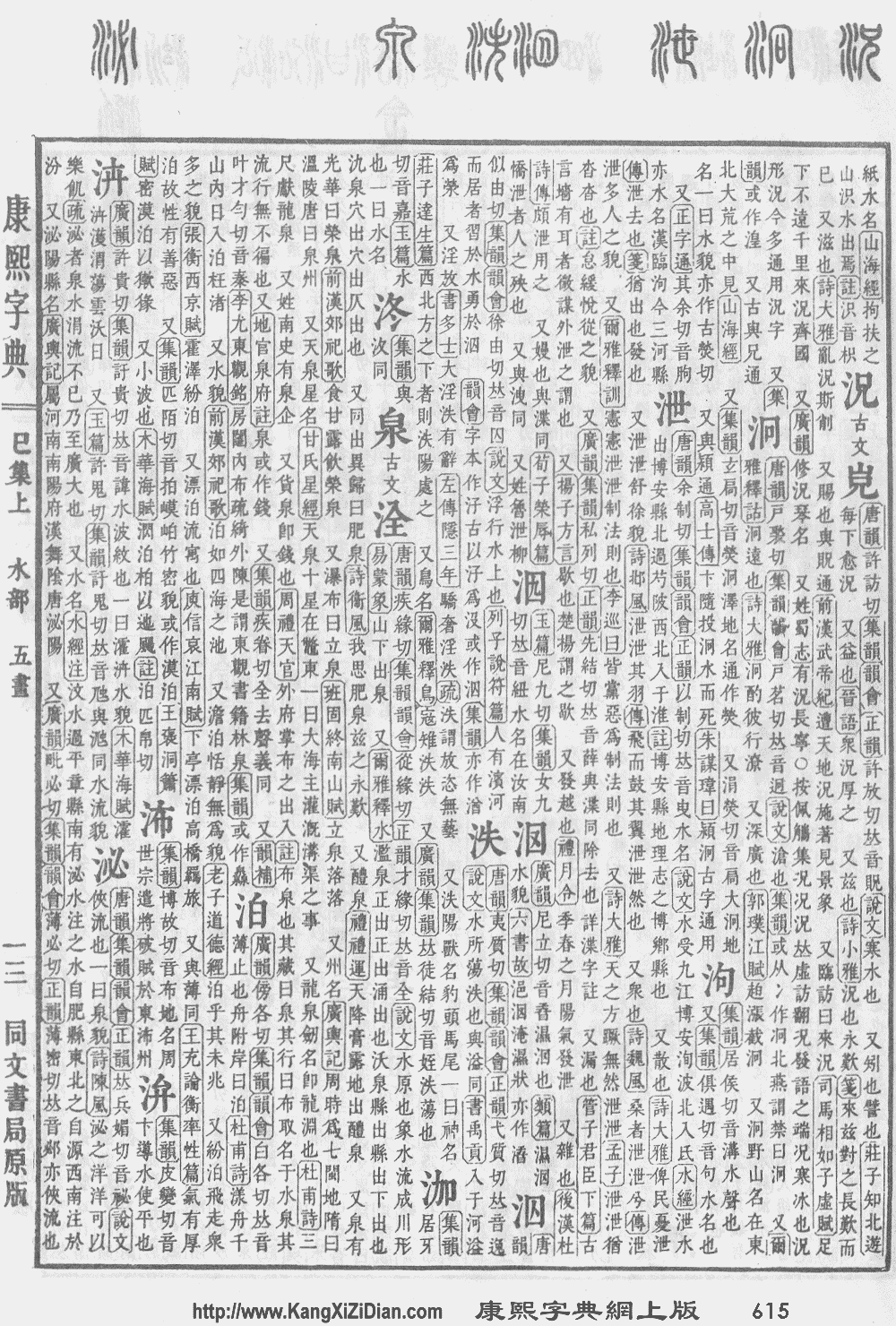
- Kangxi Dictionary: page 615, character 12
- Dai Kanwa Jiten: character 17274
- Dae Jaweon: page 1009, character 9
- Hanyu Da Zidian (first edition): volume 3, page 1576, character 10
- Unihan data for U+6CC9
Chinese
| simp. and trad. |
泉 | |
|---|---|---|
| alternative forms | 𤽄 湶 | |
Glyph origin
| Historical forms of the character 泉 | |||
|---|---|---|---|
| Shang | Western Zhou | Warring States | Shuowen Jiezi (compiled in Han) |
| Oracle bone script | Bronze inscriptions | Chu slip and silk script | Small seal script |
 |
 |
 |
 |
Pictogram (象形) or ideogrammic compound (會意/会意) : 白 (“spring mouth”) + 水 (“water”) – water flowing from the source of a spring.
Etymology
Schuessler (2007) minimally reconstructs the Old Chinese as *dzwan and also reconstructs Proto-Tibeto-Burman *tso (“to bubble; to boil”) (> Tibetan འཚོད་པ ('tshod pa, “to be boiled”), Tibetan བཙོས (btsos, “to cook in boiling water”), Burmese ဆူ (hcu, “to boil; to bubble”)), and considers 泉 (OC *sɡʷen, “spring (of water)”) to be cognate to it (with an n-suffix nominalization). However, STEDT considers the above three Tibeto-Burman terms to be descended from Proto-Tibeto-Burman *tsjow (“to boil; to burn; to bake; to bake”), to which 焦 (OC *ʔsew, “to roast; to burn; to scorch”) is cognate.
Pronunciation
Definitions
泉
Synonyms
- (springwater):
- (mouth of a spring):
Compounds
- 三泉
- 下泉
- 不飲盜泉/不饮盗泉
- 九泉 (jiǔquán)
- 乳泉
- 五眼泉 (Wǔyǎnquán)
- 冷泉 (lěngquán)
- 冽泉 (lièquán)
- 千泉 (Qiānquán)
- 卓刀泉 (Zhuódāoquán)
- 噴泉/喷泉 (pēnquán)
- 奔泉
- 寒泉之思
- 寶泉局/宝泉局
- 山泉 (shānquán)
- 平泉莊/平泉庄
- 廉泉
- 思如泉湧/思如泉涌
- 思如湧泉/思如涌泉
- 思若湧泉/思若涌泉
- 息影林泉
- 操瓶湧泉/操瓶涌泉
- 文思泉湧/文思泉涌
- 月牙泉 (Yuèyáquán)
- 林泉 (línquán)
- 毖泉
- 水泉 (shuǐquán)
- 氿泉 (guǐquán)
- 泉下 (quánxià)
- 泉世 (quánshì)
- 泉口 (Quánkǒu)
- 泉壤 (quánrǎng)
- 泉子
- 泉州 (Quánzhōu)
- 泉幣/泉币 (quánbì)
- 泉幣文字/泉币文字
- 泉扃
- 泉水 (quánshuǐ)
- 沸泉 (fèiquán)
- 泉湧/泉涌
- 泉源 (quányuán)
- 泉溪 (Quánxī)
- 泉溝/泉沟 (Quángōu)
- 泉眼 (quányǎn)
- 泉石 (quánshí)
- 泉石膏肓
- 泉脈/泉脉 (quánmài)
- 泉臺/泉台 (quántái)
- 泉貝/泉贝
- 泉路 (quánlù)
- 洪泉 (hóngquán)
- 流泉 (liúquán)
- 淚如泉湧/泪如泉涌 (lèirúquányǒng)
- 清泉 (qīngquán)
- 淵泉/渊泉
- 湧泉/涌泉
- 湯泉/汤泉 (tāngquán)
- 渴驥奔泉/渴骥奔泉
- 源泉 (yuánquán)
- 溫泉/温泉 (wēnquán)
- 溫泉浴/温泉浴
- 源泉萬斛/源泉万斛
- 澧泉
- 濆泉/𣸣泉
- 瀵泉
- 火然泉達/火然泉达
- 玉泉 (Yùquán)
- 玻璃泉
- 甘泉 (gānquán)
- 甘泉必竭
- 白泉 (báiquán)
- 盜泉/盗泉 (Dàoquán)
- 盜泉寧渴/盗泉宁渴
- 石泉
- 硫磺泉
- 碧落黃泉/碧落黄泉
- 礦泉/矿泉 (kuàngquán)
- 礦泉水/矿泉水 (kuàngquánshuǐ)
- 神泉
- 萬斛泉源/万斛泉源
- 窮泉/穷泉
- 荒漠甘泉
- 言泉 (yánquán)
- 誓泉之譏/誓泉之讥
- 謀如湧泉/谋如涌泉
- 貨泉/货泉
- 貪泉酌飲/贪泉酌饮
- 趵突泉
- 趵突泉詩/趵突泉诗
- 酒泉 (jiǔquán)
- 醴泉
- 重泉 (zhòngquán)
- 間歇噴泉/间歇喷泉
- 間歇泉/间歇泉 (jiànxiēquán)
- 阪泉
- 飛泉/飞泉 (fēiquán)
- 馬跑泉/马跑泉
- 鹽泉/盐泉
- 黃泉/黄泉 (huángquán)
- 龍泉/龙泉 (lóngquán)
- 龍泉窯/龙泉窑
References
- “泉”, in 漢語多功能字庫 (Multi-function Chinese Character Database), 香港中文大學 (the Chinese University of Hong Kong), 2014–
Japanese
Readings
Compounds
Etymology
| Kanji in this term |
|---|
| 泉 |
| いずみ Grade: 6 |
| kun’yomi |
/idumi/ → /id͡zumi/ → (for most modern Japanese dialects; see also Yotsugana) /izumi/
From Old Japanese. Found in the Man'yōshū, completed some time after 759 CE.
Compound of 出づ (ancient reading idu, modern izu, “to come out”) + 水 (mi, “water”).[1][2][3][4]
Noun
- natural spring, a wellspring
- 1999 August 26, “泉の妖精 [Fairy of the Fountain]”, in BOOSTER 4, Konami:
- 泉を守る妖精。泉を汚す者を容赦なく攻撃。
- Izumi o mamoru yōsei. Izumi o kegasu mono o yōsha naku kōgeki.
- A fairy who mercilessly assaults anyone who dares contaminate the fountain she’s sworn protects.
- 泉を守る妖精。泉を汚す者を容赦なく攻撃。
References
- Shōgaku Tosho (1988) 国語大辞典(新装版) [Unabridged Dictionary of Japanese (Revised Edition)] (in Japanese), Tōkyō: Shogakukan, →ISBN
- Matsumura, Akira, editor (2006), 大辞林 [Daijirin] (in Japanese), Third edition, Tōkyō: Sanseidō, →ISBN
- Matsumura, Akira (1995) 大辞泉 [Daijisen] (in Japanese), First edition, Tōkyō: Shogakukan, →ISBN
- Kindaichi, Kyōsuke et al., editors (1997), 新明解国語辞典 [Shin Meikai Kokugo Jiten] (in Japanese), Fifth edition, Tōkyō: Sanseidō, →ISBN
- NHK Broadcasting Culture Research Institute, editor (1998), NHK日本語発音アクセント辞典 [NHK Japanese Pronunciation Accent Dictionary] (in Japanese), Tōkyō: NHK Publishing, →ISBN
Korean
Etymology
From Middle Chinese 泉 (MC dzjwen).
| Historical Readings | ||
|---|---|---|
| Dongguk Jeongun Reading | ||
| Dongguk Jeongun, 1448 | ᄍᆑᆫ (Yale: ccyyèn) | |
| Middle Korean | ||
| Text | Eumhun | |
| Gloss (hun) | Reading | |
| Hunmong Jahoe, 1527 | ᄉᆡᆷ〯 (Yale: sǒym) | 쳔 (Yale: chyèn) |
Pronunciation
- (SK Standard/Seoul) IPA(key): [t͡ɕʰʌ̹n]
- Phonetic hangul: [천]