畑
| ||||||||
Translingual
Han character
| Stroke order | |||
|---|---|---|---|
 | |||
| Stroke order (Japan) | |||
|---|---|---|---|
 | |||
畑 (Kangxi radical 102, 田+4, 9 strokes, cangjie input 火田 (FW), four-corner 96800, composition ⿰火田)
Derived characters
- 𬊴
References
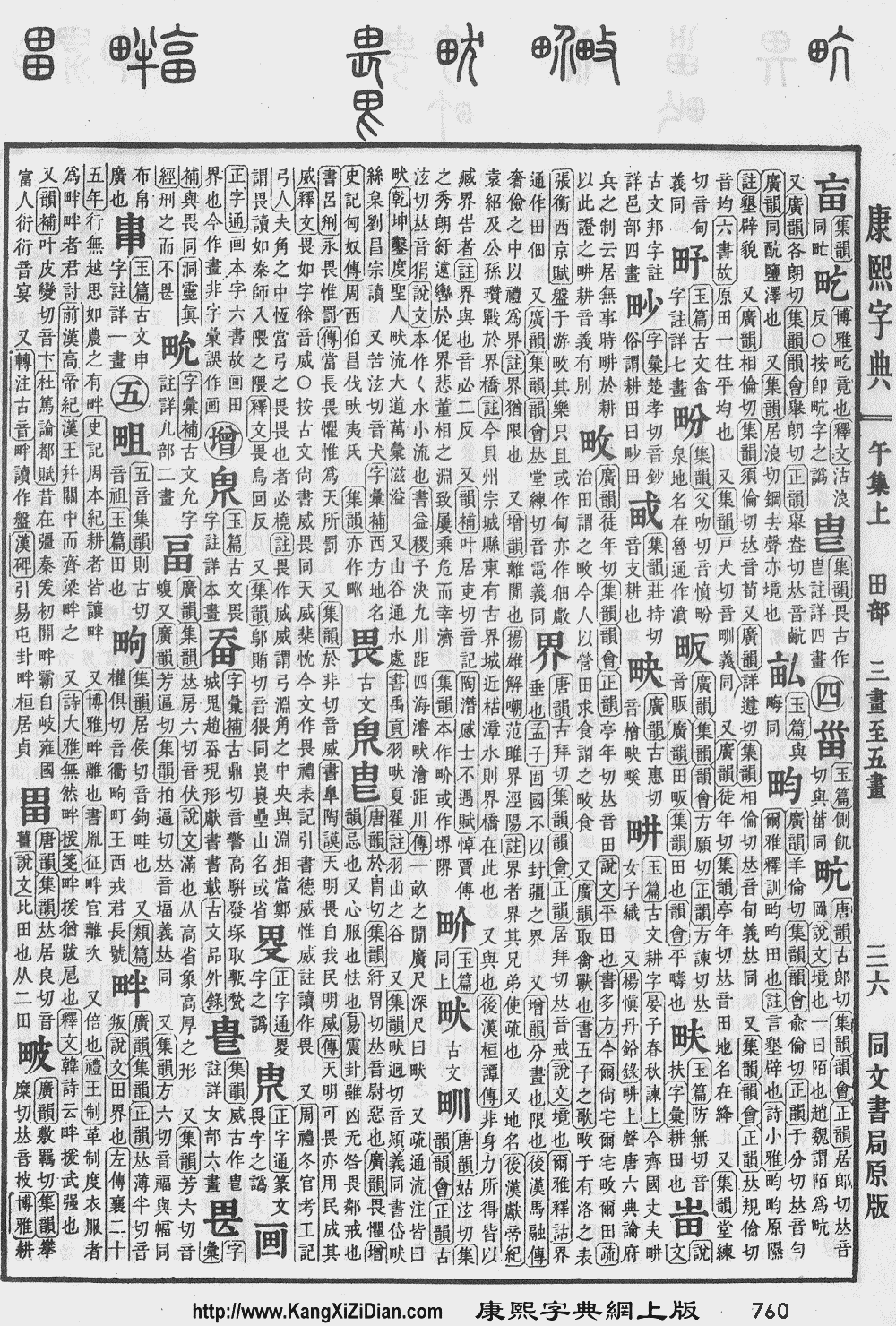
- Kangxi Dictionary: not present, would follow page 760, character 34
- Dai Kanwa Jiten: character 21797
- Dae Jaweon: page 1078, character 17
- Hanyu Da Zidian (first edition): volume 3, page 2195, character 11
- Unihan data for U+7551
Chinese
| trad. | 畑 | |
|---|---|---|
| simp. # | 畑 | |
Etymology
Spelling pronunciation, as 田 (tián).
Pronunciation
Definitions
畑
- Used in Japanese personal names.
Japanese
Glyph origin
A 国字 (kokuji, “Japanese-coined character”).
Ideogrammic compound (會意/会意) : semantic 火 (“fire”) + semantic 田 (“field”)
Etymology
| Kanji in this term |
|---|
| 畑 |
| はたけ Grade: 3 |
| kun’yomi |
| Alternative spelling |
|---|
| 畠 |
From Old Japanese. First attested in the Man’yōshū, completed sometime after 759 CE.[1] In turn from reconstructed Proto-Japonic *patakay. Compare Korean 밭 (bat, “dry field”).
The final -ke2 element might be an apophonic form of 処 (ka, locative suffix, compare 中 (naka, “middle”)).
Derived terms
Derived terms
- 茶畑 (chabatake): tea plantation
- 葡萄畑 (budōbatake): vineyard
References
- “畑・畠”, in 日本国語大辞典 (Nihon Kokugo Daijiten, “Nihon Kokugo Daijiten”) (in Japanese), concise edition, Tōkyō: Shogakukan, 2000
- Matsumura, Akira, editor (2006), 大辞林 [Daijirin] (in Japanese), Third edition, Tōkyō: Sanseidō, →ISBN
Korean
Hanja
畑 • (jeon) (hangeul 전, revised jeon, McCune–Reischauer chŏn, Yale cen)
- This term needs a translation to English. Please help out and add a translation, then remove the text
{{rfdef}}.
Vietnamese
References
- Nguyễn (2014).
- Nguyễn et al. (2009).
- Trần (2004).
- Génibrel (1898).
- Taberd & Pigneau de Béhaine (1838).
- Hồ (1976).
This article is issued from Wiktionary. The text is licensed under Creative Commons - Attribution - Sharealike. Additional terms may apply for the media files.