疣
| ||||||||
Translingual
Han character
疣 (Kangxi radical 104, 疒+4, 9 strokes, cangjie input 大戈大山 (KIKU), four-corner 00114, composition ⿸疒尤)
References
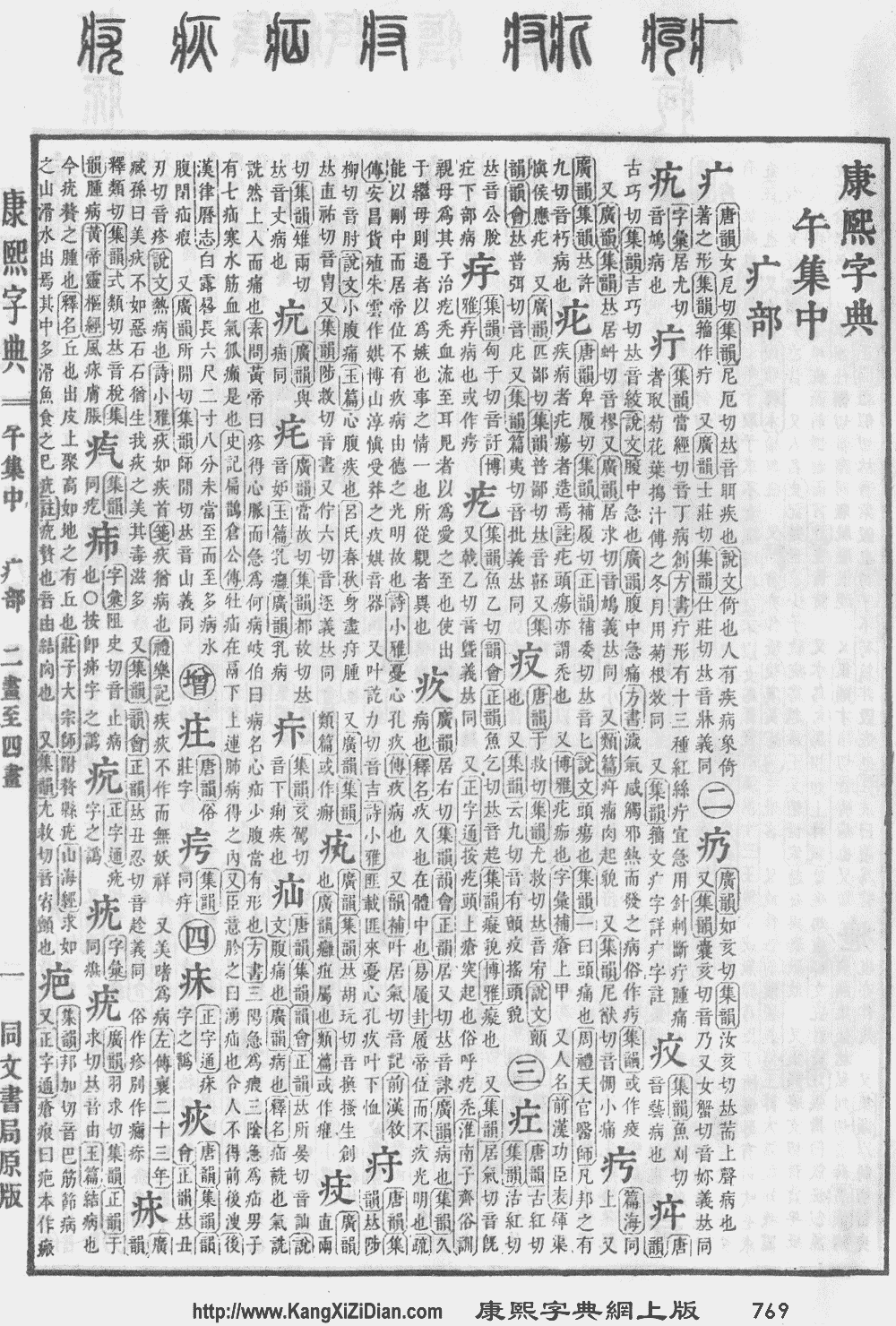
- Kangxi Dictionary: page 769, character 30
- Dai Kanwa Jiten: character 22050
- Dae Jaweon: page 1180, character 4
- Hanyu Da Zidian (first edition): volume 4, page 2661, character 13
- Unihan data for U+75A3
Chinese
| simp. and trad. |
疣 | |
|---|---|---|
| alternative forms | 肬 𪐤 | |
Glyph origin
Characters in the same phonetic series (尤) (Zhengzhang, 2003)
Phono-semantic compound (形聲/形声, OC *ɢʷɯ) : semantic 疒 (“disease”) + phonetic 尤 (OC *ɢʷɯ).
Pronunciation
Synonyms
Japanese
Etymology 1
| Kanji in this term |
|---|
| 疣 |
| いぼ Hyōgaiji |
| kun’yomi |
A contraction of Old Japanese-derived 飯粒 (ihibo, modern reading ībo, literally “rice grain”), from the way that a wart or skin tag may look like a grain of rice.[1][2]
Alternative forms
Noun
疣 • (ibo)
- a small protrusion of the skin: a wart, a verruca, a skin tag
- a wart-like protrusion on the surface of something
Derived terms
Derived terms
- 疣の木 (ibonoki): Ligustrum obtusifolium, a kind of privet tree
- 疣足 (iboashi): a parapodium
- 疣結 (iboi): a kind of knot
- 疣石 (iboishi): “wart stone” → a stone believed to have the power to cure warts
- 疣猪 (iboinoshishi): a warthog
- 疣疣 (iboibo): a rash resembling many small warts; a surface covered in small protrusions
- 疣毟 (iboujiri): “wart plucker” → alternate name for 蟷螂 (kamakiri), the praying mantis
- 疣落 (ibootoshi): “wart dropper” → alternate name for 蝦蔓, 蘡薁 (ebizuru): Vitis heyneana subsp. ficifolia (syn. Vitis ficifolia), a kind of liana related to the grape
- 疣蛙 (ibogaeru): a toad
- 疣金物 (ibo kanamono): “warty metal” → a metal plate into which numerous round-headed rivets have been driven, such as might be used in building construction or in shipbuilding
- 疣蟹 (ibogani): “warty crab” → a kind of king crab, a member of genus Paralithodes
- 疣細螺 (ibokisago): a kind of marine snail in family Trochidae
- 疣草 (ibokusa): “wart weed” → Murdannia keisak, a type of flowering plant related to the dayflower
- 疣仙人掌 (ibo saboten): “wart cactus” → general name for cactus plants of genus Mammillaria
- 疣痔 (iboji): a hemorrhoid, blind piles
- 疣地蔵 (ibo jizō): “wart jizō” → a jizō statue believed to have the power to cure warts
- 疣占地 (ibo shimeji): “wart shimeji” → alternate name for 占地 (shimeji), the shimeji mushroom
- 疣症 (iboshō): vercositas, verrucosis
- 疣状 (ibojō): verrucous, verruciform
- 疣毟 (ibojiri): “wart plucker” → alternate name for 蟷螂 (kamakiri), the praying mantis
- 疣毟巻 (ibojirimaki): “wart-plucker curls” → a women's hairstyle popular among rural women until the early Shōwa period, so named for a resemblance to the praying mantis
- 疣背 (iboze): “wartback” → alternate for 疣鯛 (ibodai): wart perch, Japanese butterfish
- 疣取 (ibota): Ligustrum obtusifolium, a kind of privet tree
- 疣取の木 (ibotanoki): Ligustrum obtusifolium, a kind of privet tree
- 疣鯛 (ibodai): wart perch, Japanese butterfish
- 疣取 (ibotori): Ligustrum obtusifolium, a kind of privet tree
- 疣螺 (ibonishi), 疣辛螺 (ibonishi): Reishia clavigera (syn. Thais clavigera, a kind of predatory marine snail
- 疣虫 (ibomushi): “wart bug” → alternate name for 蟷螂 (kamakiri), the praying mantis
- 疣毟 (ibomushiri): “wart plucker” → alternate name for 蟷螂 (kamakiri), the praying mantis
- 疣目 (ibome): a callus, a hardening of the skin due to repeated rubbing or pressure
- 疣海楊 (iboyagi): a kind of sea fan, a member of order Alcyonacea, formerly classed under order Gorgonacea
- 疣結 (iboyui): a kind of knot
- 足底疣 (sokutei ibo): a plantar wart
- 副疣 (fukuibo): a secondary tubercle
Etymology 2
| Kanji in this term |
|---|
| 疣 |
| たり Hyōgaiji |
| kun’yomi |
Unknown. Possibly an extension of the nominalized continuative form tari of Old Japanese-derived verb 垂る (taru, “to hang down, to hang off of”, superseded by modern 垂れる tareru).
Appears with this reading in the 新選字鏡 (Shinsen Jikyō)[1] Japanese dictionary of Chinese,[3] compiled in 898-901.
Pronunciation
- IPA(key): [ta̠ɾʲi]
Pronunciation
- IPA(key): [jɯ̟ᵝː]
Affix
Derived terms
Derived terms
- 疣腫 (yūshu): a sycoma, a skin tag
- 疣状 (yūjō): verrucous, verruciform
- 疣贅 (yūzei): a small protrusion of the skin, more specifically caused by HPV: a wart, a verruca, a skin tag
- 疣贅症 (yūzeishō): keratiasis, keratosis
- 主疣 (shuyū): primary tubercle
- 小疣 (shōyū): a thymion
- 贅疣 (zeiyū): a bump or knot of useless flesh; something useless
- 足底疣贅 (sokutei yūzei): a plantar wart
- 軟疣 (nan'yū): a soft wart, a molluscum
References
- Shōgaku Tosho (1988) 国語大辞典(新装版) [Unabridged Dictionary of Japanese (Revised Edition)] (in Japanese), Tōkyō: Shogakukan, →ISBN
- Matsumura, Akira, editor (2006), 大辞林 [Daijirin] (in Japanese), Third edition, Tōkyō: Sanseidō, →ISBN
- 898–901, Shinsen Jikyō:
Korean
Hanja
疣 • (yu) (hangeul 유, McCune–Reischauer yu, Yale yu)
- This term needs a translation to English. Please help out and add a translation, then remove the text
{{rfdef}}.
This article is issued from Wiktionary. The text is licensed under Creative Commons - Attribution - Sharealike. Additional terms may apply for the media files.