笧
| ||||||||
Translingual
Alternative forms
Due to Han unification, the traditional form containing 冊 and simplified form containing 册 are encoded under the same code point. Depending on the font installed, this character may appear to be either 笧 or 笧.
Han character
笧 (Kangxi radical 118, 竹+5, 11 strokes, cangjie input 竹月月一 (HBBM) or 竹月廿 (HBT) or 難竹月月一 (XHBBM) or 難竹月廿 (XHBT), composition ⿱𥫗册(G) or ⿱𥫗冊(HTJK))
References
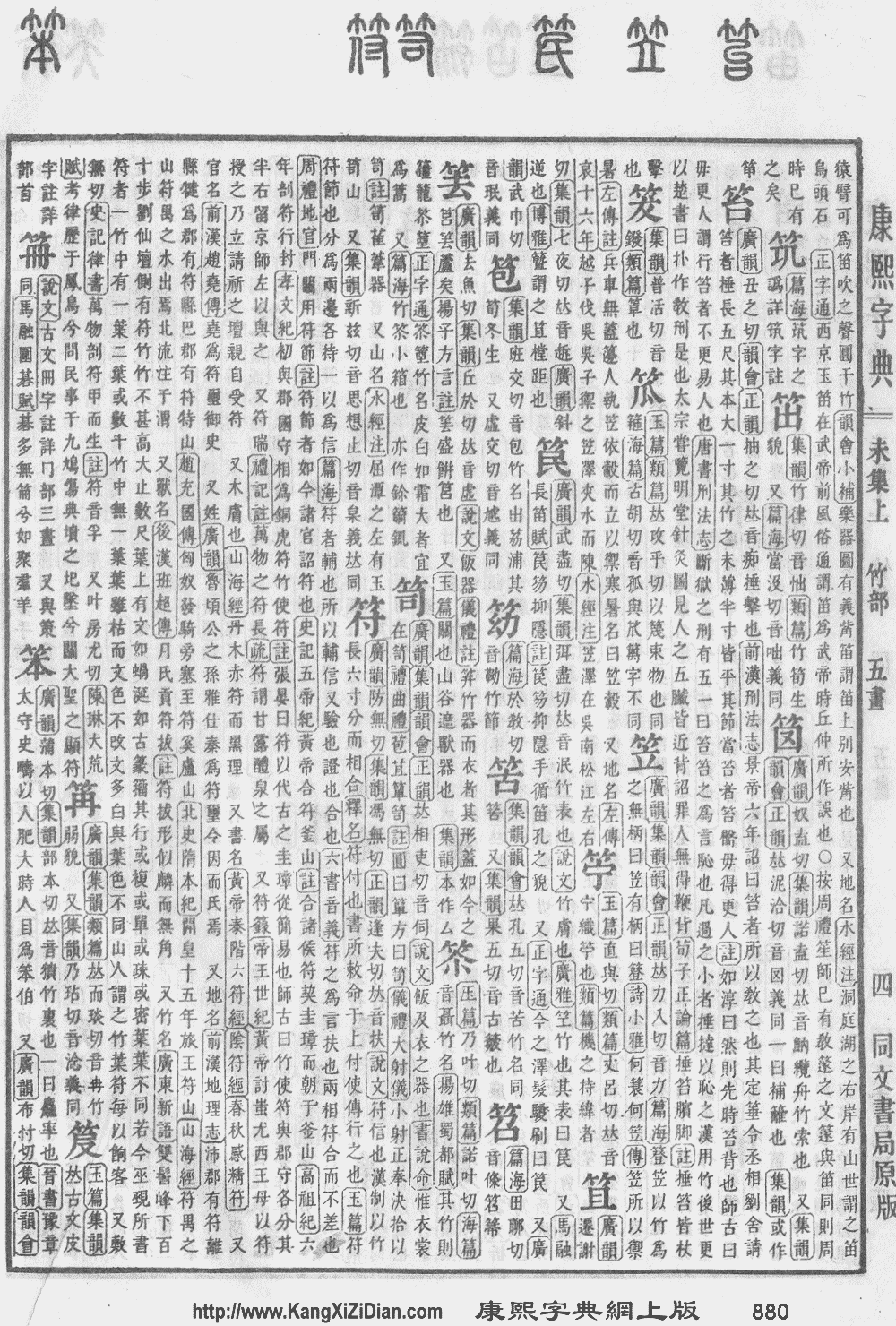
- Kangxi Dictionary: page 880, character 21
- Dai Kanwa Jiten: character 25938
- Dae Jaweon: page 1308, character 15
- Hanyu Da Zidian (first edition): volume 5, page 2955, character 3
- Unihan data for U+7B27
Chinese
Glyph origin
Japanese
Kanji
笧
Korean
This article is issued from Wiktionary. The text is licensed under Creative Commons - Attribution - Sharealike. Additional terms may apply for the media files.